Loading...
This comparison has not been analyzed yet.
One-time AI generation (~1 minute). Scores and timeline are already available below.
Mahadji Scindia vs Wu Sangui
Mahadji Scindia leads by 1.3 pts · 2 figures compared
…
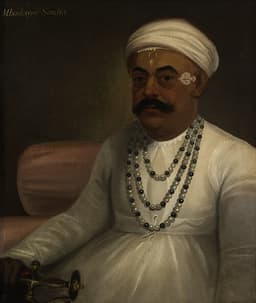
Mahadji Scindia
General · Modern
65.4Total

Wu Sangui
General · Modern
64.1Total
Basic Information
Born
1730
1612
Died
1794
1678
Era
Modern
Modern
Nationality
India
China
Occupation
General
General
Civilization
Indian
Eastern
Score Comparison
Military (10%)
85.0
82.0
Political (20%)
78.0
68.0
Influence (20%)
56.7
56.7
Legacy (20%)
52.0
55.0
Leadership (15%)
72.0
80.0
Strategy (15%)
72.0
58.0
TOTAL
65.4
64.1
Mahadji Scindia — Complete Timeline
1768 AD
Became Regent of GwaliorPolitical Action◆ Major
Mahadji Scindia assumed the regency of Gwalior after the death of his predecessor. He consolidated power and expanded the Scindia domain through military campaigns and alliances.
SuccessionGwaliorScindia Dynasty
Impact: regionalconstructive
1771 AD
Battle of DelhiWar◆ Major
Mahadji Scindia led Maratha forces to capture Delhi from the Rohilla Afghans. He restored the Mughal Emperor Shah Alam II to the throne, becoming the de facto power behind the Mughal court.
Maratha-Afghan WarsDelhiMughal Restoration
Impact: national
1784 AD
Appointed Mughal RegentPolitical Action
Mahadji Scindia was appointed as the regent (Vakil-i-Mutlaq) of the Mughal Empire by Shah Alam II. This gave him control over Mughal administration and military, making him the most powerful figure in northern India.
Mughal EmpireRegencyScindia
Impact: nationalconstructive
1787 AD
Battle of LalsotWar
Mahadji Scindia fought against the Rajput coalition of Jaipur and Jodhpur at Lalsot. The battle ended inconclusively, but it weakened Rajput resistance to Maratha expansion.
Maratha-Rajput WarsBattleRajasthan
Impact: regional
1790 AD
Battle of PatanWar◆ Major
Mahadji Scindia defeated the Rajput forces of Jaipur at the Battle of Patan. The victory forced Jaipur to accept Maratha suzerainty and pay tribute.
Maratha-Rajput WarsBattleJaipur
Impact: regional
Battle of MertaWar◆ Major
Mahadji Scindia defeated the Rajput forces of Jodhpur at the Battle of Merta. This victory extended Maratha control over Marwar and established Scindia as the dominant power in Rajasthan.
Maratha-Rajput WarsBattleJodhpur
Impact: regional
Wu Sangui — Complete Timeline
1644 AD
Defeated Li Zicheng at the Battle of Shanhai PassWar◆ Major
Wu Sangui allied with the Manchu forces to defeat Li Zicheng's rebel army at the Battle of Shanhai Pass. The combined Qing-Ming loyalist army routed Li's forces, forcing Li to retreat from Beijing. This battle sealed the Qing conquest of northern China.
Ming-Qing TransitionBattleAlliance
Impact: globaldestructive
Opened Shanhai Pass to the ManchusPolitical Action
Wu Sangui, commanding the Ming garrison at Shanhai Pass, opened the pass to the Manchu army led by Dorgon. This allowed the Manchus to enter China proper and march on Beijing, which had been captured by Li Zicheng's rebel forces.
Ming-Qing TransitionBetrayalShanhai Pass
Impact: globaldestructive
Appointed Prince of Pingxi by the QingPolitical Action◆ Major
Wu Sangui was appointed Prince of Pingxi by the Qing dynasty for his role in their conquest. He was granted control over Yunnan province, becoming one of the three powerful feudatories that ruled southern China under Qing suzerainty.
Qing DynastyFeudatoryAppointment
Impact: national
1673 AD
Launched the Revolt of the Three FeudatoriesWar
Wu Sangui initiated the Revolt of the Three Feudatories against the Qing dynasty. He proclaimed a new dynasty and led a rebellion from his base in Yunnan, initially gaining control of much of southern China before the Qing counteroffensive.
Qing DynastyRebellionThree Feudatories
Impact: nationaldestructive
1678 AD
Proclaimed Emperor of the Zhou DynastyPolitical Action◆ Major
Wu Sangui proclaimed himself Emperor of the Zhou dynasty in Hengzhou (modern Hengyang). This act formalized his rebellion against the Qing. However, he died later that same year, and his rebellion collapsed shortly after.
Qing DynastyRebellionProclamation
Impact: nationaldestructive
This comparison has not been analyzed yet.
One-time AI generation (~1 minute). Scores and timeline are already available below.
Rankings
🥇
Mahadji ScindiaLeader
Mil: 85.0Pol: 78.0Inf: 56.7
65.4
🥈
Wu Sangui
Mil: 82.0Pol: 68.0Inf: 56.7
64.1
+1.3 behind
How This Comparison Works
Algorithm
Each figure is scored on 6 dimensions (0—100 scale) based on structured historical data: Military (10%), Political (20%), Influence (20%), Legacy (20%), Leadership (15%), Strategy (15%). The weighted total produces the final ranking.
Data Sources
Scores are computed from structured sub-indicators in the database. Scale factors adjust for era (Ancient ×0.85, Modern ×1.0) and civilization size (Eastern ×1.05, Other ×0.80) to account for differences in population and military scale.
Maximum 3 Figures
Comparisons are limited to 2—3 figures to ensure readability and statistical meaningfulness.
Error Margins
±5 points per dimension — Sub-scores are derived from historical records with inherent uncertainty. Two figures within 5 points on a dimension should be considered roughly equivalent in that area.
Total Score Accuracy
±3 points overall — The weighted combination of 6 dimensions produces a total score with approximately ±3 points of uncertainty. Differences of less than 3 points are not statistically significant— the figures are effectively tied.
Known Limitations
- Historical records are incomplete and uneven across civilizations
- Figures from oral-tradition societies may be underrepresented
- Occupation labels can misclassify multi-role figures
- Scores measure capability and impact, not moral character
- Quantitative scoring is a comparison tool, not absolute truth
Capability Radar
Military (10%) — Battles & Warfare
Battles
85
75
Win Rate
80
70
Expansion
80
70
Political (20%) — Governance & Reform
Reform
70
30
Diplomacy
90
70
Economy
70
40
Influence (20%) — Cultural & Global Reach
Cultural
60
50
Global
55
55
Legacy (20%) — Historical Impact
Historical
75
70
Longevity
60
60
Leadership (15%) — Power & Stability
Tenure
85
65
Stability
65
30
Strategy (15%) — Tactics & Innovation
Strategy
90
80
Tactics
85
75
Reform
75
40
Similar Comparisons
Comments & Discussion
No comments yet. Be the first to share your thoughts!