Loading...
Mahadji Scindia vs Napoleon Bonaparte
Napoleon Bonaparte leads by 5.5 pts · 2 figures compared
…
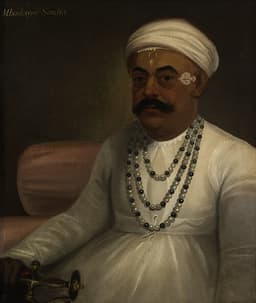
Mahadji Scindia
General · Modern
65.4Total

Napoleon Bonaparte
General · Modern
70.9Total
Basic Information
Born
1730
1769
Died
1794
1821
Era
Modern
Modern
Nationality
India
France
Occupation
General
General
Civilization
Indian
Western
Score Comparison
Military (10%)
85.0
94.0
Political (20%)
78.0
72.0
Influence (20%)
56.7
40.0
Legacy (20%)
52.0
80.0
Leadership (15%)
72.0
78.0
Strategy (15%)
72.0
90.0
TOTAL
65.4
70.9
Mahadji Scindia — Complete Timeline
1768 AD
Became Regent of GwaliorPolitical Action◆ Major
Mahadji Scindia assumed the regency of Gwalior after the death of his predecessor. He consolidated power and expanded the Scindia domain through military campaigns and alliances.
SuccessionGwaliorScindia Dynasty
Impact: regionalconstructive
1771 AD
Battle of DelhiWar◆ Major
Mahadji Scindia led Maratha forces to capture Delhi from the Rohilla Afghans. He restored the Mughal Emperor Shah Alam II to the throne, becoming the de facto power behind the Mughal court.
Maratha-Afghan WarsDelhiMughal Restoration
Impact: national
1784 AD
Appointed Mughal RegentPolitical Action
Mahadji Scindia was appointed as the regent (Vakil-i-Mutlaq) of the Mughal Empire by Shah Alam II. This gave him control over Mughal administration and military, making him the most powerful figure in northern India.
Mughal EmpireRegencyScindia
Impact: nationalconstructive
1787 AD
Battle of LalsotWar
Mahadji Scindia fought against the Rajput coalition of Jaipur and Jodhpur at Lalsot. The battle ended inconclusively, but it weakened Rajput resistance to Maratha expansion.
Maratha-Rajput WarsBattleRajasthan
Impact: regional
1790 AD
Battle of PatanWar◆ Major
Mahadji Scindia defeated the Rajput forces of Jaipur at the Battle of Patan. The victory forced Jaipur to accept Maratha suzerainty and pay tribute.
Maratha-Rajput WarsBattleJaipur
Impact: regional
Battle of MertaWar◆ Major
Mahadji Scindia defeated the Rajput forces of Jodhpur at the Battle of Merta. This victory extended Maratha control over Marwar and established Scindia as the dominant power in Rajasthan.
Maratha-Rajput WarsBattleJodhpur
Impact: regional
Napoleon Bonaparte — Complete Timeline
1799 AD
Coup of 18 BrumaireOther◆ Major
Napoleon Bonaparte, with support from his brother Lucien and key political figures, overthrew the Directory in a bloodless coup. He established the Consulate with himself as First Consul, effectively becoming the ruler of France. This event ended the French Revolution's most unstable period.
French RevolutionCoupRise to Power
Impact: regional
1804 AD
Promulgation of the Napoleonic CodeOther◆ Major
Napoleon enacted the Civil Code of the French, known as the Napoleonic Code, a comprehensive set of laws that replaced the fragmented feudal legal systems. The code established legal equality, protected property rights, and secularized law. It became the basis for legal systems in many European and world countries.
Legal ReformNapoleonic CodeCivil Law
Impact: globalconstructive
1805 AD
Battle of AusterlitzWar◆ Major
Napoleon's Grande Arm
Napoleonic WarsBattleDecisive Victory
Impact: global
1812 AD
Invasion of RussiaWar◆ Major
Napoleon led the Grande Arm
Napoleonic WarsInvasionDisaster
Impact: globaldestructive
1815 AD
Battle of WaterlooWar◆ Major
Napoleon's French army was defeated by the combined forces of the Duke of Wellington's Anglo-Allied army and Gebhard Leberecht von Bl
Napoleonic WarsBattleFinal Defeat
Impact: globaldestructive
Expert Analysis
mahadji-scindia-vs-napoleon-bonaparte
# The Emperor and the Regent: Two Paths to Power in an Age of Empire
In the summer of 1815, Napoleon Bonaparte stood on the deck of HMS *Bellerophon*, watching the coast of France recede into the Atlantic mist. His empire had collapsed, his armies shattered, his name destined for legend. Twenty-one years earlier, in 1794, another great commander had died in his bed at Gwalior Fort, surrounded by the spoils of a different kind of empire—one built not on European battlefields but on the dusty plains of Hindustan, where he had restored a Mughal emperor to his throne. Napoleon and Mahadji Scindia never met, never fought, but their lives pose a question that haunts history: What makes one conqueror build an empire that burns bright and fast, while another builds one that endures in shadow?
Origins
Napoleon was born in 1769 on Corsica, an island of fierce independence recently annexed by France. His family were minor nobles, proud and impoverished. The young Napoleon grew up speaking Italian, nursing resentment against the French who had conquered his homeland, and devouring books on military history and Enlightenment philosophy. He was a product of Europe's revolutionary ferment—a world where old certainties were crumbling and a man of talent could rise to the top.
Mahadji Scindia entered the world in 1730, forty years before Napoleon, in a very different universe. He was born into the Maratha Confederacy, a loose alliance of warrior clans that had risen from the hills of western India to challenge Mughal supremacy. His father was a military commander, and young Mahadji was raised in the saddle, learning the arts of cavalry warfare and diplomacy in a world of shifting alliances, where loyalty was a currency and betrayal a tool. The Marathas were not revolutionaries but restorers—they sought not to overthrow the old order but to claim their place within it.
Rise to Power
Napoleon's ascent was meteoric and theatrical. In 1795, at just twenty-six, he saved the French Revolutionary government from a royalist uprising with a "whiff of grapeshot." Two years later, he led a ragged army across the Alps into Italy and carved out a personal empire of glory. Every victory was a stepping stone, every battle a proclamation of his genius. He was the self-made man of the Enlightenment, the little corporal who became emperor, crowned in Notre Dame in 1804 with his own hands.
Mahadji's rise was slower, more patient, and rooted in the politics of survival. In 1768, he became regent of Gwalior after his predecessor's death, inheriting a small kingdom surrounded by enemies. He spent years consolidating power, fighting not only external foes but internal rivals within the Maratha confederacy. His turning point came in 1771, when he led the Maratha capture of Delhi from the Rohilla Afghans, restoring the Mughal Emperor Shah Alam II to his throne. In 1784, Shah Alam appointed him *Vakil-i-Mutlaq*—the regent of the Mughal Empire. Napoleon seized power; Mahadji was given it, because he had proven himself indispensable.
Leadership & Governance
As a military commander, Napoleon was a genius of the offensive. His campaigns—Austerlitz in 1805, Jena in 1806, Friedland in 1807—were masterpieces of speed, deception, and concentration of force. He revolutionized warfare with the *corps* system, turning armies into mobile killing machines. His strategic score of 93 reflects a mind that could see the battlefield as a chessboard and move pieces with terrifying precision.
Mahadji's military style was different—more patient, more defensive, and adapted to Indian conditions. His victories at Patan in 1790 and Merta later that year were not Napoleonic blitzkriegs but grinding campaigns that wore down Rajput coalitions through maneuver and siegecraft. His strategy score of 77 is lower, but it underestimates his genius for the political dimensions of war. He understood that in India, victory on the battlefield meant little without control of the court.
Politically, Mahadji outshone Napoleon. His political score of 80 against Napoleon's 75 reflects a man who governed through influence, not conquest. As Mughal regent, he did not abolish the empire but used it as a source of legitimacy, issuing decrees in Shah Alam's name while collecting revenues for himself. Napoleon, by contrast, made enemies of every crowned head in Europe, placing his brothers on thrones and provoking coalitions that eventually crushed him.
Triumph & Tragedy
Napoleon's greatest moment was Austerlitz in 1805, where he destroyed the combined armies of Russia and Austria, forcing the Holy Roman Empire to dissolve. His greatest failure was the invasion of Russia in 1812—a catastrophic overreach that cost half a million lives and exposed his empire's fragility. He died in 1821 on Saint Helena, a prisoner of the British, his ambition finally shackled.
Mahadji's triumph was subtler but more durable. By 1790, he had restored Mughal authority in Delhi, defeated the Rajput kingdoms, and made the Marathas the dominant power in northern India. His tragedy was that he could not unite the Maratha confederacy itself—the jealousies and rivalries that had always plagued his people continued after his death. He died in 1794, still in power, but his successors lacked his political touch. Within twenty years, the British had broken Maratha power forever.
Character & Destiny
Napoleon was driven by an insatiable hunger for glory. "I live only for posterity," he once said, and he meant it. His personality—brilliant, arrogant, restless—shaped every decision. He could not stop, could not consolidate, because stopping meant admitting he was mortal. His destiny was to burn out, a shooting star that illuminates the sky for a moment and then vanishes.
Mahadji was more pragmatic, more patient. He understood that power was not a prize to be seized but a plant to be cultivated. He did not seek to conquer the world; he sought to master the world he had. His destiny was to build something that outlasted him—not an empire, but a legacy of political wisdom that Indian rulers would study for generations.
Legacy
Napoleon's legacy is written in the laws of Europe—the Napoleonic Code, the metric system, the modern state. His influence score of 82 reflects a man who reshaped a continent. But his empire was ephemeral; within a decade of his death, the Bourbons were back, and Europe's old order had reasserted itself.
Mahadji's legacy is quieter but perhaps more profound. He is remembered not as a conqueror but as a restorer—the man who gave the Mughal Empire its last gasp of life. In India, he is a symbol of Maratha pride, a figure who proved that Indians could match European military and political sophistication. His total score of 73.5 is lower than Napoleon's 82.4, but it measures a different kind of greatness: not the greatness of the comet, but of the steady flame.
Conclusion
Napoleon and Mahadji Scindia were both children of their time—one a child of revolution, the other of restoration. Napoleon believed that history was made by will; Mahadji believed it was made by patience. Napoleon conquered Europe and lost it; Mahadji restored an empire and kept it, for a time. In the end, the difference between them is not a matter of scores or strategies but of philosophy. Napoleon asked, "What can I take?" Mahadji asked, "What can I preserve?" And perhaps that is the deepest question history asks of every leader: Do you build for the moment, or for the ages?
Rankings
🥇
Napoleon BonaparteLeader
Mil: 94.0Pol: 72.0Inf: 40.0
70.9
🥈
Mahadji Scindia
Mil: 85.0Pol: 78.0Inf: 56.7
65.4
+5.5 behind
How This Comparison Works
Algorithm
Each figure is scored on 6 dimensions (0—100 scale) based on structured historical data: Military (10%), Political (20%), Influence (20%), Legacy (20%), Leadership (15%), Strategy (15%). The weighted total produces the final ranking.
Data Sources
Scores are computed from structured sub-indicators in the database. Scale factors adjust for era (Ancient ×0.85, Modern ×1.0) and civilization size (Eastern ×1.05, Other ×0.80) to account for differences in population and military scale.
Maximum 3 Figures
Comparisons are limited to 2—3 figures to ensure readability and statistical meaningfulness.
Error Margins
±5 points per dimension — Sub-scores are derived from historical records with inherent uncertainty. Two figures within 5 points on a dimension should be considered roughly equivalent in that area.
Total Score Accuracy
±3 points overall — The weighted combination of 6 dimensions produces a total score with approximately ±3 points of uncertainty. Differences of less than 3 points are not statistically significant— the figures are effectively tied.
Known Limitations
- Historical records are incomplete and uneven across civilizations
- Figures from oral-tradition societies may be underrepresented
- Occupation labels can misclassify multi-role figures
- Scores measure capability and impact, not moral character
- Quantitative scoring is a comparison tool, not absolute truth
Capability Radar
Military (10%) — Battles & Warfare
Battles
85
95
Win Rate
80
90
Expansion
80
95
Political (20%) — Governance & Reform
Reform
70
95
Diplomacy
90
80
Economy
70
85
Influence (20%) — Cultural & Global Reach
Cultural
60
85
Global
55
90
Legacy (20%) — Historical Impact
Historical
75
95
Longevity
60
90
Leadership (15%) — Power & Stability
Tenure
85
85
Stability
65
70
Strategy (15%) — Tactics & Innovation
Strategy
90
95
Tactics
85
98
Reform
75
92
Similar Comparisons
Comments & Discussion
Mahadji-Sez6/17/2026
Napoleon's empire blazed across Europe like a comet, but it was all flash and no foundation. Mahadji built something real—he restored a Mughal emperor to the throne and created a political system that lasted decades. Napoleon couldn't keep a coalition together for ten years without imploding. The Corsican's only longevity was in exile narratives, while Scindia's Maratha confederacy set the stage for Indian resistance against the British. Give me slow-burn stability over pyrotechnic collapse any
数据侦探6/17/2026
数字不会骗人:拿破仑打仗烧掉法国60万青年,十年就玩完;辛蒂亚用一万人的军队稳住北印度四十载,还活到寿终正寝。拿战粉丝吹他多厉害,可到最后他连巴黎都守不住,只能去圣赫勒拿岛写回忆录。什么叫真实力?不是会打仗,是会活下来、会留底牌。辛蒂亚才是帝国建造者的模板,拿破仑就是个华丽破产的赌徒。
Rat-Picker6/17/2026
Comparing these two is like apples and hand grenades—similar shapes, totally different payloads. Napoleon fought European states with organized armies and supply lines; Mahadji fought Mughal successor states with monsoon seasons and mercenaries who changed sides mid-battle. The real genius is that Scindia restored a Mughal emperor without European gunpowder empire infrastructure. Napoleon inherited the French Revolution's military machine; Mahadji built his from scratch. Context matters, and you
历史老炮儿6/17/2026
辛蒂亚1794年走的时候,儿子能继续管;拿破仑1815年流放时,儿子根本活不过维也纳会议的全家福。这不是运气,是制度设计。拿破仑的帝国靠他一个人的光环活着,他一下台,百日王朝就成闹剧了;辛蒂亚的马拉塔联盟从基层地主到地方军队都有自运转能力。谁是真英雄?那个死了以后帝国继续跑二十年的,不是那个被囚在岛上写书的。
Classics-Fail6/17/2026
You're comparing a man who conquered Egypt and Russia in his spare time to a regional power broker who couldn't even stop the British East India Company from eating India alive by 1803. Napoleon redefined warfare with corps d'armée and the Continental System; Mahadji just did what every Maratha chieftain did since Shivaji—raid, negotiate, survive. History remembers one because he changed the world; it forgets the other because he only changed who collected taxes in Gwalior. The scale is incompar