Loading...
This comparison has not been analyzed yet.
One-time AI generation (~1 minute). Scores and timeline are already available below.
Mahendravarman I vs Rajendra Chola I
Rajendra Chola I leads by 23.5 pts · 2 figures compared
…
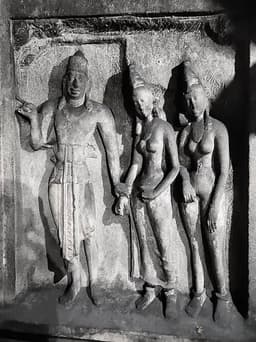
Mahendravarman I
Emperor · Medieval
58.7Total

Rajendra Chola I
Emperor · Medieval
82.2Total
Basic Information
Born
600
971
Died
630
1044
Era
Medieval
Medieval
Nationality
India
India
Occupation
Emperor
Emperor
Civilization
Indian
Indian
Score Comparison
Military (10%)
60.0
84.7
Political (20%)
62.7
82.0
Influence (20%)
55.0
84.0
Legacy (20%)
52.0
84.0
Leadership (15%)
66.0
78.0
Strategy (15%)
66.3
77.6
TOTAL
58.7
82.2
Mahendravarman I — Complete Timeline
610 AD
Patronage of Cave Temples at MandagapattuCultural◆ Major
Mahendravarman I excavated the first rock-cut cave temple at Mandagapattu, dedicated to Brahma, Vishnu, and Shiva. This innovation initiated the Pallava tradition of rock-cut architecture, influencing later temples across South India.
Rock-cut ArchitecturePallava ArtReligious Patronage
Impact: regionalconstructive
Conversion to Jainism and Patronage of Jain MonksCultural
Mahendravarman I initially patronized Jainism and built Jain cave temples, such as the one at Sittannavasal. He later converted to Shaivism under the influence of the saint Appar, reflecting religious shifts in the Pallava court.
Religious ConversionJainismShaivism
Impact: regional
620 AD
Defeat by Chalukya Pulakeshin IIWar◆ Major
Mahendravarman I suffered a military defeat against the Chalukya king Pulakeshin II, who invaded the Pallava kingdom. This loss resulted in the temporary loss of northern territories and demonstrated the military rivalry between the Pallavas and Chalukyas.
Pallava-Chalukya ConflictMilitary DefeatTerritorial Loss
Impact: regionaldestructive
630 AD
Construction of the Shore Temple at MamallapuramCultural◆ Major
Mahendravarman I built the Shore Temple, a structural granite temple at Mamallapuram. This temple is a major example of early Dravidian architecture and a UNESCO World Heritage site. It was dedicated to Shiva and marked a shift from rock-cut to structural temple building.
Pallava ArchitectureTemple BuildingDravidian Style
Impact: regionalconstructive
Rajendra Chola I — Complete Timeline
1014 AD
Accession to the Chola ThronePolitical Action
Rajendra Chola I succeeded his father Raja Raja Chola I as emperor of the Chola Empire. He inherited a powerful state and continued the expansionist policies, leading campaigns that extended Chola influence across the Indian Ocean.
Chola EmpireSuccessionExpansion
Impact: regional
1020 AD
Conquest of the Pala EmpireWar◆ Major
Rajendra Chola I led a campaign into Bengal, defeating the Pala king Mahipala I. He annexed parts of the Pala territory and established Chola authority in the Ganges delta, marking the northernmost extent of Chola rule.
Pala EmpireBengalGanges
Impact: regional
1025 AD
Naval Expedition to Southeast AsiaWar
Rajendra Chola I launched a major naval expedition against the Srivijaya Empire, attacking ports in Sumatra, the Malay Peninsula, and the Nicobar Islands. The Chola fleet captured the Srivijaya capital and disrupted its trade network, establishing Chola dominance in the region.
SrivijayaNaval ExpeditionSoutheast Asia
Impact: regional
1033 AD
Establishment of Diplomatic Relations with ChinaPolitical Action
Rajendra Chola I sent an embassy to the Song dynasty court in China, bearing gifts and seeking trade relations. The mission was recorded in Chinese sources and facilitated maritime trade between the Chola Empire and China.
ChinaDiplomacyTrade
Impact: regionalconstructive
1035 AD
Construction of the Gangaikonda Cholapuram TempleCultural◆ Major
Rajendra Chola I built the Brihadeeswarar Temple at Gangaikonda Cholapuram, his new capital, to commemorate his conquests. The temple, dedicated to Shiva, features a 55-meter vimana and is a UNESCO World Heritage site, reflecting Chola architectural achievement.
Gangaikonda CholapuramTempleChola Architecture
Impact: regionalconstructive
This comparison has not been analyzed yet.
One-time AI generation (~1 minute). Scores and timeline are already available below.
Rankings
🥇
Rajendra Chola ILeader
Mil: 84.7Pol: 82.0Inf: 84.0
82.2
🥈
Mahendravarman I
Mil: 60.0Pol: 62.7Inf: 55.0
58.7
+23.5 behind
How This Comparison Works
Algorithm
Each figure is scored on 6 dimensions (0—100 scale) based on structured historical data: Military (10%), Political (20%), Influence (20%), Legacy (20%), Leadership (15%), Strategy (15%). The weighted total produces the final ranking.
Data Sources
Scores are computed from structured sub-indicators in the database. Scale factors adjust for era (Ancient ×0.85, Modern ×1.0) and civilization size (Eastern ×1.05, Other ×0.80) to account for differences in population and military scale.
Maximum 3 Figures
Comparisons are limited to 2—3 figures to ensure readability and statistical meaningfulness.
Error Margins
±5 points per dimension — Sub-scores are derived from historical records with inherent uncertainty. Two figures within 5 points on a dimension should be considered roughly equivalent in that area.
Total Score Accuracy
±3 points overall — The weighted combination of 6 dimensions produces a total score with approximately ±3 points of uncertainty. Differences of less than 3 points are not statistically significant— the figures are effectively tied.
Known Limitations
- Historical records are incomplete and uneven across civilizations
- Figures from oral-tradition societies may be underrepresented
- Occupation labels can misclassify multi-role figures
- Scores measure capability and impact, not moral character
- Quantitative scoring is a comparison tool, not absolute truth
Capability Radar
Military (10%) — Battles & Warfare
Battles
55
95
Win Rate
60
98
Expansion
55
95
Political (20%) — Governance & Reform
Reform
65
88
Diplomacy
60
85
Economy
60
92
Influence (20%) — Cultural & Global Reach
Cultural
75
85
Global
55
85
Legacy (20%) — Historical Impact
Historical
70
88
Longevity
65
80
Leadership (15%) — Power & Stability
Tenure
70
90
Stability
65
90
Strategy (15%) — Tactics & Innovation
Strategy
60
92
Tactics
65
90
Reform
50
85
Similar Comparisons
Comments & Discussion
No comments yet. Be the first to share your thoughts!