Loading...
Marc Mitscher vs Vo Nguyen Giap
Vo Nguyen Giap leads by 19.7 pts · 2 figures compared
…
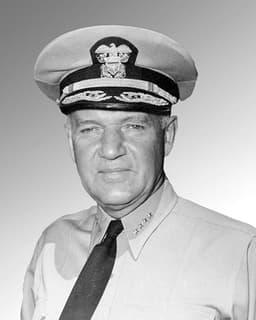
Marc Mitscher
General · Modern
53.8Total
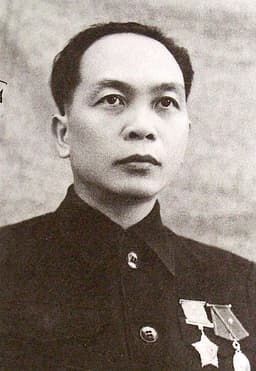
Vo Nguyen Giap
General · Modern
73.5Total
Basic Information
Born
1887
1911
Died
1947
2013
Era
Modern
Modern
Nationality
United States
Vietnam
Occupation
General
General
Civilization
Western
Eastern
Score Comparison
Military (10%)
78.5
74.0
Political (20%)
27.9
60.0
Influence (20%)
62.0
88.0
Legacy (20%)
52.0
72.0
Leadership (15%)
40.4
68.0
Strategy (15%)
72.0
69.2
TOTAL
53.8
73.5
Marc Mitscher — Complete Timeline
1942 AD
Commanded USS Hornet during Doolittle RaidWar◆ Major
Mitscher commanded the USS Hornet, which launched the Doolittle Raid on Tokyo. He was responsible for the safe launch of B-25 bombers from the carrier deck, a feat never before attempted.
World War IIDoolittle RaidNaval Aviation
Impact: regional
1944 AD
Commanded Task Force 58 at the Battle of the Philippine SeaWar◆ Major
Mitscher commanded Task Force 58 in the Battle of the Philippine Sea, where US carrier aircraft destroyed over 300 Japanese planes and sank three carriers. The victory crippled Japanese naval aviation.
World War IIPacific TheaterNaval Battle
Impact: regional
Commanded Carrier Forces at the Battle of Leyte GulfWar◆ Major
Mitscher's Task Force 58 played a key role in the Battle of Leyte Gulf, the largest naval battle of World War II. His carriers provided air cover for the invasion and attacked Japanese surface forces.
World War IILeyte GulfNaval Battle
Impact: regional
1945 AD
Led Carrier Strikes on TokyoWar◆ Major
Mitscher's Task Force 58 conducted carrier-based air strikes against Tokyo and other Japanese home islands, demonstrating US naval air power and contributing to the strategic bombing campaign.
World War IIPacific TheaterNaval Aviation
Impact: regional
Vo Nguyen Giap — Complete Timeline
1954 AD
Battle of Dien Bien PhuWar
General Giap commanded Viet Minh forces in a 56-day siege that defeated the French garrison at Dien Bien Phu. This victory ended French colonial rule in Indochina and forced France to negotiate the Geneva Accords.
DecolonizationVietnamMilitary Strategy
Impact: regional
1965 AD
Battle of the Ia Drang ValleyWar◆ Major
Giap's forces engaged US troops in the first major battle of the Vietnam War at Ia Drang. The battle demonstrated the effectiveness of North Vietnamese tactics against US air mobility and set the pattern for future engagements.
Vietnam WarBattleUS Military
Impact: regional
1968 AD
Tet OffensiveWar
Giap planned and executed the Tet Offensive, a coordinated attack on over 100 South Vietnamese cities and US bases. Though a military defeat for North Vietnam, it shocked US public opinion and led to the US withdrawal from Vietnam.
Vietnam WarTet OffensiveUS Public Opinion
Impact: globaldestructive
1972 AD
Easter OffensiveWar◆ Major
Giap launched the Easter Offensive, a large-scale conventional invasion of South Vietnam. The offensive was repelled by US and South Vietnamese forces with heavy losses, but it demonstrated North Vietnam's ability to sustain major operations.
Vietnam WarOffensiveConventional Warfare
Impact: regionaldestructive
1975 AD
Fall of SaigonWar
Giap's forces captured Saigon, ending the Vietnam War. The victory unified Vietnam under communist rule and led to the establishment of the Socialist Republic of Vietnam.
Vietnam WarUnificationCommunist Victory
Impact: national
Expert Analysis
Origins
Marc Mitscher was born on January 26, 1887, in Hillsboro, Wisconsin, to a family with a naval tradition; his father was a federal Indian agent. He attended the United States Naval Academy, graduating in 1910. His early career included service on battleships and submarines, and he earned his pilot wings in 1916, becoming one of the Navy's first aviators. His formative experience came as commander of the USS Hornet, which launched the Doolittle Raid in April 1942.
Vo Nguyen Giap was born on August 25, 1911, in Quang Binh Province, French Indochina, into a peasant family. He attended the Lycée Albert Sarraut in Hanoi and later studied law at the University of Hanoi. His political activism against French colonial rule led him to join the Communist Party in the 1930s. He fled to China in 1939 after a crackdown, where he met Ho Chi Minh. Giap's military education was largely self-taught, studying guerrilla warfare and the works of Mao Zedong.
Rise to Power
Mitscher's rise came through his expertise in naval aviation. He commanded the USS Hornet during the Doolittle Raid (April 18, 1942), which boosted US morale after Pearl Harbor. He then took command of the carrier USS Saratoga and later served as commander of Carrier Division 3. His big break came in 1944 when Admiral Raymond Spruance appointed him commander of Task Force 58, the main carrier strike force of the US Pacific Fleet. Mitscher's aggressive tactics and proficiency in air operations made him the ideal leader for fast carrier task forces.
Giap's rise to power paralleled the growth of the Viet Minh. In 1944, he organized the Armed Propaganda Brigade for National Liberation, the precursor to the People's Army of Vietnam. His first major operation was the Battle of Cao Bằng in 1947, where he used guerrilla tactics against French forces. Giap became the commander-in-chief of the Viet Minh in 1949, and his strategic acumen was proven at the Battle of Dien Bien Phu (March–May 1954), where he besieged and defeated a French fortress, ending French colonial rule in Indochina.
Leadership & Governance
Mitscher led Task Force 58 with a hands-on style, often flying his own aircraft to observe operations. He was known for his quiet demeanor and lack of charisma, but he earned respect through competence. He delegated tactical decisions to his air group commanders but maintained overall strategic control. His governance approach was strictly military; he did not engage in political matters. His leadership scores 40.4, reflecting his limited scope beyond naval command.
Giap was both a military commander and a political figure, serving as Defense Minister and Politburo member. He combined guerrilla warfare with conventional operations, as seen in the Tet Offensive (1968) and the Easter Offensive (1972). His leadership style was adaptive, but he faced criticism for high casualties, especially during Tet. Giap's political score is 60.0, indicating his significant role in Vietnam's communist government. He oversaw the integration of military strategy with political goals, often prioritizing long-term victory over short-term losses.
Triumph & Tragedy
Mitscher's greatest triumph was the Battle of the Philippine Sea (June 19–20, 1944), where his carriers destroyed over 300 Japanese aircraft and sank three carriers, crippling Japanese naval aviation. He also led carrier strikes on Tokyo in February 1945. However, his greatest failure was the loss of the USS Princeton during the Battle of Leyte Gulf (October 1944) due to a Japanese air attack. Mitscher's aggressive tactics sometimes exposed his carriers to risk, but overall his military score of 78.5 reflects his effectiveness.
Giap's triumph was the Battle of Dien Bien Phu, where he demonstrated masterful siege tactics, leading to the French surrender and the Geneva Accords. His Tet Offensive, though a military defeat, was a political victory that turned US public opinion against the war. His greatest tragedy was the high casualty rates in his campaigns, especially during the Easter Offensive, which failed to achieve its objectives. Giap's military score of 74.0 is slightly lower than Mitscher's, but his influence score of 88.0 is much higher.
Character & Destiny
Mitscher was reserved and focused on operations, often described as a "sailor's admiral" who cared for his men but kept his distance. His decision-making was methodical, but he could be bold when necessary, as shown by his order to turn on ship lights to guide returning aircraft after the Battle of the Philippine Sea. His character shaped his fate as a respected but not legendary figure, overshadowed by Nimitz and Spruance. He died in 1947, shortly after retirement.
Giap was determined and strategic, willing to sacrifice troops for long-term goals. He was a disciplined communist ideologue but also pragmatic, adapting tactics based on enemy strengths. His character led him to persist through decades of war, ultimately achieving the unification of Vietnam. However, his reliance on attrition warfare caused immense suffering. Giap's legacy is tied to his role in defeating two major powers, the French and the Americans.
Legacy
Mitscher's legacy is primarily within naval history. He advanced carrier warfare tactics, emphasizing coordinated air strikes and fast task force maneuvers. His methods influenced US Navy doctrine for decades. However, his impact beyond the military is limited, reflected in his legacy score of 52.0. He is remembered as an expert carrier commander but not a household name.
Giap's legacy is vast. He is celebrated in Vietnam as a national hero who defeated colonialism and imperialism. His guerrilla warfare strategies have been studied by militaries worldwide. The Vietnam War's outcome reshaped global politics, demonstrating that a smaller power could resist a superpower. Giap's legacy score of 72.0 and influence score of 88.0 highlight his enduring impact.
Conclusion
While Mitscher excelled in carrier warfare, his impact was confined to a specific theater and era. Giap, with a total score of 73.5 compared to Mitscher's 53.8, had a greater and more lasting impact on global history. Giap's victories directly altered the course of decolonization and Cold War dynamics, while Mitscher's contributions, though significant, were part of a larger Allied effort. Therefore, Vo Nguyen Giap is the more influential figure.
Rankings
🥇
Vo Nguyen GiapLeader
Mil: 74.0Pol: 60.0Inf: 88.0
73.5
🥈
Marc Mitscher
Mil: 78.5Pol: 27.9Inf: 62.0
53.8
+19.7 behind
How This Comparison Works
Algorithm
Each figure is scored on 6 dimensions (0—100 scale) based on structured historical data: Military (10%), Political (20%), Influence (20%), Legacy (20%), Leadership (15%), Strategy (15%). The weighted total produces the final ranking.
Data Sources
Scores are computed from structured sub-indicators in the database. Scale factors adjust for era (Ancient ×0.85, Modern ×1.0) and civilization size (Eastern ×1.05, Other ×0.80) to account for differences in population and military scale.
Maximum 3 Figures
Comparisons are limited to 2—3 figures to ensure readability and statistical meaningfulness.
Error Margins
±5 points per dimension — Sub-scores are derived from historical records with inherent uncertainty. Two figures within 5 points on a dimension should be considered roughly equivalent in that area.
Total Score Accuracy
±3 points overall — The weighted combination of 6 dimensions produces a total score with approximately ±3 points of uncertainty. Differences of less than 3 points are not statistically significant— the figures are effectively tied.
Known Limitations
- Historical records are incomplete and uneven across civilizations
- Figures from oral-tradition societies may be underrepresented
- Occupation labels can misclassify multi-role figures
- Scores measure capability and impact, not moral character
- Quantitative scoring is a comparison tool, not absolute truth
Capability Radar
Military (10%) — Battles & Warfare
Battles
85
85
Win Rate
90
80
Expansion
80
70
Political (20%) — Governance & Reform
Reform
10
60
Diplomacy
15
70
Economy
10
50
Influence (20%) — Cultural & Global Reach
Cultural
40
65
Global
60
70
Legacy (20%) — Historical Impact
Historical
70
80
Longevity
55
60
Leadership (15%) — Power & Stability
Tenure
20
65
Stability
15
55
Strategy (15%) — Tactics & Innovation
Strategy
88
88
Tactics
92
90
Reform
75
75
Similar Comparisons
Comments & Discussion
No comments yet. Be the first to share your thoughts!