Loading...
This comparison has not been analyzed yet.
One-time AI generation (~1 minute). Scores and timeline are already available below.
Marcus Claudius Marcellus vs Sad ibn Abi Waqqas
Marcus Claudius Marcellus leads by 4.1 pts · 2 figures compared
…
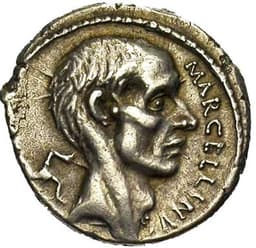
Marcus Claudius Marcellus
General · Ancient
55.8Total

Sad ibn Abi Waqqas
General · Ancient
51.7Total
Basic Information
Born
-268
-595
Died
-208
—
Era
Ancient
Ancient
Nationality
Roman Republic
Rashidun Caliphate
Occupation
General
General
Civilization
Western
Middle Eastern
Score Comparison
Military (10%)
72.0
75.0
Political (20%)
32.2
25.0
Influence (20%)
60.0
55.0
Legacy (20%)
50.0
58.0
Leadership (15%)
64.5
40.4
Strategy (15%)
66.3
61.3
TOTAL
55.8
51.7
Marcus Claudius Marcellus — Complete Timeline
222 BC
First Consulship and Campaign in Cisalpine GaulWar◆ Major
Marcellus was elected consul for the first time and campaigned in Cisalpine Gaul against the Insubres. He killed the Gallic chieftain Viridomarus in single combat, winning the spolia opima, a rare honor awarded for killing an enemy leader in battle.
Roman RepublicGallic WarsSpolia Opima
Impact: regional
216 BC
Defended Nola Against HannibalWar◆ Major
After the disaster at Cannae, Marcellus defended the city of Nola against Hannibal's forces. He successfully repelled the Carthaginian attack, earning a reputation as one of the few Roman commanders able to stand up to Hannibal in the field.
Second Punic WarHannibalNola
Impact: regional
212 BC
Captured SyracuseWar◆ Major
Marcellus captured the Greek city of Syracuse after a two-year siege. The city had allied with Carthage, and its fall was a major blow to Hannibal's strategy. During the sack, the mathematician Archimedes was killed by a Roman soldier, despite Marcellus's orders to spare him.
Second Punic WarSyracuseArchimedes
Impact: regionaldestructive
208 BC
Killed in Ambush at VenusiaWar◆ Major
While reconnoitering near Venusia, Marcellus and his colleague were ambushed by a Carthaginian force under Hannibal. Marcellus was killed in the skirmish, and his death was a significant loss for Rome. Hannibal reportedly gave him a proper burial.
Second Punic WarHannibalDeath
Impact: regionaltragic
Sad ibn Abi Waqqas — Complete Timeline
636 AD
Battle of al-QadisiyyahWar◆ Major
Sa'd ibn Abi Waqqas commanded the Muslim Arab army against the Sassanid Persian forces at al-Qadisiyyah in Iraq. The Muslim victory broke the back of the Sassanid army and opened the way for the conquest of the Persian heartland.
Islamic ConquestPersiaBattle
Impact: regional
637 AD
Conquest of CtesiphonWar◆ Major
Following al-Qadisiyyah, Sa'd ibn Abi Waqqas led the Muslim army to capture Ctesiphon, the capital of the Sassanid Empire. The city fell after a siege, yielding immense wealth and marking the effective end of Sassanid resistance.
Islamic ConquestPersiaCapital
Impact: regional
638 AD
Governor of KufaPolitical Action
Sa'd ibn Abi Waqqas was appointed governor of Kufa, the newly founded garrison city in Iraq. He administered the city and its surrounding territories, overseeing the settlement of Arab tribes and the administration of the conquered lands.
GovernorshipIraqAdministration
Impact: regionalconstructive
This comparison has not been analyzed yet.
One-time AI generation (~1 minute). Scores and timeline are already available below.
Rankings
🥇
Marcus Claudius MarcellusLeader
Mil: 72.0Pol: 32.2Inf: 60.0
55.8
🥈
Sad ibn Abi Waqqas
Mil: 75.0Pol: 25.0Inf: 55.0
51.7
+4.1 behind
How This Comparison Works
Algorithm
Each figure is scored on 6 dimensions (0—100 scale) based on structured historical data: Military (10%), Political (20%), Influence (20%), Legacy (20%), Leadership (15%), Strategy (15%). The weighted total produces the final ranking.
Data Sources
Scores are computed from structured sub-indicators in the database. Scale factors adjust for era (Ancient ×0.85, Modern ×1.0) and civilization size (Eastern ×1.05, Other ×0.80) to account for differences in population and military scale.
Maximum 3 Figures
Comparisons are limited to 2—3 figures to ensure readability and statistical meaningfulness.
Error Margins
±5 points per dimension — Sub-scores are derived from historical records with inherent uncertainty. Two figures within 5 points on a dimension should be considered roughly equivalent in that area.
Total Score Accuracy
±3 points overall — The weighted combination of 6 dimensions produces a total score with approximately ±3 points of uncertainty. Differences of less than 3 points are not statistically significant— the figures are effectively tied.
Known Limitations
- Historical records are incomplete and uneven across civilizations
- Figures from oral-tradition societies may be underrepresented
- Occupation labels can misclassify multi-role figures
- Scores measure capability and impact, not moral character
- Quantitative scoring is a comparison tool, not absolute truth
Capability Radar
Military (10%) — Battles & Warfare
Battles
75
75
Win Rate
70
80
Expansion
65
80
Political (20%) — Governance & Reform
Reform
30
20
Diplomacy
55
50
Economy
40
30
Influence (20%) — Cultural & Global Reach
Cultural
55
55
Global
45
60
Legacy (20%) — Historical Impact
Historical
65
70
Longevity
50
65
Leadership (15%) — Power & Stability
Tenure
60
40
Stability
50
35
Strategy (15%) — Tactics & Innovation
Strategy
75
75
Tactics
80
70
Reform
30
30
Similar Comparisons
Comments & Discussion
No comments yet. Be the first to share your thoughts!