Loading...
This comparison has not been analyzed yet.
One-time AI generation (~1 minute). Scores and timeline are already available below.
Mario Soares vs Sir Thomas Stamford Raffles
Mario Soares leads by 9.0 pts · 2 figures compared
…
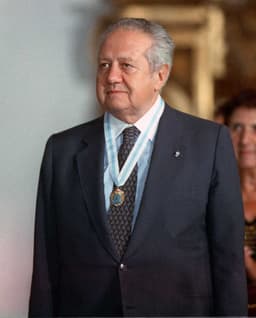
Mario Soares
Politician · Modern
63.8Total
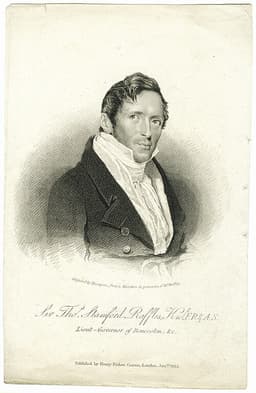
Sir Thomas Stamford Raffles
Politician · Modern
54.8Total
Basic Information
Born
1924
1781
Died
—
1826
Era
Modern
Modern
Nationality
Portugal
Great Britain
Occupation
Politician
Politician
Civilization
Western
Western
Score Comparison
Military (10%)
14.6
43.3
Political (20%)
84.0
45.0
Influence (20%)
68.0
58.3
Legacy (20%)
68.0
55.0
Leadership (15%)
78.0
67.0
Strategy (15%)
40.8
53.8
TOTAL
63.8
54.8
Mario Soares — Complete Timeline
1973 AD
Founding of the Portuguese Socialist PartyPolitical Action◆ Major
Soares co-founded the Portuguese Socialist Party (PS) in West Germany, in exile from the Estado Novo regime. The party became a key force in the democratic transition after the Carnation Revolution.
Political PartyDemocracyExile
Impact: nationalconstructive
1974 AD
Return from Exile after Carnation RevolutionPolitical Action◆ Major
After the Carnation Revolution overthrew the Estado Novo, Soares returned from exile to Portugal. He was greeted by large crowds and immediately entered the political negotiations for the new democratic regime.
Carnation RevolutionDemocracyReturn
Impact: nationalconstructive
1976 AD
Election as Prime MinisterPolitical Action◆ Major
Soares became the first democratically elected Prime Minister of Portugal after the Carnation Revolution, leading a minority Socialist government. His election marked the consolidation of democratic institutions.
ElectionDemocracyGovernment
Impact: nationalconstructive
1985 AD
Negotiation of Portugal's Accession to the EECPolitical Action◆ Major
As Prime Minister, Soares led the negotiations for Portugal's accession to the European Economic Community (EEC). The treaty was signed in 1985, integrating Portugal into the European project and modernizing its economy.
European UnionIntegrationTreaty
Impact: regionalconstructive
1986 AD
Election as President of PortugalPolitical Action◆ Major
Soares was elected President of the Republic, becoming the first civilian president since the Carnation Revolution. He served two five-year terms, providing stability and continuity during Portugal's consolidation of democracy.
PresidencyDemocracyElection
Impact: nationalconstructive
Sir Thomas Stamford Raffles — Complete Timeline
1817 AD
Published 'The History of Java'Cultural◆ Major
Raffles published 'The History of Java' in 1817, a two-volume work detailing Javanese history, culture, and archaeology. The book included descriptions of Borobudur and other temples, and became a foundational text for Southeast Asian studies.
ScholarshipHistoryJava
Impact: globalconstructive
1818 AD
Discovery of the Rafflesia arnoldiiInvention◆ Major
Raffles, as a naturalist, discovered the Rafflesia arnoldii in Sumatra in 1818. This parasitic plant produces the largest individual flower in the world, up to one meter in diameter. The discovery was documented by botanist Joseph Arnold.
BotanyDiscoveryNatural History
Impact: globalconstructive
1819 AD
Founding of SingaporePolitical Action◆ Major
Raffles, as Lieutenant-Governor of Bencoolen, signed a treaty with the Sultan of Johor on February 6, 1819, establishing a British trading post on the island of Singapore. This action created a free port that rapidly grew into a major commercial hub.
ColonialismTradeSingapore
Impact: globalconstructive
1824 AD
Anglo-Dutch Treaty of 1824Political Action◆ Major
Raffles' establishment of Singapore led to the Anglo-Dutch Treaty of 1824, which divided the Malay Archipelago into British and Dutch spheres of influence. The treaty confirmed British control of Singapore and Malacca, while the Dutch retained the East Indies.
ColonialismTreatySoutheast Asia
Impact: global
This comparison has not been analyzed yet.
One-time AI generation (~1 minute). Scores and timeline are already available below.
Rankings
🥇
Mario SoaresLeader
Mil: 14.6Pol: 84.0Inf: 68.0
63.8
🥈
Sir Thomas Stamford Raffles
Mil: 43.3Pol: 45.0Inf: 58.3
54.8
+9.0 behind
How This Comparison Works
Algorithm
Each figure is scored on 6 dimensions (0—100 scale) based on structured historical data: Military (10%), Political (20%), Influence (20%), Legacy (20%), Leadership (15%), Strategy (15%). The weighted total produces the final ranking.
Data Sources
Scores are computed from structured sub-indicators in the database. Scale factors adjust for era (Ancient ×0.85, Modern ×1.0) and civilization size (Eastern ×1.05, Other ×0.80) to account for differences in population and military scale.
Maximum 3 Figures
Comparisons are limited to 2—3 figures to ensure readability and statistical meaningfulness.
Error Margins
±5 points per dimension — Sub-scores are derived from historical records with inherent uncertainty. Two figures within 5 points on a dimension should be considered roughly equivalent in that area.
Total Score Accuracy
±3 points overall — The weighted combination of 6 dimensions produces a total score with approximately ±3 points of uncertainty. Differences of less than 3 points are not statistically significant— the figures are effectively tied.
Known Limitations
- Historical records are incomplete and uneven across civilizations
- Figures from oral-tradition societies may be underrepresented
- Occupation labels can misclassify multi-role figures
- Scores measure capability and impact, not moral character
- Quantitative scoring is a comparison tool, not absolute truth
Capability Radar
Military (10%) — Battles & Warfare
Battles
21
5
Win Rate
24
5
Expansion
26
25
Political (20%) — Governance & Reform
Reform
95
60
Diplomacy
90
55
Economy
70
65
Influence (20%) — Cultural & Global Reach
Cultural
70
55
Global
65
65
Legacy (20%) — Historical Impact
Historical
85
70
Longevity
75
70
Leadership (15%) — Power & Stability
Tenure
85
30
Stability
75
40
Strategy (15%) — Tactics & Innovation
Strategy
33
15
Tactics
35
10
Reform
35
10
Similar Comparisons
Comments & Discussion
No comments yet. Be the first to share your thoughts!