Loading...
Maximinus Thrax vs Simbar-shipak
Maximinus Thrax leads by 5.1 pts · 2 figures compared
…
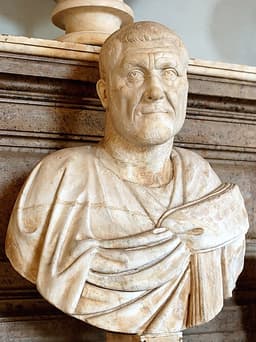
Maximinus Thrax
Emperor · Ancient
41.0Total
Simbar-shipak
Emperor · Ancient
35.9Total
Basic Information
Born
173
-1025
Died
238
-1008
Era
Ancient
Ancient
Nationality
Roman Empire
Babylon
Occupation
Emperor
Emperor
Civilization
Western
Middle Eastern
Score Comparison
Military (10%)
45.0
25.9
Political (20%)
26.4
27.9
Influence (20%)
47.9
47.1
Legacy (20%)
38.3
35.8
Leadership (15%)
33.6
31.2
Strategy (15%)
60.0
36.8
TOTAL
41.0
35.9
Maximinus Thrax — Complete Timeline
235 AD
Campaign against the AlemanniWar◆ Major
Maximinus led a campaign against the Alemanni tribe in Germania. He defeated them in battle and drove them back across the Rhine. He then devastated their territory, earning the title 'Germanicus Maximus' from the Senate.
Germanic WarsRhine FrontierMilitary Victory
Impact: regional
Accession as EmperorPolitical Action
Maximinus was proclaimed emperor by the Pannonian legions after the assassination of Severus Alexander. He was the first emperor to rise from the ranks of the army without any senatorial background, marking a shift in imperial power dynamics.
Imperial AccessionBarracks EmperorMilitary Coup
Impact: global
238 AD
Siege of AquileiaWar◆ Major
Maximinus marched on Italy to suppress a rebellion led by the Senate and the Gordians. He besieged the city of Aquileia, which resisted his army. The siege dragged on, and Maximinus's troops grew discontented with the lack of supplies and progress.
Civil WarSiegeItaly
Impact: regionaldestructive
Assassination by His Own TroopsPolitical Action◆ Major
Maximinus was assassinated in his tent by soldiers of the Legio II Parthica during the siege of Aquileia. His death ended his three-year reign. The Praetorian Guard and the Senate then recognized the new emperors Pupienus and Balbinus.
AssassinationMilitary MutinyEnd of Reign
Impact: nationaltragic
Simbar-shipak — Complete Timeline
1025 BC
Founding of the Fifth Dynasty of BabylonPolitical Action◆ Major
Simbar-shipak established the Fifth Dynasty of Babylon, also known as the Second Sealand Dynasty. He seized power after a period of instability, founding a new ruling line that would govern Babylon for several decades.
Dynasty FoundingPolitical ChangeBabylon
Impact: nationalconstructive
Expert Analysis
Origins
Maximinus Thrax, born around 173 AD in Thrace (modern-day Bulgaria), came from humble beginnings. His father was a Gothic shepherd, and his mother was an Alanic woman. He rose through the Roman army due to his immense physical strength—reportedly standing 8 feet tall—and his prowess in combat. He served under emperors Septimius Severus and Severus Alexander, earning military tribuneships and eventually command of Legio IV Italica.
Simbar-shipak, by contrast, lived in the 11th century BC during a chaotic period in Babylonian history. Little is known of his early life, but he likely came from the Sealand region in southern Mesopotamia. He seized power after the collapse of the Second Dynasty of Isin, founding the Fifth Dynasty of Babylon (also known as the Second Sealand Dynasty). His background was likely military or administrative, given his ability to navigate the turbulent politics of the time.
Rise to Power
Maximinus Thrax rose to power in 235 AD during a military crisis. After the assassination of Emperor Severus Alexander by his own troops, the Pannonian legions proclaimed Maximinus emperor. He was the first soldier to ascend the throne without any senatorial background, marking a turning point in Roman history—the beginning of the 'Barracks Emperors' era. His reign was immediately contested by the Senate, which recognized Gordian I and II in Africa, leading to civil war.
Simbar-shipak's rise was less dramatic but equally significant. Around 1025 BC, he established the Fifth Dynasty after a period of instability following the Elamite invasions. He likely deposed the last king of the Fourth Dynasty, though details are sparse. His legitimacy came from military strength and the support of the Sealand region, which had been a persistent rival to Babylon. By founding a new dynasty, he restored order and continued the struggle against Assyrian expansion.
Leadership & Governance
Maximinus Thrax's leadership was centered on military campaigns. He spent most of his short reign (235-238 AD) fighting Germanic tribes, particularly the Alemanni, whom he defeated in 236 AD, and the Sarmatians. He also waged war against the Dacians. His governance was harsh: he imposed heavy taxes to fund his wars and confiscated temple treasures, alienating the Roman elite. He never visited Rome, ruling from the frontier, which weakened his political standing. His military score of 45.0 reflects his tactical success in the field, but his political score of 26.4 shows his failure to secure support.
Simbar-shipak's governance focused on consolidating power in Babylon. He is known for rebuilding temples and restoring cults, which legitimized his rule. He maintained stability in a region often threatened by Assyria and Elam. However, his reign was short—only about 18 years—and he left few inscriptions. His political score of 27.9 is slightly higher than Maximinus's, indicating better domestic management, but his military score of 25.9 is lower, reflecting fewer campaigns.
Triumph & Tragedy
Maximinus's greatest triumph was his successful campaign against the Alemanni in 236 AD, where he drove them across the Rhine and devastated their lands. He also achieved a victory over the Sarmatians. However, his tragedy came in 238 AD when he marched on Italy to suppress a rebellion. He besieged Aquileia but failed to take it quickly. His troops, demoralized by supply shortages and the death of their commander, assassinated him in his tent. This ended his reign and plunged Rome into further chaos.
Simbar-shipak's triumph was founding the Fifth Dynasty, which lasted for about 20 years and restored Babylonian independence. He also likely repelled Assyrian incursions, though records are scarce. His tragedy is that his dynasty did not endure; after his death, the Sixth Dynasty (the Bazi Dynasty) took over. His legacy is overshadowed by more famous Babylonian rulers like Hammurabi or Nebuchadnezzar II, and his reign left few lasting monuments.
Character & Destiny
Maximinus Thrax was a giant of a man, known for his raw strength and courage. He was a soldier's emperor, but his lack of political acumen and his brutal taxation alienated the Senate and the people. His character—stubborn, militaristic, and uncompromising—led to his downfall. He trusted his army but failed to win over the civilian population. Historians view him as a capable general but a poor ruler, whose short reign foreshadowed the crisis of the third century.
Simbar-shipak was a shrewd founder, but his character is poorly recorded. He likely possessed political cunning to seize power and maintain it. His destiny was to be a transitional figure, bridging the gap between the Isin and Sealand dynasties. He is remembered as a restorer of order, but not as a transformative leader.
Legacy
Maximinus Thrax's legacy is significant as the first barracks emperor, setting a precedent for military usurpation in Rome. His reign accelerated the decline of the Roman Empire's stability. He scored 38.3 in legacy, reflecting his role in the Crisis of the Third Century. Simbar-shipak's legacy score of 35.8 is slightly lower; he is a minor figure in Babylonian history, remembered primarily for founding a short-lived dynasty.
Conclusion
Maximinus Thrax had a greater impact on history than Simbar-shipak, despite his low scores. His military score of 45.0 and strategy score of 60.0 exceed Simbar-shipak's 25.9 and 36.8, respectively. His total score of 41.0 is 5.1 points higher. More importantly, his reign marked a turning point in Roman history, whereas Simbar-shipak's dynasty was ephemeral. Maximinus's failure to govern politically underscores the fragility of military-based rule, a lesson that resonates through history. Simbar-shipak, while a founder, did not shape the course of civilization as profoundly. Thus, Maximinus Thrax emerges as the more consequential figure.
Rankings
🥇
Maximinus ThraxLeader
Mil: 45.0Pol: 26.4Inf: 47.9
41.0
🥈
Simbar-shipak
Mil: 25.9Pol: 27.9Inf: 47.1
35.9
+5.1 behind
How This Comparison Works
Algorithm
Each figure is scored on 6 dimensions (0—100 scale) based on structured historical data: Military (10%), Political (20%), Influence (20%), Legacy (20%), Leadership (15%), Strategy (15%). The weighted total produces the final ranking.
Data Sources
Scores are computed from structured sub-indicators in the database. Scale factors adjust for era (Ancient ×0.85, Modern ×1.0) and civilization size (Eastern ×1.05, Other ×0.80) to account for differences in population and military scale.
Maximum 3 Figures
Comparisons are limited to 2—3 figures to ensure readability and statistical meaningfulness.
Error Margins
±5 points per dimension — Sub-scores are derived from historical records with inherent uncertainty. Two figures within 5 points on a dimension should be considered roughly equivalent in that area.
Total Score Accuracy
±3 points overall — The weighted combination of 6 dimensions produces a total score with approximately ±3 points of uncertainty. Differences of less than 3 points are not statistically significant— the figures are effectively tied.
Known Limitations
- Historical records are incomplete and uneven across civilizations
- Figures from oral-tradition societies may be underrepresented
- Occupation labels can misclassify multi-role figures
- Scores measure capability and impact, not moral character
- Quantitative scoring is a comparison tool, not absolute truth
Capability Radar
Military (10%) — Battles & Warfare
Battles
55
10
Win Rate
50
10
Expansion
35
10
Political (20%) — Governance & Reform
Reform
15
15
Diplomacy
20
15
Economy
15
15
Influence (20%) — Cultural & Global Reach
Cultural
20
10
Global
25
10
Legacy (20%) — Historical Impact
Historical
30
15
Longevity
20
10
Leadership (15%) — Power & Stability
Tenure
20
20
Stability
10
15
Strategy (15%) — Tactics & Innovation
Strategy
40
10
Tactics
45
10
Reform
30
10
Similar Comparisons
Comments & Discussion
No comments yet. Be the first to share your thoughts!