Loading...
Menachem Begin vs Mohammed bin Salman
Menachem Begin leads by 10.1 pts · 2 figures compared
…
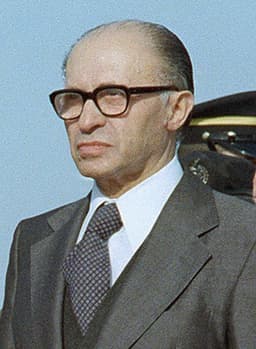
Menachem Begin
Politician · Modern
61.5Total

Mohammed bin Salman
Politician · Modern
51.4Total
Basic Information
Born
1913
1985
Died
1992
—
Era
Modern
Modern
Nationality
Israel
Saudi Arabia
Occupation
Politician
Politician
Civilization
Middle Eastern
Middle Eastern
Score Comparison
Military (10%)
21.2
14.9
Political (20%)
70.0
78.0
Influence (20%)
82.0
62.0
Legacy (20%)
55.0
45.0
Leadership (15%)
72.0
48.8
Strategy (15%)
38.6
41.0
TOTAL
61.5
51.4
Menachem Begin — Complete Timeline
1946 AD
Irgun Command of the King David Hotel BombingPolitical Action◆ Major
As commander of the Irgun, Begin ordered the bombing of the King David Hotel in Jerusalem, which housed British Mandate offices. The attack killed 91 people and was condemned internationally, but it intensified pressure on Britain to end the Mandate.
IrgunBritish MandateTerrorism
Impact: regionaldestructive
1978 AD
Signing of the Camp David AccordsPolitical Action
As prime minister, Begin signed the Camp David Accords with Egyptian President Anwar Sadat at the White House, brokered by US President Jimmy Carter. The framework led to the 1979 Egypt-Israel Peace Treaty, the first between Israel and an Arab state.
Peace TreatyEgyptCamp David
Impact: globalconstructive
1981 AD
Operation Opera (Iraqi Nuclear Reactor Strike)War◆ Major
Begin authorized the Israeli Air Force to bomb the Osirak nuclear reactor near Baghdad, Iraq. The strike destroyed the reactor, preventing Iraq from developing nuclear weapons, but was widely condemned internationally as a violation of sovereignty.
Nuclear ProliferationIraqPreemptive Strike
Impact: regional
Mohammed bin Salman — Complete Timeline
2015 AD
Appointed Minister of DefensePolitical Action◆ Major
Mohammed bin Salman was appointed Minister of Defense by his father King Salman at age 29. This position gave him control over the Saudi military and marked his rapid rise to power within the royal family.
AppointmentMilitaryPower
Impact: national
2016 AD
Launch of Vision 2030Reform
As Deputy Crown Prince, Mohammed bin Salman unveiled Vision 2030, a sweeping plan to reduce Saudi Arabia's dependence on oil, diversify the economy, and implement social reforms including allowing women to drive and opening entertainment venues.
Economic ReformSocial ReformModernization
Impact: globalconstructive
2017 AD
Appointed Crown Prince of Saudi ArabiaPolitical Action
King Salman appointed Mohammed bin Salman as Crown Prince, replacing Mohammed bin Nayef. This made him the heir to the throne and the de facto ruler of Saudi Arabia, centralizing power in his hands.
SuccessionPower Consolidation
Impact: global
2018 AD
Involvement in the killing of Jamal KhashoggiPolitical Action◆ Major
Saudi journalist Jamal Khashoggi was killed inside the Saudi consulate in Istanbul. U.S. intelligence agencies concluded that Mohammed bin Salman approved the operation, leading to international condemnation and diplomatic fallout.
AssassinationHuman RightsDiplomatic Crisis
Impact: globaldestructive
Expert Analysis
Origins
Menachem Begin was born in 1913 in Brest, then part of the Russian Empire, into a Jewish family with a strong Zionist tradition. His father was a timber merchant and community leader. Begin studied law at the University of Warsaw, graduating in 1935. His early political activism was shaped by the rise of anti-Semitism and the Holocaust, which he survived after fleeing to the Soviet Union and later joining the Polish Anders Army.
Mohammed bin Salman was born in 1985 in Jeddah, Saudi Arabia, the sixth son of King Salman. He studied law at King Saud University, graduating in 2007. His early career was in the private sector, but he quickly moved into government roles, becoming an advisor to the Riyadh Governorate. His formative experiences included exposure to the kingdom's oil-dependent economy and the need for diversification.
Rise to Power
Begin rose to prominence as the commander of the Irgun, a Zionist paramilitary group, leading attacks against British authorities in Mandatory Palestine. The 1946 King David Hotel bombing, which killed 91 people, made him a controversial figure. After Israel's independence, he founded the Herut party and spent decades in opposition. His rise to power culminated in the 1977 election victory, ending the Labor Party's dominance. He became Prime Minister on June 20, 1977.
Mohammed bin Salman's rise was rapid and familial. Appointed Minister of Defense in 2015 at age 29, he then became Deputy Crown Prince and architect of Vision 2030, unveiled in April 2016. In June 2017, his father replaced the incumbent Crown Prince with him, making him heir to the throne. His consolidation of power involved sidelining rivals, including the previous crown prince and other royal family members.
Leadership & Governance
Begin's leadership was characterized by a strong ideological commitment to Zionism and a confrontational style. He pursued peace with Egypt, signing the Camp David Accords in 1978, which led to a peace treaty in 1979. Domestically, he implemented liberal economic policies, including the abolition of foreign currency controls. However, his governance was also marked by the 1982 Lebanon War, which drew criticism. His political score is 70.0, reflecting his ability to achieve major diplomatic breakthroughs.
Mohammed bin Salman's governance is centered on economic transformation and social liberalization. Vision 2030 aims to diversify the economy, reduce oil dependence, and expand sectors like tourism and entertainment. Socially, he has lifted the ban on women driving, reduced the power of religious police, and promoted entertainment events. However, his leadership is also authoritarian, with a crackdown on dissent, including the 2018 killing of journalist Jamal Khashoggi, which severely damaged his international reputation. His political score is 78.0, but his legacy score is only 45.0 due to such controversies.
Triumph & Tragedy
Begin's greatest triumph was the Camp David Accords, which ended decades of war with Egypt and returned the Sinai Peninsula. He shared the Nobel Peace Prize with Anwar Sadat in 1978. However, his tragedy was the 1982 Lebanon War, which led to high casualties and the Sabra and Shatila massacre, for which an Israeli commission found him indirectly responsible. The war eroded his popularity and led to his resignation in 1983.
Mohammed bin Salman's triumph is the successful implementation of Vision 2030, including the launch of NEOM, a $500 billion mega-city, and the IPO of Saudi Aramco, the world's largest oil company. Social reforms have improved women's rights. His tragedy is the Khashoggi killing, which led to global condemnation and a perception of his regime as ruthless. The Saudi-led intervention in Yemen has also resulted in a humanitarian crisis.
Character & Destiny
Begin was a stubborn, principled ideologue, often uncompromising. His decisiveness enabled peace with Egypt but also led to the Lebanon misadventure. He suffered from depression and withdrew from public life after his wife's death. His character shaped his destiny: he achieved his life's goal of peace but ended his career in tragedy.
Mohammed bin Salman is ambitious and risk-taking, with a vision for a post-oil Saudi Arabia. His ruthlessness is evident in his consolidation of power and the Khashoggi affair. His character suggests a leader who will go to great lengths to achieve his goals, but his legacy remains uncertain due to the human rights costs.
Legacy
Begin's legacy is the peace treaty with Egypt, which has held for over four decades, and his role in transforming Israel from a socialist to a market-oriented economy. He is remembered as a founding father of the Israeli right. His military score is low (21.2), but his influence is high (82.0).
Mohammed bin Salman's legacy is still forming. If Vision 2030 succeeds, he will be remembered as the reformer who modernized Saudi Arabia. However, the Khashoggi killing and Yemen war tarnish his reputation. His influence score is 62.0, lower than Begin's.
Conclusion
Menachem Begin had a greater impact than Mohammed bin Salman, as evidenced by his higher total score (61.5 vs 51.4). Begin's peace treaty with Egypt reshaped Middle East geopolitics and has endured, while MBS's reforms are ongoing and his controversies may undermine his achievements. Begin's legacy is more concrete and historically significant, whereas MBS's is still uncertain and marred by authoritarian excesses.
Rankings
🥇
Menachem BeginLeader
Mil: 21.2Pol: 70.0Inf: 82.0
61.5
🥈
Mohammed bin Salman
Mil: 14.9Pol: 78.0Inf: 62.0
51.4
+10.1 behind
How This Comparison Works
Algorithm
Each figure is scored on 6 dimensions (0—100 scale) based on structured historical data: Military (10%), Political (20%), Influence (20%), Legacy (20%), Leadership (15%), Strategy (15%). The weighted total produces the final ranking.
Data Sources
Scores are computed from structured sub-indicators in the database. Scale factors adjust for era (Ancient ×0.85, Modern ×1.0) and civilization size (Eastern ×1.05, Other ×0.80) to account for differences in population and military scale.
Maximum 3 Figures
Comparisons are limited to 2—3 figures to ensure readability and statistical meaningfulness.
Error Margins
±5 points per dimension — Sub-scores are derived from historical records with inherent uncertainty. Two figures within 5 points on a dimension should be considered roughly equivalent in that area.
Total Score Accuracy
±3 points overall — The weighted combination of 6 dimensions produces a total score with approximately ±3 points of uncertainty. Differences of less than 3 points are not statistically significant— the figures are effectively tied.
Known Limitations
- Historical records are incomplete and uneven across civilizations
- Figures from oral-tradition societies may be underrepresented
- Occupation labels can misclassify multi-role figures
- Scores measure capability and impact, not moral character
- Quantitative scoring is a comparison tool, not absolute truth
Capability Radar
Military (10%) — Battles & Warfare
Battles
20
10
Win Rate
25
10
Expansion
15
30
Political (20%) — Governance & Reform
Reform
65
75
Diplomacy
85
60
Economy
55
65
Influence (20%) — Cultural & Global Reach
Cultural
60
55
Global
70
55
Legacy (20%) — Historical Impact
Historical
75
40
Longevity
65
30
Leadership (15%) — Power & Stability
Tenure
70
45
Stability
50
40
Strategy (15%) — Tactics & Innovation
Strategy
35
20
Tactics
30
20
Reform
40
55
Similar Comparisons
Comments & Discussion
No comments yet. Be the first to share your thoughts!