Loading...
Menachem Begin vs Napoleon Bonaparte
Napoleon Bonaparte leads by 9.4 pts · 2 figures compared
…
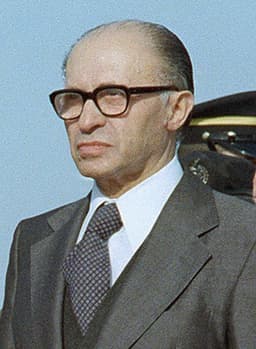
Menachem Begin
Politician · Modern
61.5Total

Napoleon Bonaparte
General · Modern
70.9Total
Basic Information
Born
1913
1769
Died
1992
1821
Era
Modern
Modern
Nationality
Israel
France
Occupation
Politician
General
Civilization
Middle Eastern
Western
Score Comparison
Military (10%)
21.2
94.0
Political (20%)
70.0
72.0
Influence (20%)
82.0
40.0
Legacy (20%)
55.0
80.0
Leadership (15%)
72.0
78.0
Strategy (15%)
38.6
90.0
TOTAL
61.5
70.9
Menachem Begin — Complete Timeline
1946 AD
Irgun Command of the King David Hotel BombingPolitical Action◆ Major
As commander of the Irgun, Begin ordered the bombing of the King David Hotel in Jerusalem, which housed British Mandate offices. The attack killed 91 people and was condemned internationally, but it intensified pressure on Britain to end the Mandate.
IrgunBritish MandateTerrorism
Impact: regionaldestructive
1978 AD
Signing of the Camp David AccordsPolitical Action
As prime minister, Begin signed the Camp David Accords with Egyptian President Anwar Sadat at the White House, brokered by US President Jimmy Carter. The framework led to the 1979 Egypt-Israel Peace Treaty, the first between Israel and an Arab state.
Peace TreatyEgyptCamp David
Impact: globalconstructive
1981 AD
Operation Opera (Iraqi Nuclear Reactor Strike)War◆ Major
Begin authorized the Israeli Air Force to bomb the Osirak nuclear reactor near Baghdad, Iraq. The strike destroyed the reactor, preventing Iraq from developing nuclear weapons, but was widely condemned internationally as a violation of sovereignty.
Nuclear ProliferationIraqPreemptive Strike
Impact: regional
Napoleon Bonaparte — Complete Timeline
1799 AD
Coup of 18 BrumaireOther◆ Major
Napoleon Bonaparte, with support from his brother Lucien and key political figures, overthrew the Directory in a bloodless coup. He established the Consulate with himself as First Consul, effectively becoming the ruler of France. This event ended the French Revolution's most unstable period.
French RevolutionCoupRise to Power
Impact: regional
1804 AD
Promulgation of the Napoleonic CodeOther◆ Major
Napoleon enacted the Civil Code of the French, known as the Napoleonic Code, a comprehensive set of laws that replaced the fragmented feudal legal systems. The code established legal equality, protected property rights, and secularized law. It became the basis for legal systems in many European and world countries.
Legal ReformNapoleonic CodeCivil Law
Impact: globalconstructive
1805 AD
Battle of AusterlitzWar◆ Major
Napoleon's Grande Arm
Napoleonic WarsBattleDecisive Victory
Impact: global
1812 AD
Invasion of RussiaWar◆ Major
Napoleon led the Grande Arm
Napoleonic WarsInvasionDisaster
Impact: globaldestructive
1815 AD
Battle of WaterlooWar◆ Major
Napoleon's French army was defeated by the combined forces of the Duke of Wellington's Anglo-Allied army and Gebhard Leberecht von Bl
Napoleonic WarsBattleFinal Defeat
Impact: globaldestructive
Expert Analysis
menachem-begin-vs-napoleon-bonaparte
# The Corsican and the Commander
On a winter morning in 1978, Menachem Begin stood beside Anwar Sadat at the White House, two men who had been enemies moments before in history’s eye, shaking hands over a document that would reshape the Middle East. One hundred and sixty-three years earlier, Napoleon Bonaparte had boarded a British ship off the coast of Rochefort, surrendering his empire to the same European order he had spent two decades shattering. Both men were revolutionaries turned statesmen. Both rose from obscurity to lead nations. Yet one died in exile on a remote Atlantic island, the other in Jerusalem as a Nobel Peace Prize laureate. The difference between their fates is not merely a matter of luck—it is a story of how power, when unleashed without restraint, consumes itself, while power anchored in a people’s dream can outlast defeat.
Origins
Napoleon was born in 1769 on Corsica, a Mediterranean island that had only recently become French. His family was minor nobility, poor enough to feel the sting of humiliation, proud enough to nurse a grudge. He spoke French with an Italian accent, wore shabby uniforms, and carried the chip of an outsider onto the mainland. The French Revolution, which erupted when he was twenty, tore down the aristocracy and opened every military post to talent. Napoleon seized that opening with ferocious ambition. He was a child of chaos, and chaos became his element.
Menachem Begin was born in 1913 in Brest-Litovsk, then part of the Russian Empire, now in Belarus. His father was a timber merchant and a devout Zionist. When German troops invaded in 1915, the family fled, and young Begin absorbed the lesson that Jews had no home but the one they built themselves. He studied law in Warsaw, but the rise of Nazism and the Soviet invasion of Poland in 1939 shattered his world. Arrested by the NKVD, he spent months in a Siberian labor camp. When released, he joined the Polish army in exile, then made his way to Palestine in 1942. Where Napoleon was forged by opportunity, Begin was forged by persecution. His cause was not personal glory but national survival.
Rise to Power
Napoleon’s ascent was a staircase of victories. At twenty-four, he drove the British out of Toulon. At twenty-six, he crushed a royalist uprising in Paris with a “whiff of grapeshot.” At twenty-seven, he led a ragged army across the Alps into Italy and won six battles in a month. By thirty, he had conquered Egypt and made himself First Consul of France. Each campaign fed the next. He understood that in revolutionary France, legitimacy came from success, and success came from war.
Begin’s rise was slower and more painful. He became commander of the Irgun, the underground militia fighting British rule in Palestine, in 1943. His methods were not Napoleonic battles but guerrilla strikes—and one that would haunt him. On July 22, 1946, he ordered the bombing of the King David Hotel in Jerusalem, which housed the British administrative headquarters. The explosion killed ninety-one people, most of them civilians. The British called it terrorism. Begin called it a necessary blow against an occupying empire. For years afterward, his political rivals—David Ben-Gurion above all—refused to sit with him, branding him a fascist. While Napoleon climbed through glory, Begin climbed through defiance. He did not conquer armies; he outlasted empires.
Leadership & Governance
As emperor, Napoleon ruled with a blend of brilliance and megalomania. He reformed French law with the Napoleonic Code, establishing equality before the law, religious toleration, and merit-based advancement. He built roads, schools, and a centralized bureaucracy that still shapes France. But he also crowned himself, placed his brothers on European thrones, and treated nations as chess pieces. His military genius—rated 94 in strategy—was undeniable, but it was tethered to a political score of 75. He could win battles but could not consolidate peace. His governance was a dictatorship of efficiency, not a republic of consent.
Begin’s leadership was the opposite. His political score of 77.6 reflects a man who governed through coalition, debate, and the messy compromises of democracy. As prime minister from 1977, he shocked the world by reaching out to Egypt’s Anwar Sadat, a former enemy. The Camp David Accords, signed in 1978, returned the Sinai to Egypt and made peace where war had seemed eternal. It was a strategic masterstroke, but it required him to abandon the dream of a Greater Israel. He authorized the bombing of Iraq’s Osirak nuclear reactor in 1981—Operation Opera—a preemptive strike that set back Saddam Hussein’s nuclear program by a decade. That was the old Begin, the underground commander. But he also withdrew from the Sinai, the statesman. He balanced military decisiveness with political restraint.
Triumph & Tragedy
Napoleon’s greatest moment was Austerlitz in 1805, where he destroyed the combined armies of Russia and Austria. His worst was the invasion of Russia in 1812, where he lost half a million men to winter and exhaustion. Then came Waterloo in 1815, where his gamble on a final charge failed. He died on Saint Helena in 1821, isolated and bitter, at fifty-one.
Begin’s triumph was the peace with Egypt, for which he shared the Nobel Peace Prize. His tragedy came later. The 1982 Lebanon War, launched to root out Palestinian fighters, turned into a quagmire. The Sabra and Shatila massacre—where Christian militiamen killed hundreds of Palestinian civilians while the Israeli army surrounded the camps—broke him. An official inquiry found Begin indirectly responsible. He withdrew into depression, resigned in 1983, and spent his last years in seclusion. He died in 1992, mourned but diminished.
Character & Destiny
Napoleon believed he was destiny. “I am not a man,” he once said, “but a thing.” He saw himself as an instrument of history, which justified any cruelty. His ambition was limitless, and so was his loneliness. He divorced Josephine for a Habsburg princess, then lost her too. He trusted no one, and no one trusted him.
Begin was a man of deep sentiment. He wept at the signing of the Camp David Accords. He carried the memory of his parents, murdered in the Holocaust, into every decision. His ambition was not for himself but for the Jewish state. That gave him a moral anchor Napoleon lacked. It also gave him a breaking point. When his actions led to civilian deaths in Lebanon, he could not forgive himself.
Legacy
Napoleon’s legacy is a paradox. He spread the ideals of the French Revolution—nationalism, legal equality, secular governance—across Europe with his conquests. But he also left a trail of war and destruction. His military innovations are still studied. His Napoleonic Code still shapes civil law from France to Louisiana. Yet he is remembered as a cautionary tale: genius without wisdom is catastrophe.
Begin’s legacy is more contained but more stable. He proved that a former underground fighter could govern democratically, that a hawk could make peace, that a small nation could defend itself with surgical strikes and diplomatic courage. He is remembered not as a conqueror but as a builder—of a state, a peace, and a precedent.
Conclusion
Napoleon and Begin both rose from the margins to the center of history. Both wielded power ruthlessly and dreamed of security for their people. But Napoleon’s dream was an empire of one man, and it collapsed under its own weight. Begin’s dream was a homeland for a people, and it endured. The difference lies in what they served. Napoleon served himself, and the world punished him for it. Begin served a cause larger than himself, and the world—grudgingly, incompletely—accepted him. In the end, the Corsican general and the Polish-born prime minister teach us the same lesson: power without purpose is a fire that consumes its bearer. Purpose without power is a prayer. The rare few who hold both, and use one for the other, change the world without being destroyed by it.
Rankings
🥇
Napoleon BonaparteLeader
Mil: 94.0Pol: 72.0Inf: 40.0
70.9
🥈
Menachem Begin
Mil: 21.2Pol: 70.0Inf: 82.0
61.5
+9.4 behind
How This Comparison Works
Algorithm
Each figure is scored on 6 dimensions (0—100 scale) based on structured historical data: Military (10%), Political (20%), Influence (20%), Legacy (20%), Leadership (15%), Strategy (15%). The weighted total produces the final ranking.
Data Sources
Scores are computed from structured sub-indicators in the database. Scale factors adjust for era (Ancient ×0.85, Modern ×1.0) and civilization size (Eastern ×1.05, Other ×0.80) to account for differences in population and military scale.
Maximum 3 Figures
Comparisons are limited to 2—3 figures to ensure readability and statistical meaningfulness.
Error Margins
±5 points per dimension — Sub-scores are derived from historical records with inherent uncertainty. Two figures within 5 points on a dimension should be considered roughly equivalent in that area.
Total Score Accuracy
±3 points overall — The weighted combination of 6 dimensions produces a total score with approximately ±3 points of uncertainty. Differences of less than 3 points are not statistically significant— the figures are effectively tied.
Known Limitations
- Historical records are incomplete and uneven across civilizations
- Figures from oral-tradition societies may be underrepresented
- Occupation labels can misclassify multi-role figures
- Scores measure capability and impact, not moral character
- Quantitative scoring is a comparison tool, not absolute truth
Capability Radar
Military (10%) — Battles & Warfare
Battles
20
95
Win Rate
25
90
Expansion
15
95
Political (20%) — Governance & Reform
Reform
65
95
Diplomacy
85
80
Economy
55
85
Influence (20%) — Cultural & Global Reach
Cultural
60
85
Global
70
90
Legacy (20%) — Historical Impact
Historical
75
95
Longevity
65
90
Leadership (15%) — Power & Stability
Tenure
70
85
Stability
50
70
Strategy (15%) — Tactics & Innovation
Strategy
35
95
Tactics
30
98
Reform
40
92
Similar Comparisons
Comments & Discussion
No comments yet. Be the first to share your thoughts!