Loading...
Michael Wittmann vs Wojciech Jaruzelski
Michael Wittmann leads by 6.3 pts · 2 figures compared
…

Michael Wittmann
General · Modern
58.1Total
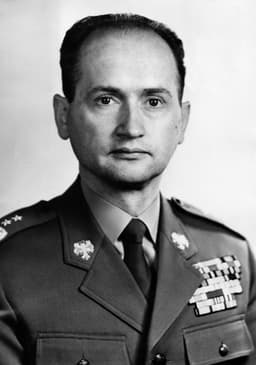
Wojciech Jaruzelski
General · Modern
51.8Total
Basic Information
Born
1914
1923
Died
1944
—
Era
Modern
Modern
Nationality
Germany
Poland
Occupation
General
General
Civilization
Western
Western
Score Comparison
Military (10%)
55.0
50.0
Political (20%)
64.9
45.1
Influence (20%)
55.7
56.4
Legacy (20%)
44.2
47.5
Leadership (15%)
79.2
65.0
Strategy (15%)
60.0
43.3
TOTAL
58.1
51.8
Michael Wittmann — Complete Timeline
1944 AD
Battle of Villers-BocageWar◆ Major
Wittmann, commanding a Tiger tank, ambushed a British armored column near Villers-Bocage, France, on June 13, 1944. He destroyed over 20 tanks and vehicles in a single engagement, temporarily halting the British advance.
Normandy CampaignTank AceAmbush
Death in ActionWar◆ Major
Wittmann was killed in action on August 8, 1944, near Saint-Aignan-de-Cramesnil, France, when his Tiger tank was destroyed by British anti-tank fire. His death marked the end of his career as one of the most famous German tank commanders.
DeathNormandyTank Battle
tragic
Wojciech Jaruzelski — Complete Timeline
1981 AD
Appointment as First Secretary of the Polish United Workers' PartyPolitical Action◆ Major
Jaruzelski became First Secretary of the Polish United Workers' Party (PZPR) amid a deep political and economic crisis. He also held the posts of Prime Minister and Minister of Defense, concentrating power in his hands.
Communist leadership
Impact: national
Imposition of Martial Law in PolandPolitical Action
Jaruzelski declared martial law on December 13, 1981, to crush the Solidarity trade union movement. The military arrested thousands of activists, including Lech Walesa, and suspended civil liberties. The crackdown was widely condemned internationally.
Martial lawRepression
Impact: nationaldestructive
1989 AD
Round Table TalksPolitical Action
Facing mounting pressure and economic collapse, Jaruzelski agreed to Round Table Talks with the opposition, including Solidarity. The talks led to partially free elections, which Solidarity won, marking the beginning of the end of communist rule in Poland.
Political transitionFall of communism
Impact: globalconstructive
1990 AD
Resignation as PresidentPolitical Action◆ Major
Jaruzelski resigned as President of Poland, handing over power to Lech Walesa, the leader of Solidarity. This completed the peaceful transition from communist to democratic rule in Poland.
Political transition
Impact: national
Expert Analysis
Origins
Michael Wittmann was born on April 22, 1914, in Vogelthal, Bavaria, into a farming family. He left school at 16 to work on the family farm before joining the Reichswehr in 1934. His early military career included service in the SS, where he trained as a tank commander. Wittmann's formative experiences came during the early campaigns of World War II, where he honed his skills as a panzer commander.
Wojciech Jaruzelski was born on July 6, 1923, in Kurow, Poland, into a landowning family. His father was a Polish patriot, and the family's estate was confiscated after the Soviet invasion of 1939. Jaruzelski was deported to Siberia, where he worked in labor camps. After the war, he joined the Polish military, attending the Soviet-sponsored Infantry Officers' School. His experiences under Soviet rule shaped his later political decisions.
Rise to Power
Wittmann's rise came through battlefield prowess. He served in the 1st SS Panzer Division Leibstandarte SS Adolf Hitler, earning the Knight's Cross in 1943 after destroying over 100 tanks. His most famous action was the Battle of Villers-Bocage on June 13, 1944, where he single-handedly attacked a British armored column, destroying over 20 tanks and vehicles. This feat made him a propaganda icon in Nazi Germany.
Jaruzelski's rise was political and military. He became a general in the Polish People's Army and served as Minister of National Defense from 1968. Amid the 1980-1981 Solidarity crisis, he was appointed First Secretary of the Polish United Workers' Party on October 18, 1981. His power culminated in the imposition of martial law on December 13, 1981, effectively making him the dictator of Poland.
Leadership & Governance
Wittmann's leadership was tactical and small-scale. He commanded a Tiger tank and later a company, leading by example in combat. His approach was aggressive and direct, focusing on destroying enemy armor. He scored 79.2 in leadership but only 60.0 in strategy, reflecting his limited scope.
Jaruzelski's leadership was political and national. He imposed martial law to suppress Solidarity, arresting thousands and banning strikes. However, he also initiated the Round Table Talks in 1989, leading to semi-free elections and the peaceful transition to democracy. His governance was a mix of repression and pragmatism, scoring 65.0 in leadership and 43.3 in strategy.
Triumph & Tragedy
Wittmann's greatest triumph was Villers-Bocage, where his ambush destroyed 20+ vehicles and disrupted British operations. His greatest tragedy was his death on August 8, 1944, near Saint-Aignan-de-Cramesnil, when his Tiger was hit by British anti-tank fire. He died at age 30, leaving a legacy as a tank ace but with no strategic impact.
Jaruzelski's triumph was the peaceful transition from communism to democracy in Poland. By agreeing to the Round Table Talks, he avoided a violent crackdown and allowed Solidarity to legalize. His tragedy was the heavy-handed martial law, which led to the deaths of at least 100 people and the imprisonment of thousands. He is remembered as a controversial figure who both oppressed and liberated Poland.
Character & Destiny
Wittmann was a loyal soldier, dedicated to his unit and the Nazi regime. He was known for his bravery and skill but lacked political ambition. His destiny was to be a war hero, dying in combat and becoming a symbol of German armored warfare.
Jaruzelski was a pragmatic communist, shaped by his wartime experiences in Siberia. He believed in the necessity of martial law to prevent Soviet invasion. His character was cautious and calculating, but he was also willing to negotiate when pressured. His destiny was to be the last communist leader of Poland, overseeing its transformation.
Legacy
Wittmann's legacy is primarily in military history and popular culture. He is remembered as a tank ace, with his exploits featured in books and games. However, his impact on the war was minimal; he scored 44.2 in legacy. His actions did not change strategic outcomes.
Jaruzelski's legacy is significant. He is a key figure in Poland's transition from communism to democracy. His decision to impose martial law remains controversial, but his role in the Round Table Talks is credited with enabling a peaceful change. He scored 47.5 in legacy, reflecting his complex impact.
Conclusion
Comparing a tank ace to a political general is challenging, but based on historical impact, Wojciech Jaruzelski had a greater influence on history. While Wittmann demonstrated tactical brilliance, his actions were limited to the battlefield and did not alter the course of World War II. Jaruzelski, despite low scores in military (50.0) and strategy (43.3), shaped Poland's destiny through martial law and the Round Table Talks, affecting millions. The total score gap of 6.3 points favors Wittmann, but legacy and influence favor Jaruzelski. In terms of long-term impact, Jaruzelski's decisions led to the end of communism in Poland, a major historical shift. Therefore, Jaruzelski has greater historical significance.
Rankings
🥇
Michael WittmannLeader
Mil: 55.0Pol: 64.9Inf: 55.7
58.1
🥈
Wojciech Jaruzelski
Mil: 50.0Pol: 45.1Inf: 56.4
51.8
+6.3 behind
How This Comparison Works
Algorithm
Each figure is scored on 6 dimensions (0—100 scale) based on structured historical data: Military (10%), Political (20%), Influence (20%), Legacy (20%), Leadership (15%), Strategy (15%). The weighted total produces the final ranking.
Data Sources
Scores are computed from structured sub-indicators in the database. Scale factors adjust for era (Ancient ×0.85, Modern ×1.0) and civilization size (Eastern ×1.05, Other ×0.80) to account for differences in population and military scale.
Maximum 3 Figures
Comparisons are limited to 2—3 figures to ensure readability and statistical meaningfulness.
Error Margins
±5 points per dimension — Sub-scores are derived from historical records with inherent uncertainty. Two figures within 5 points on a dimension should be considered roughly equivalent in that area.
Total Score Accuracy
±3 points overall — The weighted combination of 6 dimensions produces a total score with approximately ±3 points of uncertainty. Differences of less than 3 points are not statistically significant— the figures are effectively tied.
Known Limitations
- Historical records are incomplete and uneven across civilizations
- Figures from oral-tradition societies may be underrepresented
- Occupation labels can misclassify multi-role figures
- Scores measure capability and impact, not moral character
- Quantitative scoring is a comparison tool, not absolute truth
Capability Radar
Military (10%) — Battles & Warfare
Battles
35
20
Win Rate
40
25
Expansion
5
10
Political (20%) — Governance & Reform
Reform
61
30
Diplomacy
67
40
Economy
70
25
Influence (20%) — Cultural & Global Reach
Cultural
30
30
Global
15
40
Legacy (20%) — Historical Impact
Historical
35
45
Longevity
20
30
Leadership (15%) — Power & Stability
Tenure
59
60
Stability
70
20
Strategy (15%) — Tactics & Innovation
Strategy
20
40
Tactics
65
30
Reform
0
35
Similar Comparisons
Comments & Discussion
No comments yet. Be the first to share your thoughts!