Loading...
Toussaint Breda vs Wojciech Jaruzelski
Toussaint Breda leads by 13.7 pts · 2 figures compared
…

Toussaint Breda
General · Modern
65.5Total
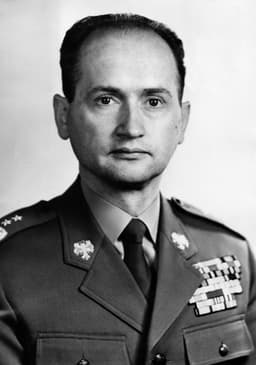
Wojciech Jaruzelski
General · Modern
51.8Total
Basic Information
Born
1743
1923
Died
1803
—
Era
Modern
Modern
Nationality
Haiti
Poland
Occupation
General
General
Civilization
Other
Western
Score Comparison
Military (10%)
76.0
50.0
Political (20%)
82.0
45.1
Influence (20%)
40.0
56.4
Legacy (20%)
75.0
47.5
Leadership (15%)
62.0
65.0
Strategy (15%)
75.3
43.3
TOTAL
65.5
51.8
Toussaint Breda — Complete Timeline
1791 AD
Joined French Army as OfficerPolitical Action◆ Major
Toussaint Breda joined the French colonial army in Saint-Domingue as a military officer after the outbreak of the Haitian Revolution. He initially fought alongside the Spanish against the French, but later switched allegiance to the French Republic when it abolished slavery in 1794. This decision positioned him as a key leader.
MilitaryAllegianceRevolution
Impact: regional
1798 AD
Defeated British Invasion ForceWar◆ Major
Toussaint Breda led the Haitian army to defeat a British invasion force that had occupied parts of Saint-Domingue since 1793. Through a combination of military tactics and diplomacy, he forced the British to withdraw in 1798, securing Haitian control over the colony and establishing himself as the dominant military leader.
BattleVictoryBritish
Impact: regional
1801 AD
Became Governor-General of Saint-DominguePolitical Action
Toussaint Breda appointed himself Governor-General for life of Saint-Domingue in 1801, consolidating political and military control over the colony. He issued a constitution that abolished slavery permanently and declared Saint-Domingue autonomous, though still nominally part of the French Empire. This act challenged Napoleon's authority.
GovernorConstitutionAutonomy
Impact: regionalconstructive
1802 AD
Captured by French ForcesWar◆ Major
Toussaint Breda was captured by French forces under General Charles Leclerc during Napoleon's expedition to restore slavery in Saint-Domingue. He was arrested under a flag of truce and deported to France, where he was imprisoned at Fort de Joux. His capture removed the revolution's most capable leader.
CaptureBetrayalImprisonment
Impact: regionaltragic
1803 AD
Died in French PrisonPolitical Action◆ Major
Toussaint Breda died on April 7, 1803, at Fort de Joux in the French Jura mountains, likely from pneumonia, starvation, and neglect. His death in captivity made him a martyr for the Haitian Revolution, which continued under Jean-Jacques Dessalines and achieved independence later that year.
DeathMartyrImprisonment
Impact: regionaltragic
Wojciech Jaruzelski — Complete Timeline
1981 AD
Appointment as First Secretary of the Polish United Workers' PartyPolitical Action◆ Major
Jaruzelski became First Secretary of the Polish United Workers' Party (PZPR) amid a deep political and economic crisis. He also held the posts of Prime Minister and Minister of Defense, concentrating power in his hands.
Communist leadership
Impact: national
Imposition of Martial Law in PolandPolitical Action
Jaruzelski declared martial law on December 13, 1981, to crush the Solidarity trade union movement. The military arrested thousands of activists, including Lech Walesa, and suspended civil liberties. The crackdown was widely condemned internationally.
Martial lawRepression
Impact: nationaldestructive
1989 AD
Round Table TalksPolitical Action
Facing mounting pressure and economic collapse, Jaruzelski agreed to Round Table Talks with the opposition, including Solidarity. The talks led to partially free elections, which Solidarity won, marking the beginning of the end of communist rule in Poland.
Political transitionFall of communism
Impact: globalconstructive
1990 AD
Resignation as PresidentPolitical Action◆ Major
Jaruzelski resigned as President of Poland, handing over power to Lech Walesa, the leader of Solidarity. This completed the peaceful transition from communist to democratic rule in Poland.
Political transition
Impact: national
Expert Analysis
Origins
Toussaint Breda, later known as Toussaint Louverture, was born into slavery around 1743 on the Breda plantation in Saint-Domingue (modern Haiti). His father was an enslaved prince from Dahomey. Toussaint learned to read and write from a Jesuit tutor, gaining knowledge of military tactics and Enlightenment philosophy. He worked as a coachman and steward, acquiring leadership skills. In 1791, he joined the slave revolt that ignited the Haitian Revolution, initially fighting for the Spanish royalists before switching to the French side.
Wojciech Jaruzelski was born on July 6, 1923, in Kurów, Poland, into a landowning family. His father was a nobleman and soldier. During World War II, his family was deported to Siberia by the Soviets; Jaruzelski lost his father to starvation. He later joined the Soviet-backed Polish People's Army, studying at the Soviet Infantry School. His wartime experiences shaped his loyalty to the Communist regime.
Rise to Power
Toussaint Louverture rose rapidly after 1793, when he offered his services to the French Republic. By 1795, he was a brigadier general. He expelled Spanish and British forces from the colony. In 1799, he defeated rival black leader André Rigaud in the War of Knives, consolidating control. In 1801, he invaded Spanish Santo Domingo and freed the slaves there. He then appointed himself Governor-General for life, drafting a constitution that abolished slavery and made him de facto ruler.
Jaruzelski rose through the Polish military. He became a general in 1960 and served as Minister of National Defense from 1968. In 1981, amid economic crisis and the rise of Solidarity, he was appointed First Secretary of the Polish United Workers' Party. He also held the posts of Prime Minister and Chairman of the Council of State, concentrating power.
Leadership & Governance
Toussaint's leadership was autocratic but pragmatic. He restored plantations using paid labor, enforced by military discipline. He promoted foreign trade and maintained a standing army. His governance focused on stability and preventing a return to slavery. He forced former slaveholders to return, but kept them as managers. His constitution named him governor for life with near-absolute power.
Jaruzelski imposed martial law on December 13, 1981, using the military to crush Solidarity. He arrested thousands of activists, suspended civil liberties, and banned trade unions. His regime was authoritarian but later engaged in talks with the opposition. In 1989, he led the Round Table Talks that resulted in semi-free elections, eventually handing power to Lech Walesa.
Triumph & Tragedy
Toussaint's greatest triumph was defeating the British invasion force in 1798, securing Haitian independence. He also negotiated a treaty with the United States. However, his tragedy came when he trusted Napoleon's promises. He was captured by French forces in 1802 and died in a French prison in 1803, never seeing Haiti's full independence.
Jaruzelski's triumph was overseeing a peaceful transition from communism to democracy, avoiding a potential civil war. He also stabilized Poland's economy temporarily. His tragedy is being remembered as the man who crushed Solidarity with martial law, responsible for political repression and economic hardship. His legacy is deeply controversial.
Character & Destiny
Toussaint was a master strategist and diplomat, but his hubris led him to overestimate his control over the colony and trust Napoleon. His decision to appoint himself governor for life alienated some supporters. He scored 62.0 in leadership, reflecting his autocratic style.
Jaruzelski was a disciplined, calculating figure who saw himself as a patriot saving Poland from Soviet invasion. He scored 65.0 in leadership, but his political score of 45.1 indicates his failure to maintain legitimacy. His character was shaped by loyalty to the Communist system, yet he ultimately oversaw its dismantling.
Legacy
Toussaint's legacy is immense: he inspired the only successful slave revolt in history, leading to Haiti's independence. His military and political strategies influenced later anticolonial leaders. He scored 75.0 in legacy. His constitution and leadership laid the groundwork for Haiti's early years.
Jaruzelski's legacy is mixed. In Poland, he is often vilified for martial law, but some credit him for the peaceful transition. His score of 47.5 reflects his negative perception. He is a symbol of Communist authoritarianism, yet his role in the Round Table Talks is acknowledged. His actions shaped Poland's post-communist trajectory.
Conclusion
Toussaint Louverture had a greater impact on history. His military score of 76.0 and political score of 82.0 far exceed Jaruzelski's 50.0 and 45.1. Toussaint's actions ended slavery in Haiti and inspired revolutions worldwide. Jaruzelski's martial law suppressed freedom temporarily, but his eventual capitulation to Solidarity was a victory for democracy. However, Toussaint's transformative, irreversible change—the abolition of slavery and establishment of an independent state—outweighs Jaruzelski's transitional role. The score gap of 13.7 points reflects this. Toussaint's legacy endures as a beacon of liberation, while Jaruzelski is largely a footnote in Poland's journey to freedom.
Rankings
🥇
Toussaint BredaLeader
Mil: 76.0Pol: 82.0Inf: 40.0
65.5
🥈
Wojciech Jaruzelski
Mil: 50.0Pol: 45.1Inf: 56.4
51.8
+13.7 behind
How This Comparison Works
Algorithm
Each figure is scored on 6 dimensions (0—100 scale) based on structured historical data: Military (10%), Political (20%), Influence (20%), Legacy (20%), Leadership (15%), Strategy (15%). The weighted total produces the final ranking.
Data Sources
Scores are computed from structured sub-indicators in the database. Scale factors adjust for era (Ancient ×0.85, Modern ×1.0) and civilization size (Eastern ×1.05, Other ×0.80) to account for differences in population and military scale.
Maximum 3 Figures
Comparisons are limited to 2—3 figures to ensure readability and statistical meaningfulness.
Error Margins
±5 points per dimension — Sub-scores are derived from historical records with inherent uncertainty. Two figures within 5 points on a dimension should be considered roughly equivalent in that area.
Total Score Accuracy
±3 points overall — The weighted combination of 6 dimensions produces a total score with approximately ±3 points of uncertainty. Differences of less than 3 points are not statistically significant— the figures are effectively tied.
Known Limitations
- Historical records are incomplete and uneven across civilizations
- Figures from oral-tradition societies may be underrepresented
- Occupation labels can misclassify multi-role figures
- Scores measure capability and impact, not moral character
- Quantitative scoring is a comparison tool, not absolute truth
Capability Radar
Military (10%) — Battles & Warfare
Battles
75
20
Win Rate
85
25
Expansion
70
10
Political (20%) — Governance & Reform
Reform
85
30
Diplomacy
80
40
Economy
70
25
Influence (20%) — Cultural & Global Reach
Cultural
85
30
Global
80
40
Legacy (20%) — Historical Impact
Historical
90
45
Longevity
85
30
Leadership (15%) — Power & Stability
Tenure
65
60
Stability
60
20
Strategy (15%) — Tactics & Innovation
Strategy
88
40
Tactics
90
30
Reform
80
35
Similar Comparisons
Comments & Discussion
No comments yet. Be the first to share your thoughts!