Loading...
Shimazu Yoshihiro vs Wojciech Jaruzelski
Shimazu Yoshihiro leads by 2.9 pts · 2 figures compared
…

Shimazu Yoshihiro
General · Modern
54.7Total
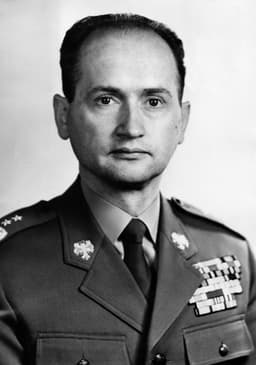
Wojciech Jaruzelski
General · Modern
51.8Total
Basic Information
Born
1535
1923
Died
1619
—
Era
Modern
Modern
Nationality
Japan
Poland
Occupation
General
General
Civilization
Eastern
Western
Score Comparison
Military (10%)
63.3
50.0
Political (20%)
42.2
45.1
Influence (20%)
61.0
56.4
Legacy (20%)
50.0
47.5
Leadership (15%)
62.0
65.0
Strategy (15%)
50.0
43.3
TOTAL
54.7
51.8
Shimazu Yoshihiro — Complete Timeline
1578 AD
Battle of MimigawaWar◆ Major
Shimazu Yoshihiro led the Shimazu clan to victory against the Otomo clan at the Battle of Mimigawa. Using a pincer movement, the Shimazu forces destroyed the Otomo army, expanding their territory in Kyushu.
Sengoku PeriodBattleKyushu
Impact: regionalconstructive
1587 AD
Siege of Udo CastleWar
Shimazu Yoshihiro besieged Udo Castle in Higo Province during Toyotomi Hideyoshi's Kyushu campaign. The castle fell after a prolonged siege, but the Shimazu clan ultimately submitted to Hideyoshi.
Sengoku PeriodSiegeKyushu Campaign
Impact: regional
1592 AD
Invasion of KoreaWar◆ Major
Shimazu Yoshihiro participated in Toyotomi Hideyoshi's invasion of Korea. He led forces in several battles, including the capture of Gyeongju, and gained a reputation for fierce fighting.
Imjin WarInvasionKorea
Impact: regionaldestructive
1600 AD
Battle of SekigaharaWar
Shimazu Yoshihiro fought for the Western Army at Sekigahara. His forces engaged Tokugawa Ieyasu's troops but were eventually forced to retreat. Yoshihiro survived the battle and returned to Satsuma.
Sengoku PeriodBattleWestern Army
Impact: nationaldestructive
Wojciech Jaruzelski — Complete Timeline
1981 AD
Appointment as First Secretary of the Polish United Workers' PartyPolitical Action◆ Major
Jaruzelski became First Secretary of the Polish United Workers' Party (PZPR) amid a deep political and economic crisis. He also held the posts of Prime Minister and Minister of Defense, concentrating power in his hands.
Communist leadership
Impact: national
Imposition of Martial Law in PolandPolitical Action
Jaruzelski declared martial law on December 13, 1981, to crush the Solidarity trade union movement. The military arrested thousands of activists, including Lech Walesa, and suspended civil liberties. The crackdown was widely condemned internationally.
Martial lawRepression
Impact: nationaldestructive
1989 AD
Round Table TalksPolitical Action
Facing mounting pressure and economic collapse, Jaruzelski agreed to Round Table Talks with the opposition, including Solidarity. The talks led to partially free elections, which Solidarity won, marking the beginning of the end of communist rule in Poland.
Political transitionFall of communism
Impact: globalconstructive
1990 AD
Resignation as PresidentPolitical Action◆ Major
Jaruzelski resigned as President of Poland, handing over power to Lech Walesa, the leader of Solidarity. This completed the peaceful transition from communist to democratic rule in Poland.
Political transition
Impact: national
Expert Analysis
Origins
Shimazu Yoshihiro was born in 1535 into the powerful Shimazu clan of Satsuma domain in southern Kyushu, Japan. As the fourth son of Shimazu Takahisa, he was raised in a samurai household steeped in military tradition. His early training focused on swordsmanship and strategy. Wojciech Jaruzelski was born on July 6, 1923, in Kurów, Poland, into a landowning family. His father fought in the Polish-Soviet War. After the Soviet invasion of 1939, his family was deported to Siberia, where his father died. Jaruzelski was conscripted into the Soviet-backed Polish Army in 1943.
Rise to Power
Yoshihiro rose through the Shimazu clan's ranks, distinguishing himself in the 1570s. At the Battle of Mimigawa in 1578, he led a pincer movement that destroyed the Otomo army, cementing his reputation. He fought in Hideyoshi's Kyushu campaign (1587) and later in the Korean invasions (1592-1598), where he captured Gyeongju and gained notoriety for his ferocity. Jaruzelski rose through the Polish communist hierarchy, becoming Minister of Defense in 1968. He was appointed First Secretary of the Polish United Workers' Party in October 1981 amid economic crisis and the rise of Solidarity. On December 13, 1981, he declared martial law, arresting thousands of Solidarity activists.
Leadership & Governance
Yoshihiro's leadership was defined by aggressive tactics and clan loyalty. At the Battle of Sekigahara in 1600, he fought for the Western Army and led a desperate charge against Tokugawa forces, but his refusal to coordinate with allies contributed to defeat. Afterward, he retreated and later submitted to the Tokugawa, preserving his clan. Jaruzelski governed through military force, imposing martial law with 70,000 soldiers and 30,000 police. He also pursued economic reforms and eventually initiated the Round Table Talks in 1989, which led to semi-free elections and the peaceful transition of power.
Triumph & Tragedy
Yoshihiro's greatest success was the Battle of Mimigawa (1578), where his tactical brilliance annihilated a larger Otomo force. His participation in the Korean invasion also demonstrated his military capability. However, his tragedy came at Sekigahara: his forces suffered heavy losses, and his clan's power waned. He scored 63.3 in military, reflecting his battlefield prowess but limited strategic impact. Jaruzelski's triumph was overseeing a bloodless transition from communism, but his imposition of martial law caused suffering: 91 deaths, 10,000 imprisoned, and economic stagnation. He scored 50.0 in military and 45.1 in politics, indicating his conflicted legacy.
Character & Destiny
Yoshihiro was known for his fierce independence and epithet "Demon of Satsuma." His refusal to retreat at Sekigahara nearly cost him everything, but his later submission showed pragmatism. Jaruzelski was a disciplined communist who believed martial law was necessary to prevent Soviet invasion. He later said he felt "tragic necessity." Both men were products of their eras, but Yoshihiro's fate was sealed on the battlefield, while Jaruzelski's was shaped by Cold War geopolitics.
Legacy
Yoshihiro is remembered as a symbol of samurai valor, especially in Satsuma. His military tactics influenced later Japanese warfare. He scores 50.0 in legacy. Jaruzelski's legacy is deeply polarizing: some credit him for avoiding a bloody Soviet crackdown, while others condemn his repression. His score of 47.5 reflects this division. The Round Table Talks he initiated led to Poland's democratic transition and inspired other Eastern Bloc countries.
Conclusion
While Yoshihiro was a skilled general (military 63.3), Jaruzelski's actions had a broader geopolitical impact. Jaruzelski's martial law and subsequent reforms directly led to the end of communist rule in Poland, influencing the collapse of the Soviet bloc. Yoshihiro's military achievements were significant but confined to regional conflicts. Therefore, Wojciech Jaruzelski had greater historical impact due to his role in shaping modern Europe, despite his lower total score of 51.8 versus Yoshihiro's 54.7.
Rankings
🥇
Shimazu YoshihiroLeader
Mil: 63.3Pol: 42.2Inf: 61.0
54.7
🥈
Wojciech Jaruzelski
Mil: 50.0Pol: 45.1Inf: 56.4
51.8
+2.9 behind
How This Comparison Works
Algorithm
Each figure is scored on 6 dimensions (0—100 scale) based on structured historical data: Military (10%), Political (20%), Influence (20%), Legacy (20%), Leadership (15%), Strategy (15%). The weighted total produces the final ranking.
Data Sources
Scores are computed from structured sub-indicators in the database. Scale factors adjust for era (Ancient ×0.85, Modern ×1.0) and civilization size (Eastern ×1.05, Other ×0.80) to account for differences in population and military scale.
Maximum 3 Figures
Comparisons are limited to 2—3 figures to ensure readability and statistical meaningfulness.
Error Margins
±5 points per dimension — Sub-scores are derived from historical records with inherent uncertainty. Two figures within 5 points on a dimension should be considered roughly equivalent in that area.
Total Score Accuracy
±3 points overall — The weighted combination of 6 dimensions produces a total score with approximately ±3 points of uncertainty. Differences of less than 3 points are not statistically significant— the figures are effectively tied.
Known Limitations
- Historical records are incomplete and uneven across civilizations
- Figures from oral-tradition societies may be underrepresented
- Occupation labels can misclassify multi-role figures
- Scores measure capability and impact, not moral character
- Quantitative scoring is a comparison tool, not absolute truth
Capability Radar
Military (10%) — Battles & Warfare
Battles
65
20
Win Rate
70
25
Expansion
55
10
Political (20%) — Governance & Reform
Reform
20
30
Diplomacy
40
40
Economy
25
25
Influence (20%) — Cultural & Global Reach
Cultural
45
30
Global
30
40
Legacy (20%) — Historical Impact
Historical
50
45
Longevity
40
30
Leadership (15%) — Power & Stability
Tenure
50
60
Stability
35
20
Strategy (15%) — Tactics & Innovation
Strategy
60
40
Tactics
75
30
Reform
30
35
Similar Comparisons
Comments & Discussion
No comments yet. Be the first to share your thoughts!