Loading...
Milton Obote vs Thomas Osborne
Thomas Osborne leads by 4.7 pts · 2 figures compared
…
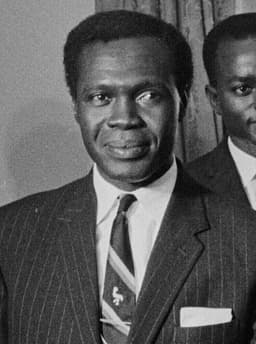
Milton Obote
Politician · Modern
50.4Total

Thomas Osborne
Politician · Modern
55.1Total
Basic Information
Born
1925
1632
Died
—
1712
Era
Modern
Modern
Nationality
Uganda
England
Occupation
Politician
Politician
Civilization
Other
Western
Score Comparison
Military (10%)
41.6
48.0
Political (20%)
46.6
68.0
Influence (20%)
51.8
52.5
Legacy (20%)
43.3
46.7
Leadership (15%)
67.0
74.0
Strategy (15%)
53.8
42.5
TOTAL
50.4
55.1
Milton Obote — Complete Timeline
1962 AD
Became first Prime Minister of independent UgandaPolitical Action◆ Major
Milton Obote became the first Prime Minister of Uganda upon independence from Britain. He led a coalition government with the Kabaka Yekka party, marking the beginning of his political dominance.
IndependencePrime MinisterUganda
Impact: nationalconstructive
1966 AD
Suspended the constitution and assumed executive powersPolitical Action◆ Major
Obote suspended the constitution, abolished the federal system, and assumed executive powers, effectively making himself President. He also ordered the arrest of several ministers and attacked the Lubiri Palace, forcing the Kabaka into exile.
Constitutional CrisisPower GrabKabaka Crisis
Impact: nationaldestructive
1971 AD
Overthrown by Idi AminPolitical Action◆ Major
While attending a Commonwealth summit in Singapore, Obote was overthrown in a military coup led by his army commander Idi Amin. Obote went into exile in Tanzania, beginning eight years of Amin's brutal rule.
CoupExileIdi Amin
Impact: nationaltragic
1980 AD
Returned to power after Tanzanian invasionWar◆ Major
Obote returned to Uganda after the Tanzanian army and Ugandan rebels overthrew Idi Amin. He won the 1980 general election, which was widely criticized as rigged, and became President again.
Return to PowerElectionTanzania
Impact: national
1985 AD
Second overthrow and exilePolitical Action◆ Major
Obote was overthrown for a second time by his own army commanders, led by Tito Okello and Bazilio Olara-Okello. He fled to Zambia, where he remained in exile until his death in 2005.
CoupExileEnd of Presidency
Impact: nationaltragic
Thomas Osborne — Complete Timeline
1673 AD
Appointed Lord Treasurer and created Earl of DanbyPolitical Action◆ Major
Charles II appointed Thomas Osborne as Lord Treasurer and created him Earl of Danby. Danby became the king's chief minister, working to restore royal finances and reduce dependence on French subsidies.
Lord TreasurerCharles IIFinance
Impact: nationalconstructive
1678 AD
Impeached for secret dealings with FrancePolitical Action◆ Major
During the Popish Plot hysteria, Parliament impeached Danby for secretly negotiating with France without Parliament's consent. He was imprisoned in the Tower of London for five years, though he avoided execution through a royal pardon.
ImpeachmentPopish PlotTower of London
Impact: nationaltragic
1688 AD
Instrumental in the Glorious RevolutionPolitical Action
Danby was one of the 'Immortal Seven' who invited William of Orange to invade England. He raised troops in Yorkshire to support William, helping to secure the overthrow of James II and the establishment of William and Mary as joint monarchs.
Glorious RevolutionWilliam of OrangeInvitation
Impact: nationalconstructive
Expert Analysis
Origins
Milton Obote was born on December 28, 1925, in Akokoro, Uganda, to a Lango chief. He attended Busoga College and Makerere University, but was expelled for political activism. He later worked in Kenya and returned to Uganda to enter politics. Thomas Osborne was born on February 20, 1632, in York, England, into a Royalist family. He studied at Cambridge but left without a degree. He entered Parliament in 1665 and quickly rose through the ranks under Charles II.
Rise to Power
Obote rose to prominence as a leader of the Uganda National Congress, later forming the Uganda People's Congress (UPC). In 1962, he became Prime Minister after leading a coalition with the Kabaka Yekka party. In 1966, he suspended the constitution, abolished the federal system, and assumed executive powers, making himself President. He also ordered the attack on the Lubiri Palace, forcing the Kabaka into exile. Osborne rose as a loyalist of Charles II. He was appointed Lord Treasurer in 1673 and created Earl of Danby. He became the king's chief minister, working to restore royal authority and secure funding through secret negotiations with France. His downfall came during the Popish Plot hysteria when Parliament impeached him for those secret dealings. He was imprisoned in the Tower of London for five years.
Leadership & Governance
Obote's leadership was characterized by centralization of power and suppression of opposition. He implemented socialist policies, including the "Common Man's Charter," and nationalized industries. However, his governance was marred by corruption and ethnic tensions. His political score of 46.6 reflects his inability to maintain stability. Osborne's leadership was more effective within the constraints of English constitutional monarchy. He managed royal finances and built a court party, but his secret dealings with France undermined trust. His political score of 68.0 indicates better governance, but his strategy score of 42.5 shows short-term thinking.
Triumph & Tragedy
Obote's greatest triumph was leading Uganda to independence in 1962. His tragedy was being overthrown twice, first by Idi Amin in 1971 and then by his own commanders in 1985. His military score of 41.6 reflects his weak control over the army. Osborne's triumph was his role in the Glorious Revolution of 1688, as one of the 'Immortal Seven' who invited William of Orange. His tragedy was his impeachment and imprisonment, which ended his career. His leadership score of 74.0 highlights his ability to navigate crises, but his legacy score of 46.7 shows limited long-term impact.
Character & Destiny
Obote was ambitious and ruthless, but lacked strategic foresight. His decision to trust Idi Amin led to his downfall. His leadership score of 67.0 suggests competence, but his influence score of 51.8 indicates limited reach. Osborne was skilled at political maneuvering but overreached. His secret dealings with France were exposed, leading to impeachment. His character was that of a pragmatist, but his destiny was shaped by the volatile politics of Restoration England.
Legacy
Obote's legacy is mixed. He is remembered as a founding father of Uganda but also as a leader whose policies led to instability. His legacy score of 43.3 reflects this. Osborne's legacy is as a key figure in the Glorious Revolution, which established constitutional monarchy in England. However, his methods were controversial. His legacy score of 46.7 is slightly higher, but his influence score of 52.5 versus Obote's 51.8 shows similar reach.
Conclusion
While Obote scored 50.4 and Osborne 55.1, the 4.7-point gap is not decisive. However, Osborne's role in the Glorious Revolution had a lasting impact on English governance, whereas Obote's rule ultimately led to decades of instability in Uganda. Therefore, Thomas Osborne had a greater overall impact, as his actions helped shape modern British constitutional monarchy, while Obote's legacy is more ambiguous.
Rankings
🥇
Thomas OsborneLeader
Mil: 48.0Pol: 68.0Inf: 52.5
55.1
🥈
Milton Obote
Mil: 41.6Pol: 46.6Inf: 51.8
50.4
+4.7 behind
How This Comparison Works
Algorithm
Each figure is scored on 6 dimensions (0—100 scale) based on structured historical data: Military (10%), Political (20%), Influence (20%), Legacy (20%), Leadership (15%), Strategy (15%). The weighted total produces the final ranking.
Data Sources
Scores are computed from structured sub-indicators in the database. Scale factors adjust for era (Ancient ×0.85, Modern ×1.0) and civilization size (Eastern ×1.05, Other ×0.80) to account for differences in population and military scale.
Maximum 3 Figures
Comparisons are limited to 2—3 figures to ensure readability and statistical meaningfulness.
Error Margins
±5 points per dimension — Sub-scores are derived from historical records with inherent uncertainty. Two figures within 5 points on a dimension should be considered roughly equivalent in that area.
Total Score Accuracy
±3 points overall — The weighted combination of 6 dimensions produces a total score with approximately ±3 points of uncertainty. Differences of less than 3 points are not statistically significant— the figures are effectively tied.
Known Limitations
- Historical records are incomplete and uneven across civilizations
- Figures from oral-tradition societies may be underrepresented
- Occupation labels can misclassify multi-role figures
- Scores measure capability and impact, not moral character
- Quantitative scoring is a comparison tool, not absolute truth
Capability Radar
Military (10%) — Battles & Warfare
Battles
10
31
Win Rate
10
34
Expansion
10
35
Political (20%) — Governance & Reform
Reform
40
55
Diplomacy
30
45
Economy
30
50
Influence (20%) — Cultural & Global Reach
Cultural
20
20
Global
20
25
Legacy (20%) — Historical Impact
Historical
40
40
Longevity
20
30
Leadership (15%) — Power & Stability
Tenure
55
60
Stability
15
30
Strategy (15%) — Tactics & Innovation
Strategy
10
40
Tactics
10
41
Reform
15
42
Similar Comparisons
Comments & Discussion
No comments yet. Be the first to share your thoughts!