Loading...
Milton Obote vs Napoleon Bonaparte
Napoleon Bonaparte leads by 20.5 pts · 2 figures compared
…
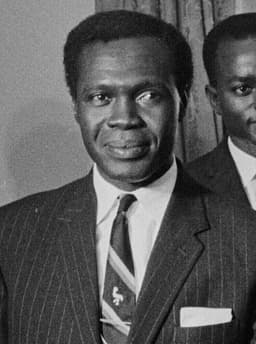
Milton Obote
Politician · Modern
50.4Total

Napoleon Bonaparte
General · Modern
70.9Total
Basic Information
Born
1925
1769
Died
—
1821
Era
Modern
Modern
Nationality
Uganda
France
Occupation
Politician
General
Civilization
Other
Western
Score Comparison
Military (10%)
41.6
94.0
Political (20%)
46.6
72.0
Influence (20%)
51.8
40.0
Legacy (20%)
43.3
80.0
Leadership (15%)
67.0
78.0
Strategy (15%)
53.8
90.0
TOTAL
50.4
70.9
Milton Obote — Complete Timeline
1962 AD
Became first Prime Minister of independent UgandaPolitical Action◆ Major
Milton Obote became the first Prime Minister of Uganda upon independence from Britain. He led a coalition government with the Kabaka Yekka party, marking the beginning of his political dominance.
IndependencePrime MinisterUganda
Impact: nationalconstructive
1966 AD
Suspended the constitution and assumed executive powersPolitical Action◆ Major
Obote suspended the constitution, abolished the federal system, and assumed executive powers, effectively making himself President. He also ordered the arrest of several ministers and attacked the Lubiri Palace, forcing the Kabaka into exile.
Constitutional CrisisPower GrabKabaka Crisis
Impact: nationaldestructive
1971 AD
Overthrown by Idi AminPolitical Action◆ Major
While attending a Commonwealth summit in Singapore, Obote was overthrown in a military coup led by his army commander Idi Amin. Obote went into exile in Tanzania, beginning eight years of Amin's brutal rule.
CoupExileIdi Amin
Impact: nationaltragic
1980 AD
Returned to power after Tanzanian invasionWar◆ Major
Obote returned to Uganda after the Tanzanian army and Ugandan rebels overthrew Idi Amin. He won the 1980 general election, which was widely criticized as rigged, and became President again.
Return to PowerElectionTanzania
Impact: national
1985 AD
Second overthrow and exilePolitical Action◆ Major
Obote was overthrown for a second time by his own army commanders, led by Tito Okello and Bazilio Olara-Okello. He fled to Zambia, where he remained in exile until his death in 2005.
CoupExileEnd of Presidency
Impact: nationaltragic
Napoleon Bonaparte — Complete Timeline
1799 AD
Coup of 18 BrumaireOther◆ Major
Napoleon Bonaparte, with support from his brother Lucien and key political figures, overthrew the Directory in a bloodless coup. He established the Consulate with himself as First Consul, effectively becoming the ruler of France. This event ended the French Revolution's most unstable period.
French RevolutionCoupRise to Power
Impact: regional
1804 AD
Promulgation of the Napoleonic CodeOther◆ Major
Napoleon enacted the Civil Code of the French, known as the Napoleonic Code, a comprehensive set of laws that replaced the fragmented feudal legal systems. The code established legal equality, protected property rights, and secularized law. It became the basis for legal systems in many European and world countries.
Legal ReformNapoleonic CodeCivil Law
Impact: globalconstructive
1805 AD
Battle of AusterlitzWar◆ Major
Napoleon's Grande Arm
Napoleonic WarsBattleDecisive Victory
Impact: global
1812 AD
Invasion of RussiaWar◆ Major
Napoleon led the Grande Arm
Napoleonic WarsInvasionDisaster
Impact: globaldestructive
1815 AD
Battle of WaterlooWar◆ Major
Napoleon's French army was defeated by the combined forces of the Duke of Wellington's Anglo-Allied army and Gebhard Leberecht von Bl
Napoleonic WarsBattleFinal Defeat
Impact: globaldestructive
Expert Analysis
milton-obote-vs-napoleon-bonaparte
# The Emperor and the Bureaucrat: Two Paths to Power, Two Destinies
On a June morning in 1815, Napoleon Bonaparte surveyed the muddy fields of Waterloo, his grand army poised for what would be the final act of his epic drama. Across the continent and more than a century later, in the sweltering heat of Kampala in 1971, Milton Obote boarded a plane for Singapore, never imagining he would never again rule the country he had helped birth. Both men rose from modest beginnings to lead nations, yet their stories could not have diverged more sharply—one a titan whose shadow still falls across Europe, the other a cautionary figure whose name barely echoes beyond the borders of his troubled land. What drove such different outcomes?
Origins
Napoleon was born in 1769 on the island of Corsica, a place only recently annexed by France. His family belonged to the minor nobility, but they were poor, and young Napoleon spoke French with a thick Italian accent that invited mockery at military school. This outsider status forged in him a hunger for recognition that would never be satisfied. The French Revolution, which erupted when he was twenty, shattered the old order and opened paths that birth alone could never have granted. A young artillery officer with talent and ambition could suddenly rise to command armies.
Milton Obote entered the world in 1925 in the Lango region of Uganda, then a British protectorate. His father was a tribal chief, giving Obote a foothold in the colonial hierarchy. He attended prestigious missionary schools and briefly studied in Kenya before returning to Uganda to work in the colonial administration. The winds of African independence were already stirring. Obote, like Napoleon, was an outsider—a northerner in a country where the south dominated politics and commerce. He too would ride a revolutionary wave, but his revolution was the end of empire, not the overthrow of a monarchy.
Rise to Power
Napoleon’s ascent was meteoric. By 1796, at just twenty-six, he commanded the French army in Italy, where his lightning campaigns stunned Europe. He understood something his opponents did not: war was not about siege lines and cautious maneuvers but about speed, audacity, and the destruction of enemy armies. His 1798 Egyptian expedition, though ultimately a strategic failure, burnished his legend. In 1799, he returned to a France weary of corruption and chaos, and in the coup of 18 Brumaire, he seized power as First Consul. Five years later, he crowned himself Emperor.
Obote’s rise was slower, more political. In 1962, when Uganda achieved independence from Britain, he became the country’s first Prime Minister, leading a fragile coalition. He was a master of compromise, stitching together alliances between northern and southern factions, between traditional kingdoms and modern political parties. But power in post-colonial Africa was a dangerous game. In 1966, he suspended the constitution, abolished the federal system, and assumed executive powers, effectively making himself president. His former ally, the Kabaka (king) of Buganda, was forced into exile. Obote had consolidated control, but at the cost of the very democratic institutions he had helped create.
Leadership & Governance
Napoleon governed with a vision that transformed France. The Napoleonic Code, introduced in 1804, standardized laws across the nation, enshrining principles of equality before the law and protection of property rights—though not for women or slaves. He reformed education, established the Bank of France, and built roads and canals that knit the country together. His military genius was undeniable: at Austerlitz in 1805, he crushed the combined armies of Russia and Austria in a battle still studied in war colleges today. His strategy score of 93 reflects a mind that could calculate the movements of hundreds of thousands of men across entire continents.
Obote’s governance was less transformative. His political score of 63.4 and leadership score of 73.7 suggest a capable but flawed administrator. He nationalized industries, expanded education, and tried to build a unified Ugandan identity. But his rule was increasingly authoritarian. The 1969 assassination attempt against him led to a crackdown on opponents. His military score of 28 reveals his fundamental weakness: he never commanded armies or understood the brute mechanics of power that Napoleon mastered. Where Napoleon forged loyalty through victory, Obote relied on patronage and fear.
Triumph & Tragedy
Napoleon’s greatest triumph was the creation of an empire that stretched from Spain to Poland, from the Baltic to the Mediterranean. His greatest tragedy was the 1812 invasion of Russia, where he lost half a million men to winter, disease, and Russian tenacity. Exiled to Elba in 1814, he escaped and returned to France for a hundred days—a final, desperate gamble that ended at Waterloo. He died in 1821 on the remote island of Saint Helena, a prisoner of the British.
Obote’s triumphs were more modest. He guided Uganda through its first years of independence and, after being overthrown in 1971 by his own army commander Idi Amin, he returned to power in 1980 following a Tanzanian invasion that ousted Amin’s brutal regime. But his second term was marred by civil war, economic collapse, and atrocities committed by his own army in the Luwero Triangle. In 1985, he was overthrown again, this time by his own commanders, and fled into exile. He died in obscurity, the exact date uncertain.
Character & Destiny
Napoleon was driven by an insatiable ambition that bordered on mania. “Impossible,” he once said, “is a word to be found only in the dictionary of fools.” His confidence, his ruthlessness, his ability to inspire men to die for him—these were the traits that built an empire and also destroyed it. He could not stop. After each victory, he sought another. His character was his destiny.
Obote was more cautious, more calculating. He was a politician, not a warrior. He understood the mechanics of coalition-building but not the raw violence that could undo him. When Idi Amin turned the army against him, Obote had no response but flight. When he returned, he had learned little. His character—pragmatic, secretive, distrustful—made him effective in the corridors of power but helpless when those corridors turned into battlefields.
Legacy
Napoleon’s legacy is immense. The Napoleonic Code influenced legal systems across Europe and the Americas. His military innovations shaped warfare for a century. He is remembered as both a liberator and a tyrant, a genius and a megalomaniac. His influence score of 82 and legacy score of 78 reflect a figure who cannot be ignored.
Obote’s legacy is diminished. He is remembered, when he is remembered at all, as the man who preceded Idi Amin, the man who failed to build a stable Uganda. His influence score of 68 and legacy score of 57 reflect a figure eclipsed by more dramatic villains. Yet he was not a monster. He was a flawed democrat in a continent where democracy was a fragile plant, a builder who could not protect what he built.
Conclusion
Napoleon and Obote lived in different worlds, yet both faced the same question: what does a man do when he holds power? Napoleon chose conquest, glory, and the transformation of a continent. Obote chose consolidation, compromise, and the slow erosion of his own authority. One died in exile, remembered as a god. The other died in exile, remembered as a footnote. The difference lies not in their ambitions but in their times and their tools. Napoleon had an army, a nation, and an era that rewarded genius. Obote had a fragile state, a divided people, and an era that punished weakness. History, as ever, is not fair.
Rankings
🥇
Napoleon BonaparteLeader
Mil: 94.0Pol: 72.0Inf: 40.0
70.9
🥈
Milton Obote
Mil: 41.6Pol: 46.6Inf: 51.8
50.4
+20.5 behind
How This Comparison Works
Algorithm
Each figure is scored on 6 dimensions (0—100 scale) based on structured historical data: Military (10%), Political (20%), Influence (20%), Legacy (20%), Leadership (15%), Strategy (15%). The weighted total produces the final ranking.
Data Sources
Scores are computed from structured sub-indicators in the database. Scale factors adjust for era (Ancient ×0.85, Modern ×1.0) and civilization size (Eastern ×1.05, Other ×0.80) to account for differences in population and military scale.
Maximum 3 Figures
Comparisons are limited to 2—3 figures to ensure readability and statistical meaningfulness.
Error Margins
±5 points per dimension — Sub-scores are derived from historical records with inherent uncertainty. Two figures within 5 points on a dimension should be considered roughly equivalent in that area.
Total Score Accuracy
±3 points overall — The weighted combination of 6 dimensions produces a total score with approximately ±3 points of uncertainty. Differences of less than 3 points are not statistically significant— the figures are effectively tied.
Known Limitations
- Historical records are incomplete and uneven across civilizations
- Figures from oral-tradition societies may be underrepresented
- Occupation labels can misclassify multi-role figures
- Scores measure capability and impact, not moral character
- Quantitative scoring is a comparison tool, not absolute truth
Capability Radar
Military (10%) — Battles & Warfare
Battles
10
95
Win Rate
10
90
Expansion
10
95
Political (20%) — Governance & Reform
Reform
40
95
Diplomacy
30
80
Economy
30
85
Influence (20%) — Cultural & Global Reach
Cultural
20
85
Global
20
90
Legacy (20%) — Historical Impact
Historical
40
95
Longevity
20
90
Leadership (15%) — Power & Stability
Tenure
55
85
Stability
15
70
Strategy (15%) — Tactics & Innovation
Strategy
10
95
Tactics
10
98
Reform
15
92
Similar Comparisons
Comments & Discussion
BayeuxStitcher6/17/2026
Napoleon took risks that would make any sane commander weep—invading Russia in winter, fighting simultaneous wars across a continent. But here's the thing: his failures were historic *because* his victories were too. Obote led a coup and then got toppled from Singapore like a forgotten briefcase. One man shaped epochs; the other couldn't hold onto his own airport lounge. Let's not pretend these are comparable pantheons.
历史剂量师6/17/2026
拿数据说事:拿破仑巅峰时直接统治约7000万欧洲人口,指挥60万大军攻俄;奥博特治理的乌干达1970年人口不足千万,GDP还不如法兰西帝国一个省。规模差了两个数量级,谈什么比较?这就像把村镇企业的摊煎饼和米其林三星的法式大餐放一起比味道——根本上不了台面。
VirtueGeneral6/17/2026
Let's be brutally honest: Obote was a competent bureaucrat who played ethnic politics and then got outmaneuvered by his own general. Napoleon restructured law, administration, and warfare across a continent. The "bureaucrat vs emperor" frame flatters Obote enormously—he was more like a regional party boss who briefly held the wheel before the car swerved into a ditch.
古典六边形6/17/2026
从古典军事史角度看,拿破仑在弗里德兰战役中用精准的炮兵部署打垮俄军,这种战役指挥层次在撒哈拉以南非洲近现代根本找不到对应。奥博特最像的不是将军,而是斯巴达的民选监察官——握有名义权威却无实际战力。把这两位放一起比较,就像把罗马军团的鹰旗和村委会公章并排放置。
ArchivistBitter6/17/2026
Fine, but let's not ignore context: Napoleon inherited revolutionary France's military-industrial machine. Obote inherited a colonial construction paper state with borders drawn in London pubs. Comparing outcomes without factoring in the starting infrastructure is like judging a race where one runner has a jetpack and the other has a pair of broken sandals. Still, Obote's economic mismanagement was his own—his 1970 "Common Man's Charter" was written by a committee that clearly never met a common