Loading...
Mohamed Mediène vs Omar Torrijos
Omar Torrijos leads by 5.0 pts · 2 figures compared
…
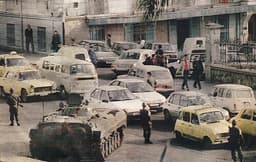
Mohamed Mediène
General · Modern
53.1Total

Omar Torrijos
General · Modern
58.1Total
Basic Information
Born
1939
1929
Died
—
—
Era
Modern
Modern
Nationality
Algeria
Panama
Occupation
General
General
Civilization
Middle Eastern
Western
Score Comparison
Military (10%)
50.0
10.2
Political (20%)
62.7
78.0
Influence (20%)
53.3
72.0
Legacy (20%)
50.0
52.0
Leadership (15%)
62.0
72.0
Strategy (15%)
35.7
35.7
TOTAL
53.1
58.1
Mohamed Mediène — Complete Timeline
1990 AD
Appointed Head of DRSPolitical Action◆ Major
Mediène, known as Toufik, was appointed head of the Department of Intelligence and Security (DRS) in 1990. He became the most powerful figure in Algeria, controlling intelligence and security services for over two decades.
DRSIntelligencePowerbroker
Impact: national
1992 AD
Role in the Algerian Civil WarWar
Mediène was a key architect of the military's crackdown on Islamists after the 1992 election cancellation. The DRS under his leadership was accused of involvement in massacres and disappearances, though he denied direct responsibility.
Civil WarHuman RightsDRS
Impact: nationaldestructive
2015 AD
Dismissal from DRSPolitical Action◆ Major
Mediène was dismissed in 2015 by President Bouteflika, who dismantled the DRS and reduced its powers. The move ended Toufik's 25-year reign as intelligence chief, marking a significant shift in Algeria's political landscape.
DRSBouteflikaReform
Impact: national
Omar Torrijos — Complete Timeline
1968 AD
1968 Panamanian coup d'étatPolitical Action◆ Major
Torrijos, as a lieutenant colonel, co-led a military coup that overthrew President Arnulfo Arias. The National Guard took power, and Torrijos emerged as the de facto leader of Panama, establishing a military government.
CoupMilitary RulePanama
Impact: nationaldestructive
1969 AD
Implementation of agrarian reformReform
Torrijos initiated an agrarian reform program that redistributed land to peasant families. The reform aimed to reduce rural poverty and inequality, but its implementation was uneven and faced opposition from large landowners.
Land ReformSocial PolicyRural Development
Impact: nationalprogressive
1977 AD
Negotiation of the Torrijos-Carter TreatiesPolitical Action
Torrijos negotiated treaties with U.S. President Jimmy Carter that established the gradual transfer of the Panama Canal from U.S. to Panamanian control by 1999. The treaties were ratified by Panama in a 1977 referendum and by the U.S. Senate in 1978.
Panama CanalTreatySovereignty
Impact: globalconstructive
1981 AD
Death in plane crashOther◆ Major
Torrijos died when his De Havilland Twin Otter aircraft crashed in the mountains of Penonom
DeathAccidentConspiracy
Impact: nationaltragic
Expert Analysis
Origins
Mohamed Mediène, known as Toufik, was born in 1939 in the village of Fesdis, near Batna, Algeria. He came of age during the Algerian War of Independence (1954-1962), joining the National Liberation Army (ALN) as a teenager. After independence, he studied at the military academy in Cherchell and later specialized in intelligence. His early career was shaped by the authoritarian single-party state under Houari Boumediene, where security services were central to regime survival.
Omar Torrijos was born on February 13, 1929, in Santiago de Veraguas, Panama, to a rural schoolteacher family. He attended the Military Academy of El Salvador and later the School of the Americas in the Panama Canal Zone. His formative years were marked by U.S. control of the canal and a deep sense of Panamanian nationalism. He served in the National Guard, rising through the ranks as a professional soldier in a country where the military was small but politically influential.
Rise to Power
Mediène’s rise was gradual and secretive. In 1990, President Chadli Bendjedid appointed him head of the Department of Intelligence and Security (DRS), replacing the existing Sécurité Militaire. This move was part of a reorganization of the security apparatus. Mediène’s real power emerged after the 1991 legislative elections were cancelled by the military in January 1992, triggering the Algerian Civil War. As DRS chief, he became the architect of the state’s counter-insurgency strategy, coordinating the military’s brutal crackdown on Islamist groups. By the late 1990s, he was considered the most powerful figure in Algeria, often called “the kingmaker.”
Torrijos’s rise was swift and dramatic. On October 11, 1968, as a lieutenant colonel, he co-led a coup that overthrew the recently elected President Arnulfo Arias. The junta initially installed a civilian figurehead, but Torrijos quickly emerged as the strongman. By 1969, he had consolidated power, sidelining rivals such as Colonel Boris Martínez. His populist charisma and nationalist rhetoric gained him support among rural and urban poor. He formalized his rule as “Maximum Leader of the Panamanian Revolution” and remained in power until his death in 1981.
Leadership & Governance
Mediène governed from the shadows. He never held a formal political office but controlled the DRS, which had broad powers: surveillance, counter-intelligence, and covert operations. His leadership style was secretive and ruthless. During the civil war, he authorized the use of death squads and mass arrests. After the war, his DRS became a parallel state, infiltrating the military, political parties, and business. He blocked reforms that would have reduced the army’s role. His governance score of 62.0 reflects his effectiveness in maintaining power but also his complicity in state violence.
Torrijos was a populist authoritarian. He ruled as a military strongman but cultivated a common-man image: he wore a campaign hat and guayabera shirt, visited remote villages, and listened to grievances. His government implemented land reform, redistributing over 200,000 hectares to peasants, and expanded social services. He also created a new labor code and nationalized utilities. However, he suppressed political opposition, exiled critics, and controlled the media. His leadership score of 72.0 reflects his ability to combine authoritarian control with genuine social reform.
Triumph & Tragedy
Mediène’s greatest triumph was surviving the civil war and expanding the DRS’s power. By the early 2000s, he had built an intelligence network that controlled Algeria’s political system. His key event was maintaining the regime’s stability through the war. His tragedy was his fall: in 2015, President Abdelaziz Bouteflika, seeking to reduce the DRS’s power, dismissed him and dismantled the agency. Mediène was placed under house arrest, and his legacy of impunity was exposed. His military score of 50.0 and strategy score of 35.7 reflect the limits of pure intelligence power.
Torrijos’s triumph was the Torrijos-Carter Treaties, signed in 1977, which guaranteed Panama full control of the Panama Canal by 1999. This was a historic achievement for a small nation. His tragedy was his death in a plane crash on July 31, 1981, at age 52. The crash was officially ruled an accident, but conspiracy theories persist. He died before seeing the treaties fully implemented, and his successors—particularly Manuel Noriega—corrupted his legacy. His military score of 10.2 reflects that his power was political, not battlefield-based.
Character & Destiny
Mediène was known for his secrecy and patience. He rarely appeared in public, never gave interviews, and was described as a “gray eminence.” His character was shaped by the Algerian war and the need for regime survival at all costs. This made him effective but also paranoid, leading to the DRS’s overreach. His destiny was to be erased from power by the very system he built. Historical assessments note that he represented the deep state’s resilience, but his refusal to adapt ultimately led to his downfall.
Torrijos was charismatic and impulsive. He was a heavy drinker and womanizer, but also a skilled negotiator who could charm foreign leaders like Jimmy Carter. His nationalism was genuine, and he took risks, such as confronting the U.S. over the canal. His character made him a symbol of anti-imperialism in Latin America. His destiny was cut short by a mysterious plane crash. Historians debate whether the crash was an accident or assassination, but his death left Panama without a strong leader, leading to the Noriega dictatorship.
Legacy
Mediène’s legacy is mixed. He is remembered as the architect of the Algerian security state, which continues to dominate politics. The DRS was dissolved, but its methods live on. He scored 50.0 in legacy, as his impact was largely negative: he entrenched corruption and human rights abuses. Algeria’s political system remains opaque, and the military still holds veto power. Internationally, he is little known outside intelligence circles.
Torrijos’s legacy is more positive. He is celebrated in Panama as the man who brought the canal home. The Torrijos-Carter Treaties are a landmark in U.S.-Latin American relations. His social reforms had lasting impact: land redistribution, labor rights, and public health improvements. However, his authoritarian methods and the subsequent Noriega era tarnish his memory. His legacy score of 52.0 reflects a mix of achievement and controversy. He is a national hero, but his military rule set a precedent for future dictators.
Conclusion
Omar Torrijos had a greater impact on world history than Mohamed Mediène. Torrijos changed the geopolitical landscape by securing Panama’s sovereignty over the canal, a tangible shift in power from a superpower to a small nation. His total score of 58.1 versus Mediène’s 53.1 reflects this. Mediène’s influence was largely internal and destructive; he maintained a repressive system but did not alter Algeria’s trajectory in a positive way. Torrijos, despite his authoritarian flaws, achieved a concrete, lasting victory for his country. While Mediène was effective in his domain, Torrijos’s legacy is more globally significant and transformative.
Rankings
🥇
Omar TorrijosLeader
Mil: 10.2Pol: 78.0Inf: 72.0
58.1
🥈
Mohamed Mediène
Mil: 50.0Pol: 62.7Inf: 53.3
53.1
+5.0 behind
How This Comparison Works
Algorithm
Each figure is scored on 6 dimensions (0—100 scale) based on structured historical data: Military (10%), Political (20%), Influence (20%), Legacy (20%), Leadership (15%), Strategy (15%). The weighted total produces the final ranking.
Data Sources
Scores are computed from structured sub-indicators in the database. Scale factors adjust for era (Ancient ×0.85, Modern ×1.0) and civilization size (Eastern ×1.05, Other ×0.80) to account for differences in population and military scale.
Maximum 3 Figures
Comparisons are limited to 2—3 figures to ensure readability and statistical meaningfulness.
Error Margins
±5 points per dimension — Sub-scores are derived from historical records with inherent uncertainty. Two figures within 5 points on a dimension should be considered roughly equivalent in that area.
Total Score Accuracy
±3 points overall — The weighted combination of 6 dimensions produces a total score with approximately ±3 points of uncertainty. Differences of less than 3 points are not statistically significant— the figures are effectively tied.
Known Limitations
- Historical records are incomplete and uneven across civilizations
- Figures from oral-tradition societies may be underrepresented
- Occupation labels can misclassify multi-role figures
- Scores measure capability and impact, not moral character
- Quantitative scoring is a comparison tool, not absolute truth
Capability Radar
Military (10%) — Battles & Warfare
Battles
0
5
Win Rate
0
5
Expansion
0
5
Political (20%) — Governance & Reform
Reform
60
70
Diplomacy
65
85
Economy
30
60
Influence (20%) — Cultural & Global Reach
Cultural
20
50
Global
30
65
Legacy (20%) — Historical Impact
Historical
50
65
Longevity
40
55
Leadership (15%) — Power & Stability
Tenure
70
65
Stability
55
55
Strategy (15%) — Tactics & Innovation
Strategy
15
15
Tactics
10
10
Reform
20
20
Similar Comparisons
Comments & Discussion
No comments yet. Be the first to share your thoughts!