Loading...
Douglas MacArthur vs Omar Torrijos
Douglas MacArthur leads by 7.6 pts · 2 figures compared
…
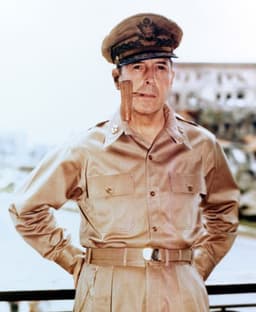
Douglas MacArthur
General · Modern
65.7Total

Omar Torrijos
General · Modern
58.1Total
Basic Information
Born
1880
1929
Died
1964
—
Era
Modern
Modern
Nationality
United States
Panama
Occupation
General
General
Civilization
Western
Western
Score Comparison
Military (10%)
85.0
10.2
Political (20%)
78.0
78.0
Influence (20%)
68.0
72.0
Legacy (20%)
40.0
52.0
Leadership (15%)
78.0
72.0
Strategy (15%)
68.0
35.7
TOTAL
65.7
58.1
Douglas MacArthur — Complete Timeline
1942 AD
Battle of Bataan and CorregidorWar◆ Major
MacArthur commanded US and Filipino forces defending the Bataan Peninsula and Corregidor Island against Japanese invasion. After months of resistance, he was ordered to evacuate to Australia, leaving his troops who later surrendered and endured the Bataan Death March.
World War IIPacific TheaterDefeat
Impact: regionaltragic
1944 AD
Return to the PhilippinesWar◆ Major
MacArthur led the Allied invasion of Leyte Gulf, fulfilling his promise 'I shall return.' The campaign liberated the Philippines from Japanese occupation, a major strategic victory in the Pacific War.
World War IIPacific TheaterVictory
Impact: regionalconstructive
1945 AD
Surrender of JapanWar
MacArthur, as Supreme Commander for the Allied Powers, accepted Japan's formal surrender aboard USS Missouri in Tokyo Bay. This ended World War II and began the Allied occupation of Japan under his leadership.
World War IIJapanOccupation
Impact: globalconstructive
Occupation of Japan ReformsReform◆ Major
MacArthur oversaw the Allied occupation of Japan, implementing sweeping reforms including a new constitution, land redistribution, women's suffrage, and demilitarization. These changes transformed Japan into a democratic and pacifist state.
JapanPost-WarDemocratization
Impact: globalprogressive
1950 AD
Inchon LandingWar◆ Major
MacArthur planned and executed a bold amphibious assault at Inchon, South Korea, behind North Korean lines. The operation cut North Korean supply lines and recaptured Seoul, turning the tide of the Korean War.
Korean WarAmphibious AssaultVictory
Impact: regionalconstructive
1951 AD
Dismissal by President TrumanPolitical Action◆ Major
President Harry S. Truman relieved MacArthur of command for insubordination after MacArthur publicly advocated for expanding the Korean War into China. The dismissal sparked a political controversy in the US and ended MacArthur's military career.
Korean WarCivil-Military RelationsDismissal
Impact: nationaldestructive
Omar Torrijos — Complete Timeline
1968 AD
1968 Panamanian coup d'étatPolitical Action◆ Major
Torrijos, as a lieutenant colonel, co-led a military coup that overthrew President Arnulfo Arias. The National Guard took power, and Torrijos emerged as the de facto leader of Panama, establishing a military government.
CoupMilitary RulePanama
Impact: nationaldestructive
1969 AD
Implementation of agrarian reformReform
Torrijos initiated an agrarian reform program that redistributed land to peasant families. The reform aimed to reduce rural poverty and inequality, but its implementation was uneven and faced opposition from large landowners.
Land ReformSocial PolicyRural Development
Impact: nationalprogressive
1977 AD
Negotiation of the Torrijos-Carter TreatiesPolitical Action
Torrijos negotiated treaties with U.S. President Jimmy Carter that established the gradual transfer of the Panama Canal from U.S. to Panamanian control by 1999. The treaties were ratified by Panama in a 1977 referendum and by the U.S. Senate in 1978.
Panama CanalTreatySovereignty
Impact: globalconstructive
1981 AD
Death in plane crashOther◆ Major
Torrijos died when his De Havilland Twin Otter aircraft crashed in the mountains of Penonom
DeathAccidentConspiracy
Impact: nationaltragic
Expert Analysis
Origins
Douglas MacArthur was born on January 26, 1880, in Little Rock, Arkansas, into a military family. His father, Arthur MacArthur Jr., was a Medal of Honor recipient and a high-ranking officer. MacArthur attended the United States Military Academy at West Point, graduating first in his class in 1903. His early career included service in the Philippines and as aide-de-camp to President Theodore Roosevelt.
Omar Torrijos Herrera was born on February 13, 1929, in Santiago de Veraguas, Panama, to a modest family. He attended the Escuela Normal de Santiago and later the Military School of the Americas in Venezuela. Torrijos joined the Panama National Guard in 1952, rising through the ranks. His formative years were shaped by Panama's struggle for sovereignty over the Panama Canal.
Rise to Power
MacArthur's rise accelerated during World War I, where he served as chief of staff of the 42nd (Rainbow) Division, earning multiple decorations. He became superintendent of West Point in 1919, implementing reforms. In 1930, he was appointed Chief of Staff of the U.S. Army. During World War II, he was recalled to active duty in 1941 as commander of U.S. forces in the Far East. After the fall of the Philippines, he was awarded the Medal of Honor and became Supreme Commander of Allied Forces in the Southwest Pacific Area.
Torrijos rose through the National Guard, becoming a lieutenant colonel. On October 11, 1968, he co-led a coup that overthrew President Arnulfo Arias. Torrijos emerged as the strongman behind the new junta, and by 1969 he consolidated power, becoming de facto leader of Panama. He cultivated a populist image, appealing to rural and working-class Panamanians.
Leadership & Governance
MacArthur's leadership was autocratic and charismatic. He governed occupied Japan from 1945 to 1951, implementing sweeping reforms: a new constitution (Article 9 renouncing war), land redistribution, women's suffrage, and labor rights. His governance scored 78.0 in political skill. However, his insubordination during the Korean War, including public disagreements with President Truman, led to his dismissal in 1951. His military strategy scored 68.0.
Torrijos ruled Panama as a military dictator but with a populist bent. He implemented agrarian reform, redistributing land to peasants, and expanded social programs. His political score is 78.0. He also pursued a nationalist foreign policy, leading to the Torrijos-Carter Treaties in 1977, which set the gradual transfer of the Panama Canal to Panama by 1999. His leadership style was more pragmatic and less confrontational than MacArthur's.
Triumph & Tragedy
MacArthur's greatest triumph was the acceptance of Japan's surrender on September 2, 1945, and the subsequent successful occupation and democratization of Japan. His Inchon Landing in September 1950 was a military masterstroke, turning the tide of the Korean War. His greatest failure was the loss of the Philippines in 1942, though he was ordered to leave. His dismissal by Truman in 1951 tarnished his legacy, as did his overreach in wanting to expand the war into China.
Torrijos's greatest triumph was the negotiation of the Torrijos-Carter Treaties, signed in 1977, which guaranteed Panama's control of the Canal by 1999. This was a landmark achievement for Panamanian sovereignty. His greatest failure was his authoritarian rule, which suppressed political opposition and limited democratic freedoms. His death in a plane crash on July 31, 1981, under suspicious circumstances, left many questions unanswered.
Character & Destiny
MacArthur was known for his egotism, strategic brilliance, and insubordination. He believed in his own destiny, famously stating, "Old soldiers never die; they just fade away." His character led to both his greatest successes and his downfall. He scored 78.0 in leadership but 40.0 in legacy, indicating a mixed historical assessment.
Torrijos was a charismatic populist who connected with the masses. He was pragmatic and willing to engage with the U.S. to achieve his goals. His death at age 52 cut short his rule, but he is remembered as a national hero in Panama. His legacy score of 52.0 reflects his impact on Panama's sovereignty but also the controversies of his dictatorship.
Legacy
MacArthur's legacy is complex. He transformed Japan into a democratic ally, and his military strategies are studied. However, his insubordination and the controversies of the Korean War limit his standing. He is remembered as one of America's most famous generals, but not among the greatest. His total score of 65.7 reflects a high impact in military and political realms but a lower legacy.
Torrijos's legacy is primarily the Panama Canal treaties, which reshaped Panama's national identity and relations with the U.S. He is revered in Panama as a hero. His agrarian reforms had mixed results, but his influence on Panamanian politics endures. His total score of 58.1 is lower than MacArthur's, but his impact on Panama is profound.
Conclusion
Douglas MacArthur had a greater overall impact on world history than Omar Torrijos, with a total score of 65.7 versus 58.1. MacArthur's role in defeating Japan, reforming its society, and shaping the post-war order affected hundreds of millions. Torrijos's achievements, while significant for Panama, were more limited in scope. However, in terms of direct influence on their nation's sovereignty, Torrijos's legacy is arguably more transformative for Panama than MacArthur's for the United States. Nevertheless, on a global scale, MacArthur's actions had wider repercussions. Thus, MacArthur holds the higher historical ranking.
Rankings
🥇
Douglas MacArthurLeader
Mil: 85.0Pol: 78.0Inf: 68.0
65.7
🥈
Omar Torrijos
Mil: 10.2Pol: 78.0Inf: 72.0
58.1
+7.6 behind
How This Comparison Works
Algorithm
Each figure is scored on 6 dimensions (0—100 scale) based on structured historical data: Military (10%), Political (20%), Influence (20%), Legacy (20%), Leadership (15%), Strategy (15%). The weighted total produces the final ranking.
Data Sources
Scores are computed from structured sub-indicators in the database. Scale factors adjust for era (Ancient ×0.85, Modern ×1.0) and civilization size (Eastern ×1.05, Other ×0.80) to account for differences in population and military scale.
Maximum 3 Figures
Comparisons are limited to 2—3 figures to ensure readability and statistical meaningfulness.
Error Margins
±5 points per dimension — Sub-scores are derived from historical records with inherent uncertainty. Two figures within 5 points on a dimension should be considered roughly equivalent in that area.
Total Score Accuracy
±3 points overall — The weighted combination of 6 dimensions produces a total score with approximately ±3 points of uncertainty. Differences of less than 3 points are not statistically significant— the figures are effectively tied.
Known Limitations
- Historical records are incomplete and uneven across civilizations
- Figures from oral-tradition societies may be underrepresented
- Occupation labels can misclassify multi-role figures
- Scores measure capability and impact, not moral character
- Quantitative scoring is a comparison tool, not absolute truth
Capability Radar
Military (10%) — Battles & Warfare
Battles
85
5
Win Rate
75
5
Expansion
85
5
Political (20%) — Governance & Reform
Reform
85
70
Diplomacy
75
85
Economy
70
60
Influence (20%) — Cultural & Global Reach
Cultural
70
50
Global
80
65
Legacy (20%) — Historical Impact
Historical
85
65
Longevity
70
55
Leadership (15%) — Power & Stability
Tenure
80
65
Stability
65
55
Strategy (15%) — Tactics & Innovation
Strategy
90
15
Tactics
80
10
Reform
70
20
Similar Comparisons
Comments & Discussion
No comments yet. Be the first to share your thoughts!