Loading...
Mohammad Reza Pahlavi vs Sayajirao Gaekwad III
Sayajirao Gaekwad III leads by 9.6 pts · 2 figures compared
…
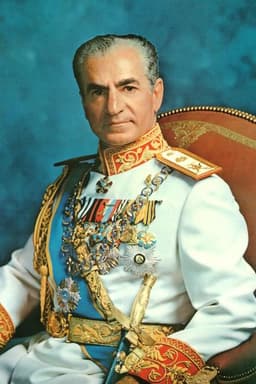
Mohammad Reza Pahlavi
Emperor · Modern
53.5Total

Sayajirao Gaekwad III
Emperor · Modern
63.1Total
Basic Information
Born
1919
1863
Died
1980
1939
Era
Modern
Modern
Nationality
Iran
India
Occupation
Emperor
Emperor
Civilization
Middle Eastern
Indian
Score Comparison
Military (10%)
22.6
45.0
Political (20%)
55.0
88.0
Influence (20%)
62.0
60.0
Legacy (20%)
48.3
49.2
Leadership (15%)
74.0
80.7
Strategy (15%)
43.3
60.0
TOTAL
53.5
63.1
Mohammad Reza Pahlavi — Complete Timeline
1953 AD
1953 Iranian coup d'étatPolitical Action
Mohammad Reza Pahlavi was reinstated as Shah after a CIA- and MI6-backed coup overthrew Prime Minister Mohammad Mossadegh. The coup ended Iran's democratic experiment and established the Shah's authoritarian rule, fueling long-term resentment.
CoupMossadeghUS intervention
Impact: nationaldestructive
1963 AD
White RevolutionReform◆ Major
The Shah launched the White Revolution, a series of land reforms, modernization, and women's suffrage. While it aimed to modernize Iran, it disrupted traditional rural life, concentrated wealth, and alienated the clergy and landowners.
Land reformModernizationWomen's rights
Impact: national
1971 AD
1971 2,500-year celebration of the Persian EmpireCultural
The Shah hosted an extravagant celebration at Persepolis to mark 2,500 years of the Persian monarchy. The event was criticized for its opulence and disregard for Iran's poverty, fueling opposition to his regime.
ExtravagancePropagandaOpposition
Impact: nationaldestructive
1979 AD
Islamic Revolution and exilePolitical Action
Mass protests led by Ayatollah Khomeini overthrew the Shah's regime. Mohammad Reza Pahlavi fled Iran in January 1979, eventually seeking medical treatment abroad. He died in exile in Egypt in 1980, never returning to Iran.
RevolutionExileKhomeini
Impact: globaltragic
Sayajirao Gaekwad III — Complete Timeline
1890 AD
Modernized Baroda's InfrastructureReform◆ Major
Sayajirao oversaw the construction of railways, roads, irrigation systems, and public buildings in Baroda. He also established a modern water supply and electricity system, transforming the state's infrastructure.
InfrastructureModernizationDevelopment
Impact: regionalconstructive
1900 AD
Abolished Untouchability in BarodaReform◆ Major
Sayajirao issued a decree abolishing untouchability in the state of Baroda. He opened temples, wells, and schools to all castes, and promoted social equality, though implementation faced resistance.
Social ReformCaste SystemEquality
Impact: regionalprogressive
1906 AD
Introduced Compulsory Primary EducationReform
Sayajirao made primary education compulsory and free for all children in Baroda. This was one of the earliest such reforms in India, significantly increasing literacy rates and setting a precedent for other princely states.
Education ReformSocial ReformModernization
Impact: regionalprogressive
1908 AD
Established the Bank of BarodaReform◆ Major
Sayajirao founded the Bank of Baroda to provide banking services and credit to the people of Baroda. The bank grew into a major financial institution in India, supporting economic development and trade.
Economic ReformBankingDevelopment
Impact: regionalconstructive
1909 AD
Hosted the Indian National Congress SessionPolitical Action
Sayajirao hosted the annual session of the Indian National Congress in Baroda. He supported the nationalist movement and provided a platform for leaders like Gopal Krishna Gokhale and Bal Gangadhar Tilak to advocate for self-rule.
Indian National CongressNationalismPolitical Support
Impact: nationalconstructive
Expert Analysis
Origins
Mohammad Reza Pahlavi was born on October 26, 1919, in Tehran, Iran, to Reza Shah and his second wife, Tadj ol-Molouk. His father, a military officer who seized power in a coup in 1921, founded the Pahlavi dynasty. Mohammad Reza was educated at the Institut Le Rosey in Switzerland and later at the Tehran Military Academy. His early life was shaped by his father's authoritarian rule and the desire to modernize Iran along Western lines.
Sayajirao Gaekwad III was born on March 10, 1863, in Kavlana, Gujarat, India, into the Maratha Gaekwad dynasty. He was adopted by Maharaja Khanderao Gaekwad II in 1875 and ascended the throne of Baroda at age 12. His education was supervised by British tutors, and he was deeply influenced by Western liberal ideas. He traveled extensively in Europe and India, observing administrative and social reforms.
Rise to Power
Mohammad Reza Pahlavi became the Shah of Iran in September 1941 after his father was forced into exile by the Allied invasion of Iran. Initially a constitutional monarch, he faced challenges from Prime Minister Mohammad Mossadegh, who nationalized the oil industry in 1951. The 1953 Iranian coup d'état, orchestrated by the CIA and MI6, overthrew Mossadegh and reinstated the Shah with increased powers. This event marked a turning point: the Shah consolidated absolute control, backed by the military and secret police (SAVAK).
Sayajirao Gaekwad III ascended the throne of Baroda in 1875 after a brief regency. He was formally invested with full ruling powers in 1881. His rise was peaceful, within the framework of British paramountcy. He focused on consolidating his authority through administrative efficiency and progressive reforms, earning respect from both British officials and Indian nationalists.
Leadership & Governance
Mohammad Reza Pahlavi ruled as an autocrat, centralizing power and suppressing dissent. His White Revolution (1963) included land reforms, women's suffrage, and industrialization. However, implementation was top-down and alienated traditional elites, clergy, and peasants. He maintained power through SAVAK, which tortured and imprisoned opponents. By the 1970s, corruption and inequality grew, and his government became increasingly isolated. His leadership score of 74.0 reflects his ability to drive modernization but with authoritarian methods that bred resistance.
Sayajirao Gaekwad III governed as a progressive constitutional monarch. He introduced compulsory primary education in 1906, one of the first such laws in India, and established the Bank of Baroda in 1908 to promote economic development. He abolished untouchability in 1907, opening temples and wells to all castes. He built railways, irrigation systems, and public libraries. His leadership score of 80.7 indicates effective governance with a focus on social welfare and education. He worked within the British system but also supported the Indian National Congress, hosting its 1909 session.
Triumph & Tragedy
Mohammad Reza Pahlavi's greatest triumph was the rapid modernization of Iran during the 1960s and 1970s: GDP grew, literacy rose, and women gained rights. However, his greatest failure was the suppression of political freedoms and the alienation of religious and secular groups, leading to the Islamic Revolution in 1979. He fled Iran and died in exile in 1980. His total score of 53.5 reflects a legacy marred by the revolution.
Sayajirao Gaekwad III's greatest triumphs were his social reforms: compulsory education, abolition of untouchability, and economic development. His Bank of Baroda grew into a major institution. However, his failure to secure a direct heir led to succession disputes after his death in 1939. Additionally, his state's autonomy was limited by British suzerainty. His total score of 63.1 reflects enduring contributions.
Character & Destiny
Mohammad Reza Pahlavi was indecisive and insecure, often relying on his authoritarian father's example. He vacillated between reform and repression, ultimately alienating all factions. His character shaped his destiny: his inability to share power or adapt to popular demands led to his downfall. Historian Abbas Milani noted his 'tragic flaw' of mistrust.
Sayajirao Gaekwad III was visionary and pragmatic, combining Western liberalism with Indian traditions. He was a reformer who worked within constraints, earning praise from figures like Mahatma Gandhi. His character ensured a peaceful and prosperous reign, but his lack of a direct heir meant his reforms did not continue under successors.
Legacy
Mohammad Reza Pahlavi's legacy is complex: he modernized Iran but is remembered as a dictator overthrown by revolution. Iran's post-revolutionary system defines itself in opposition to his rule. His scores: Military 22.6, Political 55.0, Influence 62.0, Legacy 48.3.
Sayajirao Gaekwad III's legacy is more positive: he is remembered as a model progressive ruler. His educational and social reforms influenced post-independence India. The Bank of Baroda remains a major bank. His scores: Military 45.0, Political 88.0, Influence 60.0, Legacy 49.2.
Conclusion
Sayajirao Gaekwad III had greater impact than Mohammad Reza Pahlavi. His total score of 63.1 exceeds the Shah's 53.5 by 9.6 points. While the Shah's modernization was more sweeping, it was unsustainable and collapsed. Sayajirao's reforms were more durable and inclusive, creating lasting institutions. The Shah's legacy is defined by failure; Sayajirao's by enduring progress. Thus, Sayajirao Gaekwad III stands as the more effective and visionary leader.
Rankings
🥇
Sayajirao Gaekwad IIILeader
Mil: 45.0Pol: 88.0Inf: 60.0
63.1
🥈
Mohammad Reza Pahlavi
Mil: 22.6Pol: 55.0Inf: 62.0
53.5
+9.6 behind
How This Comparison Works
Algorithm
Each figure is scored on 6 dimensions (0—100 scale) based on structured historical data: Military (10%), Political (20%), Influence (20%), Legacy (20%), Leadership (15%), Strategy (15%). The weighted total produces the final ranking.
Data Sources
Scores are computed from structured sub-indicators in the database. Scale factors adjust for era (Ancient ×0.85, Modern ×1.0) and civilization size (Eastern ×1.05, Other ×0.80) to account for differences in population and military scale.
Maximum 3 Figures
Comparisons are limited to 2—3 figures to ensure readability and statistical meaningfulness.
Error Margins
±5 points per dimension — Sub-scores are derived from historical records with inherent uncertainty. Two figures within 5 points on a dimension should be considered roughly equivalent in that area.
Total Score Accuracy
±3 points overall — The weighted combination of 6 dimensions produces a total score with approximately ±3 points of uncertainty. Differences of less than 3 points are not statistically significant— the figures are effectively tied.
Known Limitations
- Historical records are incomplete and uneven across civilizations
- Figures from oral-tradition societies may be underrepresented
- Occupation labels can misclassify multi-role figures
- Scores measure capability and impact, not moral character
- Quantitative scoring is a comparison tool, not absolute truth
Capability Radar
Military (10%) — Battles & Warfare
Battles
15
0
Win Rate
10
0
Expansion
10
0
Political (20%) — Governance & Reform
Reform
70
90
Diplomacy
60
80
Economy
55
90
Influence (20%) — Cultural & Global Reach
Cultural
55
60
Global
55
40
Legacy (20%) — Historical Impact
Historical
60
55
Longevity
30
50
Leadership (15%) — Power & Stability
Tenure
65
85
Stability
20
85
Strategy (15%) — Tactics & Innovation
Strategy
25
0
Tactics
20
0
Reform
60
20
Similar Comparisons
Comments & Discussion
No comments yet. Be the first to share your thoughts!