Loading...
This comparison has not been analyzed yet.
One-time AI generation (~1 minute). Scores and timeline are already available below.
Nana Olomu vs Tribhuvan of Nepal
Tribhuvan of Nepal leads by 6.5 pts · 2 figures compared
…

Nana Olomu
Emperor · Modern
46.9Total
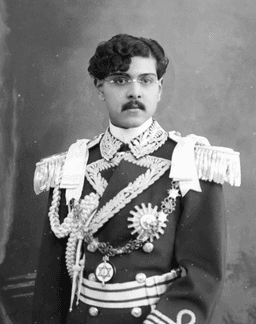
Tribhuvan of Nepal
Emperor · Modern
53.4Total
Basic Information
Born
1852
1906
Died
1916
1955
Era
Modern
Modern
Nationality
Nigeria
Nepal
Occupation
Emperor
Emperor
Civilization
Other
Indian
Score Comparison
Military (10%)
50.0
48.7
Political (20%)
39.4
45.0
Influence (20%)
51.8
54.9
Legacy (20%)
41.7
49.2
Leadership (15%)
55.3
74.6
Strategy (15%)
43.7
45.8
TOTAL
46.9
53.4
Nana Olomu — Complete Timeline
1875 AD
Rise as Itsekiri merchant princePolitical Action◆ Major
Nana Olomu emerged as the leading Itsekiri trader in the Niger Delta, controlling palm oil exports from the Benin River. He built a fleet of canoes and established a network of trading posts, becoming the wealthiest African in the region.
TradeWealthItsekiri
Impact: regionalconstructive
1890 AD
Conflict with British over trade controlPolitical Action◆ Major
Nana resisted British attempts to impose direct control over the palm oil trade, refusing to pay new duties and challenging the authority of British consuls. He armed his followers and fortified his base at Ebrohimi.
ResistanceTradeBritish
Impact: regional
1894 AD
Battle of EbrohimiWar◆ Major
British naval forces attacked Nana's fortified town of Ebrohimi, destroying his fleet and fortifications. Nana escaped but his power was broken, ending Itsekiri resistance to British control of the Niger Delta.
BattleBritish NavyDestruction
Impact: regionaltragic
Exile to AccraPolitical Action◆ Major
After his defeat, Nana surrendered to British authorities and was exiled to Accra in the Gold Coast (modern Ghana). His exile removed the last major Itsekiri obstacle to British colonial rule in the Niger Delta.
ExileColonialismItsekiri
Impact: regionaltragic
Tribhuvan of Nepal — Complete Timeline
1950 AD
Fled to India to organize opposition to Rana rulePolitical Action
King Tribhuvan, facing suppression by the ruling Rana dynasty, fled to the Indian embassy in Kathmandu and then to India. This act galvanized the Nepali Congress and Indian support, leading to the end of Rana oligarchy.
Rana regimeExileDemocracy movement
Impact: nationalconstructive
1951 AD
Signed the Delhi CompromisePolitical Action◆ Major
Tribhuvan, along with the Nepali Congress and Rana representatives, signed the Delhi Compromise in India. This agreement ended the Rana regime, restored the Shah monarchy, and established a transitional government leading to democratic elections.
DemocracyCompromiseRana regime
Impact: nationalconstructive
Returned to Nepal as sovereign monarchPolitical Action◆ Major
After the Delhi Compromise, King Tribhuvan returned to Nepal from India. He was restored as the sovereign monarch, ending 104 years of Rana hereditary rule and initiating a period of democratic governance.
Monarchy restoredDemocracyRana regime
Impact: nationalconstructive
This comparison has not been analyzed yet.
One-time AI generation (~1 minute). Scores and timeline are already available below.
Rankings
🥇
Tribhuvan of NepalLeader
Mil: 48.7Pol: 45.0Inf: 54.9
53.4
🥈
Nana Olomu
Mil: 50.0Pol: 39.4Inf: 51.8
46.9
+6.5 behind
How This Comparison Works
Algorithm
Each figure is scored on 6 dimensions (0—100 scale) based on structured historical data: Military (10%), Political (20%), Influence (20%), Legacy (20%), Leadership (15%), Strategy (15%). The weighted total produces the final ranking.
Data Sources
Scores are computed from structured sub-indicators in the database. Scale factors adjust for era (Ancient ×0.85, Modern ×1.0) and civilization size (Eastern ×1.05, Other ×0.80) to account for differences in population and military scale.
Maximum 3 Figures
Comparisons are limited to 2—3 figures to ensure readability and statistical meaningfulness.
Error Margins
±5 points per dimension — Sub-scores are derived from historical records with inherent uncertainty. Two figures within 5 points on a dimension should be considered roughly equivalent in that area.
Total Score Accuracy
±3 points overall — The weighted combination of 6 dimensions produces a total score with approximately ±3 points of uncertainty. Differences of less than 3 points are not statistically significant— the figures are effectively tied.
Known Limitations
- Historical records are incomplete and uneven across civilizations
- Figures from oral-tradition societies may be underrepresented
- Occupation labels can misclassify multi-role figures
- Scores measure capability and impact, not moral character
- Quantitative scoring is a comparison tool, not absolute truth
Capability Radar
Military (10%) — Battles & Warfare
Battles
25
29
Win Rate
20
31
Expansion
20
34
Political (20%) — Governance & Reform
Reform
20
70
Diplomacy
25
65
Economy
30
30
Influence (20%) — Cultural & Global Reach
Cultural
25
30
Global
15
30
Legacy (20%) — Historical Impact
Historical
30
55
Longevity
20
40
Leadership (15%) — Power & Stability
Tenure
30
49
Stability
20
40
Strategy (15%) — Tactics & Innovation
Strategy
25
36
Tactics
30
40
Reform
15
45
Similar Comparisons
Comments & Discussion
No comments yet. Be the first to share your thoughts!