Loading...
This comparison has not been analyzed yet.
One-time AI generation (~1 minute). Scores and timeline are already available below.
Nikola Gruevski vs Rajnath Singh
Rajnath Singh leads by 8.7 pts · 2 figures compared
…
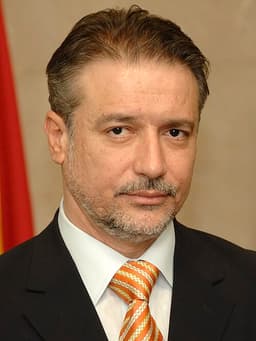
Nikola Gruevski
Politician · Modern
41.9Total

Rajnath Singh
Politician · Modern
50.6Total
Basic Information
Born
1970
1951
Died
—
—
Era
Modern
Modern
Nationality
North Macedonia
India
Occupation
Politician
Politician
Civilization
Western
Indian
Score Comparison
Military (10%)
48.7
10.0
Political (20%)
26.4
68.0
Influence (20%)
46.3
54.9
Legacy (20%)
35.8
45.0
Leadership (15%)
55.3
66.0
Strategy (15%)
42.5
45.0
TOTAL
41.9
50.6
Nikola Gruevski — Complete Timeline
2006 AD
Elected Prime Minister of MacedoniaPolitical Action◆ Major
Gruevski became Prime Minister after his party VMRO-DPMNE won the parliamentary elections. He began a decade-long rule marked by nationalist policies and economic growth.
ElectionGovernmentMacedonia
Impact: nationalconstructive
2010 AD
Initiated the Skopje 2014 projectCultural◆ Major
Gruevski launched a large-scale urban renewal project in Skopje, building statues and buildings in a neoclassical style, including a statue of Alexander the Great. The project aimed to assert Macedonian identity but was criticized for cost and historical revisionism.
Urban DevelopmentNational IdentitySkopje
Impact: nationalconstructive
2015 AD
Wiretapping scandal revelationsPolitical Action◆ Major
Opposition leader Zoran Zaev released wiretapped conversations allegedly showing Gruevski's government involved in corruption, election rigging, and media control. This sparked massive protests and a political crisis.
ScandalCorruptionProtests
Impact: nationaldestructive
2016 AD
Resigned as Prime MinisterPolitical Action◆ Major
Under pressure from the wiretapping scandal and international mediation, Gruevski resigned, paving the way for early elections. His resignation ended his decade-long rule.
ResignationPolitical CrisisMacedonia
Impact: nationaldestructive
2018 AD
Fled to Hungary to avoid prisonPolitical Action◆ Major
After being sentenced to two years in prison for corruption related to the purchase of a luxury vehicle, Gruevski fled to Hungary, where he was granted political asylum. This caused a diplomatic rift between Macedonia and Hungary.
CorruptionAsylumEscape
Impact: nationaldestructive
Rajnath Singh — Complete Timeline
2005 AD
Elected President of the Bharatiya Janata PartyPolitical Action◆ Major
Rajnath Singh was elected as the national president of the BJP in 2005, succeeding L.K. Advani. He served two consecutive terms until 2009, overseeing the party's organizational restructuring and electoral strategies during a period of opposition.
Party LeadershipBJP OrganizationPolitical Strategy
Impact: nationalconstructive
2014 AD
Appointed Union Home MinisterPolitical Action◆ Major
Rajnath Singh was appointed as the Union Home Minister in the first Modi government in May 2014. He oversaw internal security, including the handling of the Kashmir situation, the Naxalite insurgency, and the implementation of the Citizenship Amendment Act.
Cabinet AppointmentHome MinistryInternal Security
Impact: nationalconstructive
2019 AD
Oversaw the Abrogation of Article 370Political Action
As Home Minister, Rajnath Singh played a key role in the abrogation of Article 370, which revoked the special status of Jammu and Kashmir. The decision was implemented in August 2019, leading to the reorganization of the state into two union territories.
Article 370KashmirConstitutional Change
Impact: nationaldestructive
Appointed Union Defence MinisterPolitical Action◆ Major
Rajnath Singh was appointed as the Union Defence Minister in the second Modi government in May 2019. He oversaw the modernization of the armed forces, the procurement of defense equipment, and the response to border tensions with China and Pakistan.
Defence MinistryMilitary ModernizationNational Security
Impact: nationalconstructive
2020 AD
Addressed the UN General AssemblyPolitical Action
Rajnath Singh addressed the United Nations General Assembly in September 2020, highlighting India's role in global peacekeeping and counter-terrorism. He also raised the issue of cross-border terrorism from Pakistan and called for reforms in the UN Security Council.
UN AddressDiplomacyCounter-Terrorism
Impact: globalconstructive
This comparison has not been analyzed yet.
One-time AI generation (~1 minute). Scores and timeline are already available below.
Rankings
🥇
Rajnath SinghLeader
Mil: 10.0Pol: 68.0Inf: 54.9
50.6
🥈
Nikola Gruevski
Mil: 48.7Pol: 26.4Inf: 46.3
41.9
+8.7 behind
How This Comparison Works
Algorithm
Each figure is scored on 6 dimensions (0—100 scale) based on structured historical data: Military (10%), Political (20%), Influence (20%), Legacy (20%), Leadership (15%), Strategy (15%). The weighted total produces the final ranking.
Data Sources
Scores are computed from structured sub-indicators in the database. Scale factors adjust for era (Ancient ×0.85, Modern ×1.0) and civilization size (Eastern ×1.05, Other ×0.80) to account for differences in population and military scale.
Maximum 3 Figures
Comparisons are limited to 2—3 figures to ensure readability and statistical meaningfulness.
Error Margins
±5 points per dimension — Sub-scores are derived from historical records with inherent uncertainty. Two figures within 5 points on a dimension should be considered roughly equivalent in that area.
Total Score Accuracy
±3 points overall — The weighted combination of 6 dimensions produces a total score with approximately ±3 points of uncertainty. Differences of less than 3 points are not statistically significant— the figures are effectively tied.
Known Limitations
- Historical records are incomplete and uneven across civilizations
- Figures from oral-tradition societies may be underrepresented
- Occupation labels can misclassify multi-role figures
- Scores measure capability and impact, not moral character
- Quantitative scoring is a comparison tool, not absolute truth
Capability Radar
Military (10%) — Battles & Warfare
Battles
30
0
Win Rate
33
0
Expansion
35
0
Political (20%) — Governance & Reform
Reform
20
50
Diplomacy
15
55
Economy
10
45
Influence (20%) — Cultural & Global Reach
Cultural
5
30
Global
10
30
Legacy (20%) — Historical Impact
Historical
10
30
Longevity
5
30
Leadership (15%) — Power & Stability
Tenure
45
60
Stability
5
55
Strategy (15%) — Tactics & Innovation
Strategy
36
0
Tactics
40
0
Reform
46
30
Similar Comparisons
Comments & Discussion
No comments yet. Be the first to share your thoughts!