Loading...
This comparison has not been analyzed yet.
One-time AI generation (~1 minute). Scores and timeline are already available below.
Nizam-ul-Mulk Asaf Jah I vs William I of Wurttemberg
Nizam-ul-Mulk Asaf Jah I leads by 8.0 pts · 2 figures compared
…
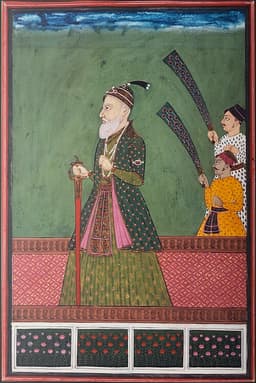
Nizam-ul-Mulk Asaf Jah I
Emperor · Modern
61.7Total
William I of Wurttemberg
Emperor · Modern
53.7Total
Basic Information
Born
1671
1781
Died
1748
1864
Era
Modern
Modern
Nationality
India
Wurttemberg
Occupation
Emperor
Emperor
Civilization
Indian
Western
Score Comparison
Military (10%)
61.7
43.3
Political (20%)
72.0
68.0
Influence (20%)
55.0
51.8
Legacy (20%)
55.0
40.0
Leadership (15%)
78.0
72.0
Strategy (15%)
55.0
54.6
TOTAL
61.7
53.7
Nizam-ul-Mulk Asaf Jah I — Complete Timeline
1722 AD
Appointed Grand Vizier of the Mughal EmpirePolitical Action◆ Major
Nizam-ul-Mulk Asaf Jah I was appointed Grand Vizier (Prime Minister) of the Mughal Empire under Emperor Muhammad Shah. He attempted to reform the empire's administration and finances but faced opposition from court factions.
Mughal EmpireGrand VizierAdministration
Impact: national
1724 AD
Battle of Shakar KhedaWar◆ Major
Nizam-ul-Mulk Asaf Jah I defeated the Mughal imperial forces led by Mubariz Khan at the Battle of Shakar Kheda. This victory solidified his control over the Deccan and effectively established his independent rule.
BattleDeccanMughal Empire
Impact: regional
Founded the Asaf Jahi dynasty and the state of HyderabadPolitical Action
After resigning as Grand Vizier, Nizam-ul-Mulk Asaf Jah I established an independent principality in the Deccan, founding the Asaf Jahi dynasty. He made Hyderabad his capital and created a stable state that would last for over two centuries.
HyderabadDynastyDeccanIndependence
Impact: regionalconstructive
1725 AD
Implemented administrative reforms in the DeccanReform◆ Major
Nizam-ul-Mulk Asaf Jah I introduced a system of revenue administration and governance in the Deccan that balanced local autonomy with central authority. His reforms provided stability and prosperity to the region for decades.
AdministrationRevenueDeccan
Impact: regionalconstructive
William I of Wurttemberg — Complete Timeline
1813 AD
Maintained neutrality during the Napoleonic WarsPolitical Action
As crown prince, William I advocated for W
Napoleonic WarsNeutralityDiplomacy
Impact: regional
1819 AD
Granted a new constitution to WürttembergReform◆ Major
William I granted a new constitution to the Kingdom of W
ConstitutionReformLiberalism
Impact: regionalprogressive
1820 AD
Promoted agricultural and economic reformsReform◆ Major
William I implemented agricultural reforms, including the abolition of serfdom and the promotion of modern farming techniques. He also supported industrialization and infrastructure projects, earning him popularity among his subjects.
AgricultureEconomic ReformPopularity
Impact: regionalconstructive
This comparison has not been analyzed yet.
One-time AI generation (~1 minute). Scores and timeline are already available below.
Rankings
🥇
Nizam-ul-Mulk Asaf Jah ILeader
Mil: 61.7Pol: 72.0Inf: 55.0
61.7
🥈
William I of Wurttemberg
Mil: 43.3Pol: 68.0Inf: 51.8
53.7
+8.0 behind
How This Comparison Works
Algorithm
Each figure is scored on 6 dimensions (0—100 scale) based on structured historical data: Military (10%), Political (20%), Influence (20%), Legacy (20%), Leadership (15%), Strategy (15%). The weighted total produces the final ranking.
Data Sources
Scores are computed from structured sub-indicators in the database. Scale factors adjust for era (Ancient ×0.85, Modern ×1.0) and civilization size (Eastern ×1.05, Other ×0.80) to account for differences in population and military scale.
Maximum 3 Figures
Comparisons are limited to 2—3 figures to ensure readability and statistical meaningfulness.
Error Margins
±5 points per dimension — Sub-scores are derived from historical records with inherent uncertainty. Two figures within 5 points on a dimension should be considered roughly equivalent in that area.
Total Score Accuracy
±3 points overall — The weighted combination of 6 dimensions produces a total score with approximately ±3 points of uncertainty. Differences of less than 3 points are not statistically significant— the figures are effectively tied.
Known Limitations
- Historical records are incomplete and uneven across civilizations
- Figures from oral-tradition societies may be underrepresented
- Occupation labels can misclassify multi-role figures
- Scores measure capability and impact, not moral character
- Quantitative scoring is a comparison tool, not absolute truth
Capability Radar
Military (10%) — Battles & Warfare
Battles
65
5
Win Rate
70
5
Expansion
70
5
Political (20%) — Governance & Reform
Reform
80
55
Diplomacy
85
55
Economy
80
50
Influence (20%) — Cultural & Global Reach
Cultural
65
30
Global
55
20
Legacy (20%) — Historical Impact
Historical
70
30
Longevity
75
20
Leadership (15%) — Power & Stability
Tenure
85
60
Stability
75
60
Strategy (15%) — Tactics & Innovation
Strategy
80
5
Tactics
75
5
Reform
60
10
Similar Comparisons
Comments & Discussion
No comments yet. Be the first to share your thoughts!