Loading...
This comparison has not been analyzed yet.
One-time AI generation (~1 minute). Scores and timeline are already available below.
Omar Bongo vs Valentina Matviyenko
Valentina Matviyenko leads by 0.7 pts · 2 figures compared
…
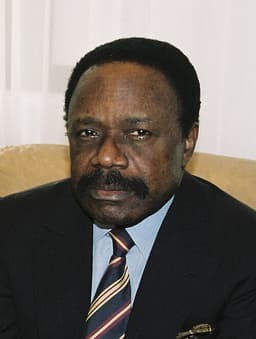
Omar Bongo
Politician · Modern
53.3Total

Valentina Matviyenko
Politician · Modern
54.0Total
Basic Information
Born
1935
1949
Died
—
—
Era
Modern
Modern
Nationality
Gabon
Russia
Occupation
Politician
Politician
Civilization
Other
Western
Score Comparison
Military (10%)
39.9
32.8
Political (20%)
45.1
45.0
Influence (20%)
53.3
57.2
Legacy (20%)
52.0
46.7
Leadership (15%)
78.0
80.0
Strategy (15%)
44.8
60.0
TOTAL
53.3
54.0
Omar Bongo — Complete Timeline
1967 AD
Became President of GabonPolitical Action
Bongo succeeded Leon Mba as President of Gabon after Mba's death. He inherited a one-party state and began a 42-year rule characterized by authoritarianism and oil wealth.
PresidencyGabonSuccession
Impact: national
1968 AD
Introduced One-Party RulePolitical Action◆ Major
Bongo established the Gabonese Democratic Party as the sole legal party, consolidating his power. One-party rule lasted until 1990, suppressing political opposition.
One-Party StateGabonAuthoritarianism
Impact: nationaldestructive
1993 AD
Re-elected in Controversial ElectionsPolitical Action◆ Major
Bongo was re-elected in Gabon's first multi-party elections, which were marred by allegations of fraud. The election sparked protests and highlighted the limits of democratic reform.
ElectionGabonControversy
Impact: national
2009 AD
Died in OfficePolitical Action
Bongo died in office after 42 years as president, making him the longest-serving head of state in Africa. His death ended an era of authoritarian rule and led to a succession by his son Ali Bongo.
DeathGabonEnd of Era
Impact: national
Valentina Matviyenko — Complete Timeline
1991 AD
Appointed Ambassador to MaltaPolitical Action
Matviyenko was appointed Ambassador of the Soviet Union (later Russia) to Malta in 1991, serving until 1994. This was her first major diplomatic role, representing Russia in a small island nation.
DiplomacyAmbassador
1998 AD
Served as Deputy Prime Minister for Social AffairsPolitical Action
Matviyenko served as Deputy Prime Minister of Russia for Social Affairs from 1998 to 2003 under Prime Ministers Yevgeny Primakov, Sergei Stepashin, and Vladimir Putin. She oversaw social policy, including healthcare and education.
GovernmentSocial Policy
Impact: national
2003 AD
Appointed Governor of Saint PetersburgPolitical Action◆ Major
Matviyenko was appointed Governor of Saint Petersburg in October 2003, serving until 2011. She oversaw the city's development, including infrastructure projects and the preparation for the 300th anniversary of the city.
GovernorshipSaint Petersburg
Impact: regional
2011 AD
Appointed Speaker of the Federation CouncilPolitical Action◆ Major
Valentina Matviyenko was appointed Speaker of the Federation Council, the upper house of the Russian parliament, in September 2011. She became the first woman to hold this position and has since been a key figure in Russian legislative politics.
ParliamentLeadership
Impact: national
This comparison has not been analyzed yet.
One-time AI generation (~1 minute). Scores and timeline are already available below.
Rankings
🥇
Valentina MatviyenkoLeader
Mil: 32.8Pol: 45.0Inf: 57.2
54.0
🥈
Omar Bongo
Mil: 39.9Pol: 45.1Inf: 53.3
53.3
+0.7 behind
How This Comparison Works
Algorithm
Each figure is scored on 6 dimensions (0—100 scale) based on structured historical data: Military (10%), Political (20%), Influence (20%), Legacy (20%), Leadership (15%), Strategy (15%). The weighted total produces the final ranking.
Data Sources
Scores are computed from structured sub-indicators in the database. Scale factors adjust for era (Ancient ×0.85, Modern ×1.0) and civilization size (Eastern ×1.05, Other ×0.80) to account for differences in population and military scale.
Maximum 3 Figures
Comparisons are limited to 2—3 figures to ensure readability and statistical meaningfulness.
Error Margins
±5 points per dimension — Sub-scores are derived from historical records with inherent uncertainty. Two figures within 5 points on a dimension should be considered roughly equivalent in that area.
Total Score Accuracy
±3 points overall — The weighted combination of 6 dimensions produces a total score with approximately ±3 points of uncertainty. Differences of less than 3 points are not statistically significant— the figures are effectively tied.
Known Limitations
- Historical records are incomplete and uneven across civilizations
- Figures from oral-tradition societies may be underrepresented
- Occupation labels can misclassify multi-role figures
- Scores measure capability and impact, not moral character
- Quantitative scoring is a comparison tool, not absolute truth
Capability Radar
Military (10%) — Battles & Warfare
Battles
22
48
Win Rate
26
49
Expansion
25
56
Political (20%) — Governance & Reform
Reform
20
55
Diplomacy
60
65
Economy
30
60
Influence (20%) — Cultural & Global Reach
Cultural
20
30
Global
30
45
Legacy (20%) — Historical Impact
Historical
30
40
Longevity
70
40
Leadership (15%) — Power & Stability
Tenure
95
70
Stability
50
65
Strategy (15%) — Tactics & Innovation
Strategy
29
54
Tactics
34
57
Reform
35
62
Similar Comparisons
Comments & Discussion
No comments yet. Be the first to share your thoughts!