Loading...
Osorkon II vs Tanshihuai
Tanshihuai leads by 11.1 pts · 2 figures compared
…
Osorkon II
Emperor · Ancient
48.1Total
Tanshihuai
Emperor · Ancient
59.2Total
Basic Information
Born
-874
141
Died
-850
181
Era
Ancient
Ancient
Nationality
Third Intermediate Egypt
Xianbei
Occupation
Emperor
Emperor
Civilization
Middle Eastern
Eastern
Score Comparison
Military (10%)
47.5
82.0
Political (20%)
68.0
68.0
Influence (20%)
50.2
52.5
Legacy (20%)
40.8
44.2
Leadership (15%)
40.0
74.0
Strategy (15%)
43.7
55.0
TOTAL
48.1
59.2
Osorkon II — Complete Timeline
860 BC
Construction of the Great Temple at BubastisCultural◆ Major
Osorkon II undertook a massive building program at Bubastis, constructing a grand temple to the goddess Bastet. The temple featured a large hypostyle hall, a pylon, and a sacred lake, becoming one of the most important religious centers of the 22nd Dynasty.
BubastisTemple ConstructionBastet
Impact: nationalconstructive
Celebration of the Sed FestivalCultural◆ Major
Osorkon II celebrated a Sed festival (jubilee) in his 30th year, a traditional ritual to renew the pharaoh's strength and legitimacy. The festival was commemorated with reliefs at Bubastis, showcasing his long reign and divine favor.
Sed FestivalJubileeBubastis
Impact: nationalconstructive
850 BC
Diplomatic Relations with AssyriaPolitical Action
Osorkon II maintained diplomatic relations with the rising Assyrian Empire under Ashurnasirpal II. He sent gifts and tribute to Assyria, avoiding conflict and securing Egypt's northern borders during a period of Assyrian expansion.
AssyriaDiplomacyTribute
Impact: regionalconstructive
Tanshihuai — Complete Timeline
156 AD
Raid on the Han frontier (156 AD)War
Tanshihuai led a large-scale raid into Han territory, attacking commanderies in the northern provinces. The Han forces were unable to stop him, and the raid caused significant destruction and loss of life, demonstrating Xianbei military power.
Han-Xianbei WarRaid
Impact: regionaldestructive
Unification of the Xianbei tribesPolitical Action◆ Major
Tanshihuai united the disparate Xianbei tribes of the Mongolian steppe into a powerful confederation. He established a centralized leadership and expanded Xianbei territory, creating a major rival to the Han dynasty in the north.
UnificationXianbei Confederation
Impact: regionalconstructive
158 AD
Defeat of the Han army at the Battle of the Yinshan MountainsWar◆ Major
Tanshihuai ambushed and defeated a Han punitive expedition in the Yinshan Mountains. The Han commander was killed, and the Xianbei captured large amounts of supplies and weapons, solidifying Tanshihuai's reputation as a formidable military leader.
BattleHan-Xianbei War
Impact: regionaldestructive
160 AD
Establishment of a Xianbei legal codeReform
Tanshihuai implemented a unified legal code for the Xianbei confederation, replacing tribal customs with standardized laws. This reform strengthened central authority and facilitated the administration of the growing empire.
Legal ReformXianbei Empire
Impact: regionalconstructive
Expert Analysis
Origins
Osorkon II was a pharaoh of the 22nd Dynasty of Egypt, ruling from approximately 872 to 837 BCE. He was born into the Libyan Meshwesh dynasty that had taken control of Egypt. His father was Takelot I, and his mother was likely a royal wife. Osorkon II grew up in the delta city of Bubastis, the dynasty's power base. His early life was shaped by the fragmented political landscape of the Third Intermediate Period, where the pharaoh's authority was challenged by local nomarchs and the powerful priesthood of Amun at Thebes.
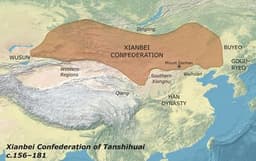
Tanshihuai was a Xianbei leader who lived from approximately 139 to 181 CE. He was born into the Xianbei tribal confederation on the Mongolian steppe. Little is known of his early life, but he rose from obscurity to unite the Xianbei tribes. His background was that of a nomadic warrior, with skills in horsemanship and archery honed from childhood. The Xianbei were a semi-nomadic people who had replaced the Xiongnu as the dominant force on the eastern steppe.
Rise to Power
Osorkon II ascended to the throne after his father Takelot I's reign of about 13 years. He consolidated power by maintaining control over the delta and Lower Egypt while asserting influence in Upper Egypt through strategic marriages and appointments. A key ally was his son, who served as High Priest of Amun at Thebes, though this position also held independent power. Osorkon II's reign saw relative stability, and he avoided major conflicts with the rising Assyrian Empire, instead sending gifts to Ashurnasirpal II. This diplomatic approach secured his northern border.
Tanshihuai's rise was more dramatic. Around 156 CE, he began uniting the Xianbei tribes through a combination of military conquest and diplomacy. He defeated rival chieftains and created a centralized confederation. His key turning point was the defeat of a Han punitive expedition at the Yinshan Mountains in 166 CE. This victory gave him control over the strategic Ordos region and immense prestige, allowing him to expand the confederation further. By the 170s, he had established a unified legal code, replacing tribal customs, which strengthened his authority.
Leadership & Governance
Osorkon II's leadership was characterized by monumental building projects and religious piety. He constructed the Great Temple at Bubastis, dedicated to the cat goddess Bastet. The temple featured a large hypostyle hall, a colonnaded forecourt, and a naos, reflecting traditional Egyptian architecture. He also celebrated a Sed festival in his 30th year, a ritual to renew his strength and legitimacy. Politically, he maintained the fragmented system of nomarchs and did not attempt to centralize power. His governance scored 68.0 politically, but his military score of 47.5 indicates a lack of aggressive expansion.
Tanshihuai governed with a focus on military strength and legal unity. He established a unified legal code for the Xianbei, which standardized punishments and property rights, replacing tribal customs. This reform scored 55.0 in strategy. His leadership score of 74.0 reflects his ability to command loyalty from diverse tribes. He led from the front in battles, such as the raid on the Han frontier in 156 AD, where he attacked commanderies in the northern provinces. The Han forces were unable to stop him, and the raid yielded substantial plunder.
Triumph & Tragedy
Osorkon II's greatest success was the construction of the Great Temple at Bubastis, which became a major religious center. His Sed festival also reinforced his legitimacy. However, his failures included inability to curb the power of the Theban priesthood, which continued to weaken central authority. His diplomatic relations with Assyria, while avoiding conflict, also showed Egypt's diminished stature. His total score of 48.1 reflects a moderate but unremarkable reign.
Tanshihuai's triumphs were his unification of the Xianbei and his defeat of the Han army at the Yinshan Mountains, which demonstrated his military prowess. His military score of 82.0 is the highest among his metrics. However, his tragedy was that his confederation did not survive his death. Without a clear succession, the Xianbei fragmented into warring tribes. His legal code was abandoned, and the Han reasserted control over the frontier. His legacy score of 44.2 reflects this impermanence.
Character & Destiny
Osorkon II was a traditionalist who prioritized religious and architectural achievements over military expansion. His character was cautious and diplomatic, preferring to pay tribute to Assyria rather than fight. This preserved his kingdom but also ceded power. His destiny was to be a relatively minor pharaoh, overshadowed by the great builders of the New Kingdom.
Tanshihuai was a charismatic and ruthless leader, driven by ambition to unite the steppe. His decision-making was aggressive, as seen in his raids into Han territory. His character shaped his fate: he built a powerful confederation but failed to establish a succession system, leading to its collapse. He is remembered as a unifier but not a founder of a lasting dynasty.
Legacy
Osorkon II's legacy is primarily architectural. The Great Temple at Bubastis was one of the largest temple complexes in the Delta, and its remains have been excavated, providing insights into 22nd Dynasty art and religion. However, his political legacy was minimal; the fragmentation of Egypt continued. He is not widely known outside Egyptology, with a legacy score of 40.8.
Tanshihuai's legacy is more significant in steppe history. He laid the groundwork for later Xianbei states, such as the Tuoba dynasty that later ruled northern China. His military tactics influenced later nomadic confederations. However, his immediate legacy was limited by the collapse of his confederation. His total score of 59.2 is higher than Osorkon II's 48.1, reflecting greater impact in military and leadership.
Conclusion
Tanshihuai had a greater impact than Osorkon II. His unification of the Xianbei and defeat of the Han army reshaped the balance of power on the steppe and influenced later dynasties. While Osorkon II's building projects were culturally important, they did not alter Egypt's political trajectory. Tanshihuai's military score of 82.0 and leadership score of 74.0 far exceed Osorkon II's 47.5 and 40.0. The score gap of 11.1 points confirms Tanshihuai's greater historical significance, despite his confederation's collapse.
Rankings
🥇
TanshihuaiLeader
Mil: 82.0Pol: 68.0Inf: 52.5
59.2
🥈
Osorkon II
Mil: 47.5Pol: 68.0Inf: 50.2
48.1
+11.1 behind
How This Comparison Works
Algorithm
Each figure is scored on 6 dimensions (0—100 scale) based on structured historical data: Military (10%), Political (20%), Influence (20%), Legacy (20%), Leadership (15%), Strategy (15%). The weighted total produces the final ranking.
Data Sources
Scores are computed from structured sub-indicators in the database. Scale factors adjust for era (Ancient ×0.85, Modern ×1.0) and civilization size (Eastern ×1.05, Other ×0.80) to account for differences in population and military scale.
Maximum 3 Figures
Comparisons are limited to 2—3 figures to ensure readability and statistical meaningfulness.
Error Margins
±5 points per dimension — Sub-scores are derived from historical records with inherent uncertainty. Two figures within 5 points on a dimension should be considered roughly equivalent in that area.
Total Score Accuracy
±3 points overall — The weighted combination of 6 dimensions produces a total score with approximately ±3 points of uncertainty. Differences of less than 3 points are not statistically significant— the figures are effectively tied.
Known Limitations
- Historical records are incomplete and uneven across civilizations
- Figures from oral-tradition societies may be underrepresented
- Occupation labels can misclassify multi-role figures
- Scores measure capability and impact, not moral character
- Quantitative scoring is a comparison tool, not absolute truth
Capability Radar
Military (10%) — Battles & Warfare
Battles
20
65
Win Rate
25
70
Expansion
15
80
Political (20%) — Governance & Reform
Reform
50
50
Diplomacy
55
55
Economy
60
45
Influence (20%) — Cultural & Global Reach
Cultural
40
40
Global
20
35
Legacy (20%) — Historical Impact
Historical
35
55
Longevity
30
30
Leadership (15%) — Power & Stability
Tenure
60
60
Stability
55
50
Strategy (15%) — Tactics & Innovation
Strategy
20
75
Tactics
20
60
Reform
15
55
Similar Comparisons
Comments & Discussion
No comments yet. Be the first to share your thoughts!