Loading...
This comparison has not been analyzed yet.
One-time AI generation (~1 minute). Scores and timeline are already available below.
Paavo Lipponen vs Sergio Moro
Paavo Lipponen leads by 2.6 pts · 2 figures compared
…
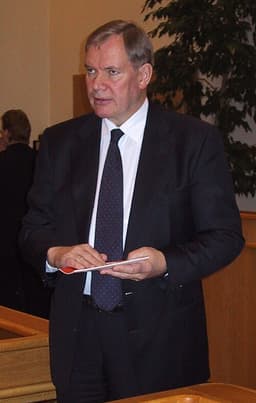
Paavo Lipponen
Politician · Modern
51.2Total

Sergio Moro
Politician · Modern
48.6Total
Basic Information
Born
1941
1972
Died
—
—
Era
Modern
Modern
Nationality
Finland
Brazil
Occupation
Politician
Politician
Civilization
Western
Western
Score Comparison
Military (10%)
21.2
49.4
Political (20%)
60.0
48.0
Influence (20%)
56.4
58.0
Legacy (20%)
45.0
47.5
Leadership (15%)
72.0
38.1
Strategy (15%)
38.9
43.8
TOTAL
51.2
48.6
Paavo Lipponen — Complete Timeline
1995 AD
Election as Prime Minister of FinlandPolitical Action◆ Major
Paavo Lipponen became Prime Minister of Finland, leading a broad coalition government of Social Democrats, Conservatives, and others. His tenure focused on economic recovery, EU integration, and welfare state reforms.
Finnish PoliticsSocial Democratic PartyCoalition Government
Impact: nationalconstructive
1999 AD
Finland's EU PresidencyPolitical Action◆ Major
Finland held its first rotating presidency of the Council of the European Union under Lipponen's leadership. The presidency focused on EU enlargement, the Helsinki Summit, and the development of the EU's security and defence policy.
European UnionFinnish Presidency
Impact: regionalconstructive
2002 AD
Introduction of the Euro in FinlandPolitical Action◆ Major
Under Lipponen's government, Finland adopted the euro as its official currency, replacing the Finnish markka. This was a key step in Finland's deeper integration into the European Union.
Euro AdoptionFinnish EconomyEU Integration
Impact: nationalconstructive
2003 AD
Resignation as Prime MinisterPolitical Action◆ Major
Lipponen resigned as Prime Minister after the Social Democrats lost seats in the general election. He was succeeded by Anneli J
Finnish PoliticsResignation
Impact: national
Sergio Moro — Complete Timeline
1996 AD
Appointed federal judge in CuritibaPolitical Action
Sérgio Moro was appointed a federal judge in Curitiba, Paraná. He specialized in financial crimes and money laundering, building expertise that would later be central to Operation Car Wash.
Judicial CareerLegal Expertise
2014 AD
Launched Operation Car WashPolitical Action
Sérgio Moro launched Operation Car Wash (Lava Jato), a massive anti-corruption investigation targeting bribery and money laundering involving Petrobras, construction companies, and politicians. The investigation led to numerous convictions and became the largest corruption probe in Brazilian history.
Anti-CorruptionOperation Car Wash
Impact: globalconstructive
2017 AD
Convicted Luiz Inácio Lula da SilvaPolitical Action
Sérgio Moro convicted former President Luiz Inácio Lula da Silva on corruption and money laundering charges related to a beachfront apartment. The conviction was later overturned by the Supreme Court on procedural grounds, but at the time it prevented Lula from running in the 2018 election.
Corruption ConvictionLula
Impact: national
2019 AD
Appointed Minister of JusticePolitical Action◆ Major
Sérgio Moro was appointed Minister of Justice and Public Security under President Jair Bolsonaro. He resigned in 2020, accusing Bolsonaro of political interference in the Federal Police.
Ministry of JusticeBolsonaro Government
Impact: national
This comparison has not been analyzed yet.
One-time AI generation (~1 minute). Scores and timeline are already available below.
Rankings
🥇
Paavo LipponenLeader
Mil: 21.2Pol: 60.0Inf: 56.4
51.2
🥈
Sergio Moro
Mil: 49.4Pol: 48.0Inf: 58.0
48.6
+2.6 behind
How This Comparison Works
Algorithm
Each figure is scored on 6 dimensions (0—100 scale) based on structured historical data: Military (10%), Political (20%), Influence (20%), Legacy (20%), Leadership (15%), Strategy (15%). The weighted total produces the final ranking.
Data Sources
Scores are computed from structured sub-indicators in the database. Scale factors adjust for era (Ancient ×0.85, Modern ×1.0) and civilization size (Eastern ×1.05, Other ×0.80) to account for differences in population and military scale.
Maximum 3 Figures
Comparisons are limited to 2—3 figures to ensure readability and statistical meaningfulness.
Error Margins
±5 points per dimension — Sub-scores are derived from historical records with inherent uncertainty. Two figures within 5 points on a dimension should be considered roughly equivalent in that area.
Total Score Accuracy
±3 points overall — The weighted combination of 6 dimensions produces a total score with approximately ±3 points of uncertainty. Differences of less than 3 points are not statistically significant— the figures are effectively tied.
Known Limitations
- Historical records are incomplete and uneven across civilizations
- Figures from oral-tradition societies may be underrepresented
- Occupation labels can misclassify multi-role figures
- Scores measure capability and impact, not moral character
- Quantitative scoring is a comparison tool, not absolute truth
Capability Radar
Military (10%) — Battles & Warfare
Battles
24
29
Win Rate
28
31
Expansion
28
36
Political (20%) — Governance & Reform
Reform
60
70
Diplomacy
70
30
Economy
65
20
Influence (20%) — Cultural & Global Reach
Cultural
30
40
Global
50
50
Legacy (20%) — Historical Impact
Historical
40
55
Longevity
30
30
Leadership (15%) — Power & Stability
Tenure
65
15
Stability
60
10
Strategy (15%) — Tactics & Innovation
Strategy
30
37
Tactics
35
43
Reform
40
46
Similar Comparisons
Comments & Discussion
No comments yet. Be the first to share your thoughts!