Loading...
This comparison has not been analyzed yet.
One-time AI generation (~1 minute). Scores and timeline are already available below.
Pratibha Patil vs Saddam Hussein
Saddam Hussein leads by 2.8 pts · 2 figures compared
…

Pratibha Patil
Politician · Modern
46.9Total
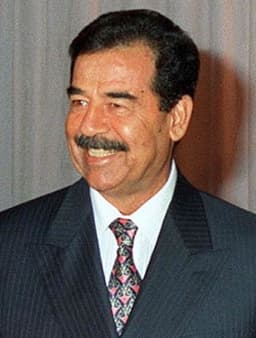
Saddam Hussein
Politician · Modern
49.7Total
Basic Information
Born
1934
1937
Died
—
—
Era
Modern
Modern
Nationality
India
Iraq
Occupation
Politician
Politician
Civilization
Indian
Middle Eastern
Score Comparison
Military (10%)
19.0
52.5
Political (20%)
42.3
43.7
Influence (20%)
54.9
58.0
Legacy (20%)
42.5
47.5
Leadership (15%)
72.0
40.0
Strategy (15%)
35.2
55.0
TOTAL
46.9
49.7
Pratibha Patil — Complete Timeline
1985 AD
Served as a minister in the Maharashtra governmentPolitical Action
Patil served as a minister in the Maharashtra state government, holding portfolios including Social Welfare, Women and Child Development, and Tourism. She was a prominent figure in the state's Congress party.
State MinisterMaharashtraSocial Welfare
Impact: regionalconstructive
1991 AD
Elected to the Lok SabhaPolitical Action
Patil was elected to the Lok Sabha, the lower house of the Indian Parliament, from the Amravati constituency. She served multiple terms and held various parliamentary positions.
Lok SabhaParliamentCongress Party
Impact: nationalconstructive
2004 AD
Served as Governor of RajasthanPolitical Action
Patil was appointed Governor of Rajasthan, the first woman to hold the office in the state. She served until her election as President, focusing on education and women's empowerment.
GovernorRajasthanWomen's Empowerment
Impact: regionalconstructive
2007 AD
Elected President of IndiaPolitical Action◆ Major
Patil was elected as the 12th President of India, becoming the first woman to hold the office. She defeated opposition candidate Bhairon Singh Shekhawat in a decisive victory.
PresidencyFirst Woman PresidentElection
Impact: nationalconstructive
Saddam Hussein — Complete Timeline
1979 AD
Became President of IraqPolitical Action
Saddam Hussein forced President Ahmed Hassan al-Bakr to resign on July 16, 1979, and assumed the presidency. He immediately purged the Ba'ath Party, executing 68 senior members in a televised purge. This consolidated his absolute control over Iraq's government and security apparatus.
Power ConsolidationPurgeBa'ath Party
Impact: nationaldestructive
1980 AD
Invaded IranWar
Saddam launched a full-scale invasion of Iran on September 22, 1980, aiming to seize the oil-rich Khuzestan province and overthrow the new Islamic regime. The war lasted eight years, resulting in hundreds of thousands of casualties and massive economic destruction for both countries, ending in a stalemate.
Iran-Iraq WarInvasionStalemate
Impact: regionaldestructive
1988 AD
Used chemical weapons against Kurds at HalabjaWar◆ Major
During the Anfal campaign, Iraqi forces under Saddam's orders attacked the Kurdish town of Halabja with mustard gas and nerve agents on March 16, 1988. An estimated 5,000 civilians were killed instantly. The attack is considered one of the worst chemical weapons attacks against a civilian population.
Chemical WeaponsWar CrimeKurds
Impact: nationaldestructive
1990 AD
Invaded KuwaitWar
Saddam ordered the invasion and annexation of Kuwait on August 2, 1990, claiming it was historically part of Iraq. The invasion was condemned internationally and led to the Gulf War. A US-led coalition expelled Iraqi forces in February 1991, and Iraq faced severe UN sanctions.
Gulf WarInvasionSanctions
Impact: globaldestructive
2003 AD
Captured by US forces and executedPolitical Action
After the US-led invasion of Iraq in March 2003, Saddam went into hiding. He was captured by US forces on December 13, 2003, near Tikrit. Tried by the Iraqi Special Tribunal for crimes against humanity, he was sentenced to death and executed by hanging on December 30, 2006.
CaptureTrialExecution
Impact: globaltragic
This comparison has not been analyzed yet.
One-time AI generation (~1 minute). Scores and timeline are already available below.
Rankings
🥇
Saddam HusseinLeader
Mil: 52.5Pol: 43.7Inf: 58.0
49.7
🥈
Pratibha Patil
Mil: 19.0Pol: 42.3Inf: 54.9
46.9
+2.8 behind
How This Comparison Works
Algorithm
Each figure is scored on 6 dimensions (0—100 scale) based on structured historical data: Military (10%), Political (20%), Influence (20%), Legacy (20%), Leadership (15%), Strategy (15%). The weighted total produces the final ranking.
Data Sources
Scores are computed from structured sub-indicators in the database. Scale factors adjust for era (Ancient ×0.85, Modern ×1.0) and civilization size (Eastern ×1.05, Other ×0.80) to account for differences in population and military scale.
Maximum 3 Figures
Comparisons are limited to 2—3 figures to ensure readability and statistical meaningfulness.
Error Margins
±5 points per dimension — Sub-scores are derived from historical records with inherent uncertainty. Two figures within 5 points on a dimension should be considered roughly equivalent in that area.
Total Score Accuracy
±3 points overall — The weighted combination of 6 dimensions produces a total score with approximately ±3 points of uncertainty. Differences of less than 3 points are not statistically significant— the figures are effectively tied.
Known Limitations
- Historical records are incomplete and uneven across civilizations
- Figures from oral-tradition societies may be underrepresented
- Occupation labels can misclassify multi-role figures
- Scores measure capability and impact, not moral character
- Quantitative scoring is a comparison tool, not absolute truth
Capability Radar
Military (10%) — Battles & Warfare
Battles
23
65
Win Rate
25
40
Expansion
31
60
Political (20%) — Governance & Reform
Reform
30
40
Diplomacy
40
35
Economy
30
30
Influence (20%) — Cultural & Global Reach
Cultural
30
30
Global
30
50
Legacy (20%) — Historical Impact
Historical
35
55
Longevity
20
20
Leadership (15%) — Power & Stability
Tenure
60
75
Stability
50
20
Strategy (15%) — Tactics & Innovation
Strategy
35
50
Tactics
33
55
Reform
40
45
Similar Comparisons
Comments & Discussion
No comments yet. Be the first to share your thoughts!