Loading...
Prem Tinsulanonda vs Samori Toure
Samori Toure leads by 13.3 pts · 2 figures compared
…
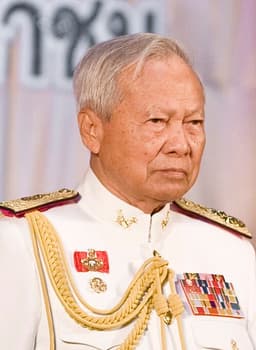
Prem Tinsulanonda
General · Modern
57.2Total
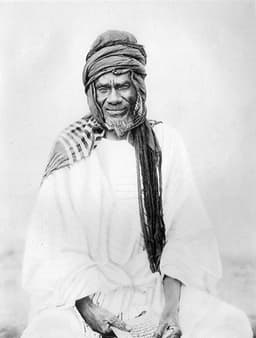
Samori Toure
General · Modern
70.5Total
Basic Information
Born
1920
1830
Died
—
1900
Era
Modern
Modern
Nationality
Thailand
Wassoulou Empire
Occupation
General
General
Civilization
Eastern
Other
Score Comparison
Military (10%)
50.0
60.0
Political (20%)
59.3
78.0
Influence (20%)
54.9
68.0
Legacy (20%)
47.5
72.0
Leadership (15%)
78.0
72.0
Strategy (15%)
60.0
70.0
TOTAL
57.2
70.5
Prem Tinsulanonda — Complete Timeline
1980 AD
Appointed Prime Minister after a coupPolitical Action◆ Major
Prem Tinsulanonda was appointed Prime Minister of Thailand by the military after a coup. He served for over eight years, overseeing a period of political stability and economic growth.
Prime MinisterMilitary RuleStability
Impact: national
1981 AD
Survived a coup attemptPolitical Action◆ Major
Prem survived a coup attempt by military officers loyal to the 'Young Turks' faction. The coup failed due to lack of support and the loyalty of key military units, allowing Prem to remain in power.
Coup AttemptPolitical CrisisMilitary
Impact: national
1988 AD
Resigned as Prime MinisterPolitical Action◆ Major
Prem resigned as Prime Minister after the general election, handing over power to a civilian government led by Chatichai Choonhavan. His resignation marked a rare peaceful transition of power in Thai politics.
ResignationDemocratic TransitionPeaceful
Impact: nationalconstructive
2016 AD
Appointed Regent of ThailandPolitical Action
After the death of King Bhumibol, Prem was appointed Regent of Thailand until the ascension of King Maha Vajiralongkorn. He served as a key figure in the transition of the monarchy.
RegentMonarchyTransition
Impact: national
Samori Toure — Complete Timeline
1878 AD
Establishment of the Wassoulou EmpirePolitical Action
Samori Toure founded the Wassoulou Empire in West Africa, uniting various Mandinka states under his rule. He established a centralized administration and a professional army, creating a powerful state that resisted French expansion.
EmpireWassoulouUnification
Impact: regionalconstructive
1880 AD
Military Reforms and ModernizationReform◆ Major
Samori Toure modernized his army by importing firearms from European traders and establishing a standing army of up to 35,000 men. He organized his forces into regular units and introduced new tactics, making them effective against French troops.
Military ReformFirearmsArmy
Impact: regionalconstructive
1882 AD
First Franco-Wassoulou WarWar◆ Major
Samori Toure's forces fought the French army in the first major conflict between the Wassoulou Empire and France. The war ended with a treaty in 1886, recognizing Samori's control over the Niger River region.
WarFranceTreaty
Impact: regional
1891 AD
Second Franco-Wassoulou WarWar◆ Major
The French resumed hostilities, forcing Samori to retreat eastward. He employed a scorched-earth strategy, destroying villages and crops to deny resources to the French, prolonging the conflict for years.
WarScorched EarthRetreat
Impact: regionaltragic
1898 AD
Capture and ExileWar
Samori Toure was captured by French forces after a long campaign. He was exiled to Gabon, where he died in 1900. His capture ended the Wassoulou Empire and marked the completion of French conquest in West Africa.
CaptureExileEnd of Empire
Impact: regionaltragic
Expert Analysis
Prem Tinsulanonda vs Samori Toure
# The General and the Regent: Two Paths of Power in a Turbulent Century
On a dusty plain in West Africa in 1898, a 68-year-old man in a white robe sat motionless as French soldiers bound his wrists. Samori Toure, who had built an empire from nothing and held France at bay for sixteen years, had finally been caught. Half a world away and eighty years later, another general sat in an air-conditioned office in Bangkok, calmly defusing a coup attempt with nothing more than a telephone call and the quiet weight of royal favor. Prem Tinsulanonda would survive that night, and many more, to become the most durable power broker in modern Thai history. These two men, both soldiers, both rulers, both facing the crushing forces of their age, stand as contrasting monuments to what military leadership could mean in the modern era—one destroyed by the very forces he resisted, the other bending those forces to his will.
Origins
Samori Toure was born around 1830 into the chaos of a collapsing Mali Empire, in what is now Guinea. His mother was a slave; his father a small trader. He grew up in a world of shifting alliances, where power belonged to those who could seize it. The slave trade had hollowed out West Africa, and the first whispers of European colonization were growing louder. Samori learned young that survival required speed, ruthlessness, and an unblinking eye for opportunity. He began as a soldier of fortune, then built his own following, and by the 1870s had carved out a domain that would become the Wassoulou Empire.
Prem Tinsulanonda was born in 1920 in Songkhla, in southern Thailand, into a world of stability. His father was a provincial judge; his mother a schoolteacher. Siam, as it was then called, had never been colonized—a fact that shaped every assumption of Prem’s life. He attended elite military academies, learned discipline and hierarchy, and absorbed the lesson that power in Thailand flowed not through conquest but through proximity to the throne. Where Samori faced the gunboats of Europe, Prem faced the intricate dance of Bangkok palace politics.
Rise to Power
Samori’s rise was violent and direct. In 1878, he declared himself *faama*—military ruler—of the Wassoulou Empire, uniting Mandinka states through a combination of marriage alliances, forced submission, and sheer military dominance. He was not a statesman building a nation; he was a warlord assembling an army. His capital, Bissandugu, became a fortress and a marketplace, where he traded gold and ivory for the one thing that mattered: rifles. By 1880, he had imported thousands of breech-loading weapons from British and German traders, and organized a standing army of 30,000 men, drilled on European lines but commanded by his own lieutenants.
Prem’s rise was slow and institutional. He served in World War II, then climbed the ranks of the Thai army with quiet competence, never seeking the spotlight. In 1980, after a coup ousted the civilian government, the military junta needed a prime minister who could manage both the generals and the palace. Prem was their choice—a man so unassuming that no one feared him, yet so connected that everyone needed him. He was not a conqueror; he was a bridge.
Leadership & Governance
Samori governed like a man building a fortress while the walls were already burning. He centralized taxation, standardized weights and measures, and imposed Islamic law across his multi-ethnic empire. But his true genius was military. When the first Franco-Wassoulou War erupted in 1882, he fought the French to a stalemate, forcing them to sign a treaty recognizing his sovereignty. He understood that he could not defeat France in open battle—so he made the cost of conquest too high. He moved his entire population eastward in 1891, burning villages and crops behind him, denying the French any resources. For seven years, he led his people on a forced march across West Africa, fighting guerilla actions while building new cities in the wilderness.
Prem governed like a man balancing on a razor. His political score of 68.8 and leadership score of 89.0 reveal the paradox: he was not a visionary, but he was a master of survival. He presided over a period of economic growth and relative stability, but his real skill was managing the military factions that had put him in power. In 1981, when the “Young Turks” attempted a coup, Prem did not fight. He called the king, secured royal endorsement, and watched the coup collapse as soldiers refused to fire on a government backed by the monarchy. He understood that in Thailand, legitimacy came not from the gun but from the throne.
Triumph & Tragedy
Samori’s greatest moment was also his most heartbreaking. In 1898, after years of retreat, he was finally cornered near the Cavally River. He negotiated a surrender that he hoped would spare his people—but the French broke their word. He was exiled to Gabon, where he died of pneumonia in 1900. His empire was dismantled, his sons scattered, his people absorbed into French West Africa. He had fought longer and smarter than any other African leader, but he had fought alone, against a power that could replace every soldier he killed.
Prem’s triumph was quieter but more lasting. In 1988, he resigned as prime minister after a general election, handing power to a civilian government—a rare thing in Thai history. He did not cling to office; he stepped back, becoming a gray eminence behind the scenes. In 2016, after the death of King Bhumibol, the 96-year-old Prem was appointed regent, the caretaker of the throne itself. He had not just survived; he had become the institution.
Character & Destiny
Samori’s character was forged in fire. He was proud, stubborn, and unwilling to compromise with what he saw as infidels and invaders. His strategy score of 68.0 reflects a man who could plan brilliantly but could not adapt to the ultimate reality of French industrial power. He chose resistance over accommodation, and that choice cost him everything. Yet he never wavered. When a French officer asked him why he had fought so long, he is said to have replied: “I would rather die than be a slave.”
Prem’s character was forged in shadow. He was patient, flexible, and utterly unreadable. He never sought personal glory, never made enemies he could not manage, and never forgot that in Thailand, power is a borrowed thing. His military score of 33.7 is almost irrelevant—he never needed to be a great general, because he understood that wars are won in council chambers, not on battlefields. Where Samori saw the world as a struggle between freedom and domination, Prem saw it as a game of alliances and debts.
Legacy
Samori Toure is remembered as a martyr of African resistance, a symbol of dignity in defeat. His name is taught in schools across West Africa; statues stand in Guinea and Mali. But his legacy is ambiguous: he fought colonialism but could not stop it, and his empire died with him. His total score of 72.0 reflects a figure respected but ultimately tragic.
Prem Tinsulanonda is remembered as the architect of modern Thai stability, the man who kept the military in check and the monarchy intact. His legacy is also ambiguous: he was a kingmaker who never sought the crown, a democrat who thrived under dictatorships. But he died in power, respected by all factions, having shaped Thailand for four decades. His total score of 68.4 is lower, but his impact was deeper.
Conclusion
One built an empire that crumbled; the other built a system that endured. Samori Toure and Prem Tinsulanonda both understood that power is never given—it is taken, held, and lost. But they understood different kinds of power. Samori’s was the power of the sword, bright and terrible, that burns out in a single generation. Prem’s was the power of the shadow, patient and cold, that outlasts empires. In the end, the question is not which man was greater, but which world we live in—the world of open war, where heroes are made and destroyed, or the world of hidden hands, where survival is its own victory.
Rankings
🥇
Samori ToureLeader
Mil: 60.0Pol: 78.0Inf: 68.0
70.5
🥈
Prem Tinsulanonda
Mil: 50.0Pol: 59.3Inf: 54.9
57.2
+13.3 behind
How This Comparison Works
Algorithm
Each figure is scored on 6 dimensions (0—100 scale) based on structured historical data: Military (10%), Political (20%), Influence (20%), Legacy (20%), Leadership (15%), Strategy (15%). The weighted total produces the final ranking.
Data Sources
Scores are computed from structured sub-indicators in the database. Scale factors adjust for era (Ancient ×0.85, Modern ×1.0) and civilization size (Eastern ×1.05, Other ×0.80) to account for differences in population and military scale.
Maximum 3 Figures
Comparisons are limited to 2—3 figures to ensure readability and statistical meaningfulness.
Error Margins
±5 points per dimension — Sub-scores are derived from historical records with inherent uncertainty. Two figures within 5 points on a dimension should be considered roughly equivalent in that area.
Total Score Accuracy
±3 points overall — The weighted combination of 6 dimensions produces a total score with approximately ±3 points of uncertainty. Differences of less than 3 points are not statistically significant— the figures are effectively tied.
Known Limitations
- Historical records are incomplete and uneven across civilizations
- Figures from oral-tradition societies may be underrepresented
- Occupation labels can misclassify multi-role figures
- Scores measure capability and impact, not moral character
- Quantitative scoring is a comparison tool, not absolute truth
Capability Radar
Military (10%) — Battles & Warfare
Battles
20
75
Win Rate
25
65
Expansion
10
60
Political (20%) — Governance & Reform
Reform
55
75
Diplomacy
60
80
Economy
50
60
Influence (20%) — Cultural & Global Reach
Cultural
30
65
Global
30
55
Legacy (20%) — Historical Impact
Historical
40
70
Longevity
35
60
Leadership (15%) — Power & Stability
Tenure
65
70
Stability
60
55
Strategy (15%) — Tactics & Innovation
Strategy
30
85
Tactics
30
80
Reform
35
70
Similar Comparisons
Comments & Discussion
THESAMURAI GENERAL6/16/2026
Anyone who equates these two hasn’t studied logistics. Samori Toure manufactured his own rifles, coordinated scorched-earth retreats across 200,000 square kilometers, and held one of Europe’s best armies at bay for 16 years with no outside support. Prem sat in an office, made one phone call, and the tanks rolled back to barracks thanks to royal patronage. One built an empire from scratch; the other inherited a power structure. Give me Samori’s strategic mind any day over a well-connected bureauc
帝国铁蹄记录者6/16/2026
说Prem不费一枪一弹就稳住了局势,那是把制度的重量误当成个人的勇气。1898年Samori被俘时,法国的夏尔·米歇尔将军缴获了超过1,000支他自制的步枪——这说明什么?一个文盲军阀能在西非腹地搞出土法军工业,而Prem不过是国王办公室里的接线员。别拿政变稳控术去碰民族解放战争,段位差了三层楼。
DATALORD6/16/2026
The analysis romanticizes Prem’s “defusing” act while ignoring hard facts. In 1992, Prem was directly accused of orchestrating the Black May massacre that left 52 dead and hundreds missing—that’s not “bending forces to his will,” that’s blood-soaked power brokering. Samori’s death toll from his slaving expeditions is estimated at 30,000+ by historian Yves Person. These aren’t noble warriors; they’re violent strongmen with different PR teams.
数字铁砧6/16/2026
说Samori是“悲剧英雄”,却故意忽略他贩卖战俘给欧洲人的细节。1887年他与法国签署《比桑杜古条约》,用土地换喘息机会,转头就把苏丹逃兵绑成奴隶卖给塞内加尔商人。这不是什么战略智慧,是两头吃。Prem玩的是宫斗,Samori玩的是人命买卖,都别涂金粉。我们要尊重事实,不是造神。
LONGVIEW CLASSICIST6/16/2026
The contrast is structural, not moral. Samori faced the steamroller of industrial imperialism—artillery, telegraphs, steamships—with tactics honed for pre-colonial African warfare. His empire lasted 16 years against that machine. Prem faced a bureaucratic coup led by a few colonels in 1981; he had the king, the air force, and the civil service on speed dial. Context matters: Samori was fighting against history; Prem was riding with it. That’s not a knock on either—it’s the difference between Dav
泥路书生6/16/2026
我不同意把Prem捧成“权力艺术家”。他1988年下台后没消失,而是以枢密院主席身份把将军们捏在