Loading...
This comparison has not been analyzed yet.
One-time AI generation (~1 minute). Scores and timeline are already available below.
Qi Jiguang vs Su Dingfang
Qi Jiguang leads by 5.3 pts · 2 figures compared
…

Qi Jiguang
General · Medieval
63.4Total
Su Dingfang
General · Medieval
58.1Total
Basic Information
Born
1528
591
Died
1588
667
Era
Medieval
Medieval
Nationality
China
China
Occupation
General
General
Civilization
Eastern
Eastern
Score Comparison
Military (10%)
80.0
80.0
Political (20%)
68.0
48.0
Influence (20%)
61.0
57.2
Legacy (20%)
58.0
47.5
Leadership (15%)
48.8
62.0
Strategy (15%)
81.6
74.4
TOTAL
63.4
58.1
Qi Jiguang — Complete Timeline
1555 AD
Formation of the Qi family armyWar◆ Major
Qi Jiguang recruited and trained a new army from the peasantry of Zhejiang province. He implemented strict discipline, innovative tactics, and specialized weapons, creating a highly effective force against Japanese pirates.
Military ReformPiracyMing Dynasty
Impact: regionalconstructive
1560 AD
Publication of 'New Treatise on Military Efficiency'Cultural◆ Major
Qi Jiguang wrote 'New Treatise on Military Efficiency' (Jixiao Xinshu), a manual on military training and tactics. The book detailed his methods for organizing, equipping, and drilling troops, influencing later Chinese military thought.
Military ManualTacticsMing Dynasty
Impact: nationalconstructive
1561 AD
Battle of CengangWar◆ Major
Qi Jiguang led his army to a decisive victory against Japanese pirates at Cengang in Zhejiang. The battle destroyed a major pirate base and significantly reduced pirate activity along the coast.
BattlePiracyMing Dynasty
Impact: regionalconstructive
1568 AD
Defense of the Great WallWar◆ Major
Qi Jiguang was appointed to strengthen the Great Wall defenses against Mongol incursions. He rebuilt sections of the wall, added watchtowers, and trained garrison troops, improving border security for decades.
Great WallDefenseMongol Incursions
Impact: nationalconstructive
Su Dingfang — Complete Timeline
635 AD
Defeated the Tuyuhun kingdomWar
Su Dingfang participated in the Tang campaign against the Tuyuhun kingdom. The Tuyuhun were defeated and became a Tang vassal, securing the Tang's western frontier.
Tang expansionTuyuhunMilitary campaign
Impact: regional
657 AD
Conquered the Western Turkic KhaganateWar
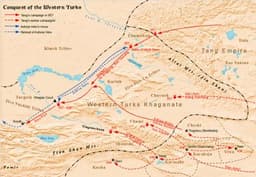
Su Dingfang led a Tang army to defeat the Western Turkic Khaganate at the Battle of Irtysh River. The khagan was captured, and the Western Turkic state was destroyed, extending Tang control over Central Asia.
Tang expansionCentral AsiaMilitary campaign
Impact: regional
Suppressed the rebellion of Ashina HeluWar◆ Major
After the conquest of the Western Turks, Su Dingfang suppressed a rebellion led by Ashina Helu, a former Turkic vassal. The rebellion was crushed, and Helu was captured, solidifying Tang control.
RebellionCentral AsiaTang dynasty
Impact: regional
This comparison has not been analyzed yet.
One-time AI generation (~1 minute). Scores and timeline are already available below.
Rankings
🥇
Qi JiguangLeader
Mil: 80.0Pol: 68.0Inf: 61.0
63.4
🥈
Su Dingfang
Mil: 80.0Pol: 48.0Inf: 57.2
58.1
+5.3 behind
How This Comparison Works
Algorithm
Each figure is scored on 6 dimensions (0—100 scale) based on structured historical data: Military (10%), Political (20%), Influence (20%), Legacy (20%), Leadership (15%), Strategy (15%). The weighted total produces the final ranking.
Data Sources
Scores are computed from structured sub-indicators in the database. Scale factors adjust for era (Ancient ×0.85, Modern ×1.0) and civilization size (Eastern ×1.05, Other ×0.80) to account for differences in population and military scale.
Maximum 3 Figures
Comparisons are limited to 2—3 figures to ensure readability and statistical meaningfulness.
Error Margins
±5 points per dimension — Sub-scores are derived from historical records with inherent uncertainty. Two figures within 5 points on a dimension should be considered roughly equivalent in that area.
Total Score Accuracy
±3 points overall — The weighted combination of 6 dimensions produces a total score with approximately ±3 points of uncertainty. Differences of less than 3 points are not statistically significant— the figures are effectively tied.
Known Limitations
- Historical records are incomplete and uneven across civilizations
- Figures from oral-tradition societies may be underrepresented
- Occupation labels can misclassify multi-role figures
- Scores measure capability and impact, not moral character
- Quantitative scoring is a comparison tool, not absolute truth
Capability Radar
Military (10%) — Battles & Warfare
Battles
75
85
Win Rate
85
90
Expansion
40
80
Political (20%) — Governance & Reform
Reform
85
40
Diplomacy
50
65
Economy
55
45
Influence (20%) — Cultural & Global Reach
Cultural
70
55
Global
55
60
Legacy (20%) — Historical Impact
Historical
75
65
Longevity
70
50
Leadership (15%) — Power & Stability
Tenure
60
50
Stability
65
55
Strategy (15%) — Tactics & Innovation
Strategy
80
85
Tactics
90
88
Reform
95
60
Similar Comparisons
Comments & Discussion
No comments yet. Be the first to share your thoughts!