Loading...
Richard II of England vs Yeonsangun of Joseon
Richard II of England leads by 3.9 pts · 2 figures compared
…
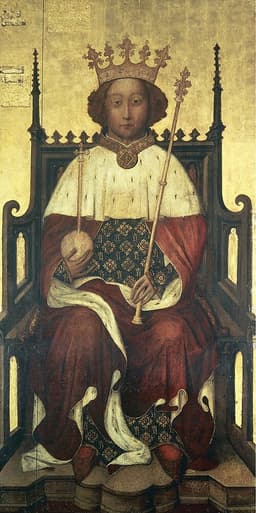
Richard II of England
Emperor · Medieval
42.8Total

Yeonsangun of Joseon
Emperor · Medieval
38.9Total
Basic Information
Born
1367
1476
Died
1400
1506
Era
Medieval
Medieval
Nationality
England
Korea
Occupation
Emperor
Emperor
Civilization
Western
Eastern
Score Comparison
Military (10%)
21.2
10.2
Political (20%)
35.1
35.0
Influence (20%)
51.8
47.9
Legacy (20%)
45.0
41.7
Leadership (15%)
48.4
38.1
Strategy (15%)
39.6
45.0
TOTAL
42.8
38.9
Richard II of England — Complete Timeline
1381 AD
Peasants' RevoltPolitical Action◆ Major
Richard II faced the Peasants' Revolt, a major uprising led by Wat Tyler. The rebels marched on London, demanding an end to serfdom and poll taxes. Richard met them at Smithfield, where Tyler was killed, and the revolt was suppressed.
RevoltPeasantsWat Tyler
Impact: nationaldestructive
1388 AD
Merciless ParliamentPolitical Action◆ Major
The Lords Appellant, a group of nobles, took control of the government through the Merciless Parliament. They executed or exiled Richard's favorites, severely limiting his power and humiliating the king.
ParliamentLords AppellantPurge
Impact: nationaldestructive
1399 AD
Deposition by Henry BolingbrokePolitical Action◆ Major
Richard II was deposed by his cousin Henry Bolingbroke, who returned from exile and seized the throne. Richard was imprisoned and forced to abdicate, ending his reign and beginning the Lancastrian dynasty.
DepositionUsurpationLancaster
Impact: nationaltragic
1400 AD
Death at Pontefract CastleOther◆ Major
Richard II died at Pontefract Castle, likely starved to death on orders of Henry IV. His death ended the Plantagenet line of direct succession and led to the Wars of the Roses.
DeathImprisonment
Impact: nationaltragic
Yeonsangun of Joseon — Complete Timeline
1498 AD
First Literati Purge (Muosahwa)Political Action◆ Major
Yeonsangun ordered the execution of several Sarim scholars who criticized his rule and his mother's status. This purge marked the beginning of his tyrannical reign and intensified factional conflict.
PurgeLiteratiJoseon Dynasty
Impact: nationaldestructive
1504 AD
Second Literati Purge (Gapjasahwa)Political Action
Yeonsangun launched a second, more brutal purge, executing hundreds of officials and scholars. He targeted those involved in his mother's death and any perceived opposition, creating a climate of terror.
PurgeTerrorJoseon Dynasty
Impact: nationaldestructive
Establishment of the Office of CensorshipPolitical Action◆ Major
Yeonsangun abolished the Office of Censorship (Saganwon) and the Office of the Inspector General (Saheonbu), removing checks on royal power. This allowed him to rule without restraint.
Political ReformAutocracyJoseon Dynasty
Impact: nationaldestructive
1506 AD
Overthrow and depositionPolitical Action
Yeonsangun was overthrown in a coup led by court officials and military commanders. He was deposed and exiled to Ganghwa Island, ending his tyrannical reign. His half-brother Jungjong was installed as king.
CoupDepositionJoseon Dynasty
Impact: national
Expert Analysis
Origins
Richard II was born in 1367 in Bordeaux, the son of Edward the Black Prince and Joan of Kent. He became king at age 10 after his grandfather Edward III died in 1377. His upbringing was dominated by court factions, and he lacked military experience. In contrast, Yeonsangun was born in 1476 as the son of King Seongjong and the deposed Queen Yoon. His mother was forced to drink poison after being implicated in a poisoning plot, an event that shaped his later persecution of officials. He ascended the throne in 1494 at age 18.
Rise to Power
Richard's early reign was marked by the Peasants' Revolt in 1381. At age 14, he confronted the rebels at Smithfield, defusing the situation by promising reforms, but later reneged and crushed the uprising. This event gave him temporary popularity, but his reliance on favorites like Robert de Vere alienated the nobility. Yeonsangun's rise was smoother; he inherited a stable kingdom. However, his obsession with his mother's death led him to purge officials involved in her demise. In 1498, he launched the First Literati Purge (Muosahwa), executing scholars who criticized his mother's status. This consolidated his power but sowed fear.
Leadership & Governance
Richard II believed in absolute monarchy, rejecting the limitations of the Magna Carta. He ruled without Parliament from 1397, seized property, and exiled opponents. His governance score is 48.4. He created a personal bodyguard of Cheshire archers to intimidate opponents. Yeonsangun, scoring 38.1 in leadership, abolished the Office of Censorship and the Inspector General, removing checks on his power. He turned the court into a place of debauchery, forcing scholars to participate in drinking and entertainment. Both rulers centralized power, but Richard was more strategic (39.6 vs 45.0 for Yeonsangun in strategy). However, Yeonsangun's purges were more systematic: the Second Literati Purge in 1504 executed hundreds, including former officials.
Triumph & Tragedy
Richard's greatest triumph was surviving the Peasants' Revolt and asserting royal authority. His tragedy was his deposition in 1399 by Henry Bolingbroke, who had popular support. Richard died at Pontefract Castle, likely starved, in 1400. Yeonsangun's triumph was his initial consolidation of power; he removed threats and ruled absolutely for 12 years. His tragedy was his overthrow in 1506 after a coup organized by officials and military leaders. He was exiled to Ganghwa Island and died there later. Both fell from power due to tyranny, but Richard's deposition led to the Wars of the Roses, while Yeonsangun's fall restored the Sarim scholars to power.
Character & Destiny
Richard was proud and impulsive, believing in divine right. He was influenced by favorites and lacked military skill. His character led to alienation of key nobles. Yeonsangun was paranoid and vengeful, driven by his mother's death. He was known for cruelty, executing even his own concubines. Historians assess Richard as a failed king who could have been effective if more pragmatic. Yeonsangun is universally condemned as a tyrant, the 'Caligula of Korea.' Their scores reflect this: Richard has 51.8 influence, Yeonsangun 47.9. Richard's political score is 35.1, Yeonsangun 35.0—nearly identical.
Legacy
Richard II's legacy is complex: his deposition weakened the monarchy and led to the Wars of the Roses. Culturally, he patronized the arts, including Chaucer. His reign is remembered as a cautionary tale of royal overreach. Yeonsangun's legacy is entirely negative; he is remembered for his purges and authoritarianism. His reign led to a strengthened Confucian bureaucracy after his fall. Richard's legacy score is 45.0, Yeonsangun's 41.7. Neither left lasting institutions; both were overthrown.
Conclusion
Richard II and Yeonsangun were both tyrants who lost power due to their excesses, but Richard had greater impact because his deposition triggered a century of civil war (Wars of the Roses) and reshaped English monarchy. Yeonsangun's fall, while significant, restored existing structures. Richard's total score of 42.8 exceeds Yeonsangun's 38.9. Therefore, Richard II had a more consequential, albeit destructive, legacy.
Rankings
🥇
Richard II of EnglandLeader
Mil: 21.2Pol: 35.1Inf: 51.8
42.8
🥈
Yeonsangun of Joseon
Mil: 10.2Pol: 35.0Inf: 47.9
38.9
+3.9 behind
How This Comparison Works
Algorithm
Each figure is scored on 6 dimensions (0—100 scale) based on structured historical data: Military (10%), Political (20%), Influence (20%), Legacy (20%), Leadership (15%), Strategy (15%). The weighted total produces the final ranking.
Data Sources
Scores are computed from structured sub-indicators in the database. Scale factors adjust for era (Ancient ×0.85, Modern ×1.0) and civilization size (Eastern ×1.05, Other ×0.80) to account for differences in population and military scale.
Maximum 3 Figures
Comparisons are limited to 2—3 figures to ensure readability and statistical meaningfulness.
Error Margins
±5 points per dimension — Sub-scores are derived from historical records with inherent uncertainty. Two figures within 5 points on a dimension should be considered roughly equivalent in that area.
Total Score Accuracy
±3 points overall — The weighted combination of 6 dimensions produces a total score with approximately ±3 points of uncertainty. Differences of less than 3 points are not statistically significant— the figures are effectively tied.
Known Limitations
- Historical records are incomplete and uneven across civilizations
- Figures from oral-tradition societies may be underrepresented
- Occupation labels can misclassify multi-role figures
- Scores measure capability and impact, not moral character
- Quantitative scoring is a comparison tool, not absolute truth
Capability Radar
Military (10%) — Battles & Warfare
Battles
15
10
Win Rate
10
10
Expansion
5
5
Political (20%) — Governance & Reform
Reform
35
5
Diplomacy
30
5
Economy
25
5
Influence (20%) — Cultural & Global Reach
Cultural
30
10
Global
20
5
Legacy (20%) — Historical Impact
Historical
40
30
Longevity
30
20
Leadership (15%) — Power & Stability
Tenure
40
40
Stability
20
5
Strategy (15%) — Tactics & Innovation
Strategy
10
5
Tactics
10
5
Reform
5
5
Similar Comparisons
Comments & Discussion
No comments yet. Be the first to share your thoughts!