Loading...
James V of Scotland vs Richard II of England
Richard II of England leads by 2.1 pts · 2 figures compared
…
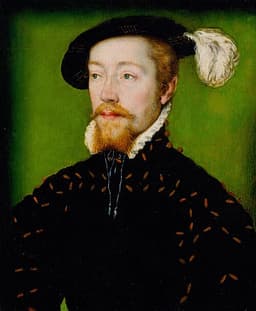
James V of Scotland
Emperor · Medieval
40.7Total
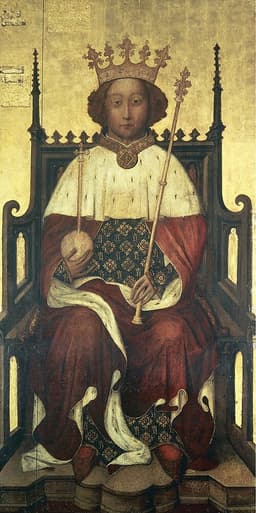
Richard II of England
Emperor · Medieval
42.8Total
Basic Information
Born
1512
1367
Died
1542
1400
Era
Medieval
Medieval
Nationality
Scotland
England
Occupation
Emperor
Emperor
Civilization
Western
Western
Score Comparison
Military (10%)
22.6
21.2
Political (20%)
36.5
35.1
Influence (20%)
48.6
51.8
Legacy (20%)
40.0
45.0
Leadership (15%)
48.4
48.4
Strategy (15%)
35.7
39.6
TOTAL
40.7
42.8
James V of Scotland — Complete Timeline
1538 AD
Marriage to Mary of GuisePolitical Action◆ Major
James V married Mary of Guise, a French noblewoman, as his second wife. The marriage strengthened the Auld Alliance with France and produced a daughter, Mary, who would become Mary Queen of Scots.
MarriageAuld AllianceFrance
Impact: nationalconstructive
1540 AD
Execution of James Hamilton of FinnartPolitical Action
James V executed James Hamilton of Finnart, a powerful noble and former regent, for treason. The execution was part of James's policy to curb noble power and centralize royal authority, but it created lasting enmity with the Hamilton family.
ExecutionNoble PurgeCentralization
Impact: nationaldestructive
Suppression of the Lords of the IslesPolitical Action◆ Major
James V conducted a campaign to suppress the Lords of the Isles, who had long held semi-independent power in the Highlands and Islands. He executed the last Lord of the Isles, Donald Dubh, and annexed their territories to the crown.
SuppressionHighlandsCentralization
Impact: regionaldestructive
1542 AD
Battle of Solway MossWar
James V's Scottish army was routed by a smaller English force at Solway Moss near the River Esk. The defeat was a humiliating disaster, with many Scottish nobles captured. James V died shortly after, reportedly of despair.
BattleDefeatDeath
Impact: nationaltragic
Richard II of England — Complete Timeline
1381 AD
Peasants' RevoltPolitical Action◆ Major
Richard II faced the Peasants' Revolt, a major uprising led by Wat Tyler. The rebels marched on London, demanding an end to serfdom and poll taxes. Richard met them at Smithfield, where Tyler was killed, and the revolt was suppressed.
RevoltPeasantsWat Tyler
Impact: nationaldestructive
1388 AD
Merciless ParliamentPolitical Action◆ Major
The Lords Appellant, a group of nobles, took control of the government through the Merciless Parliament. They executed or exiled Richard's favorites, severely limiting his power and humiliating the king.
ParliamentLords AppellantPurge
Impact: nationaldestructive
1399 AD
Deposition by Henry BolingbrokePolitical Action◆ Major
Richard II was deposed by his cousin Henry Bolingbroke, who returned from exile and seized the throne. Richard was imprisoned and forced to abdicate, ending his reign and beginning the Lancastrian dynasty.
DepositionUsurpationLancaster
Impact: nationaltragic
1400 AD
Death at Pontefract CastleOther◆ Major
Richard II died at Pontefract Castle, likely starved to death on orders of Henry IV. His death ended the Plantagenet line of direct succession and led to the Wars of the Roses.
DeathImprisonment
Impact: nationaltragic
Expert Analysis
Origins
James V of Scotland was born on April 10, 1512, at Linlithgow Palace, the son of King James IV and Margaret Tudor, sister of Henry VIII of England. His father died at the Battle of Flodden in 1513, leaving James V as an infant king. He was raised under the regency of his mother and later the Earl of Angus, experiencing a turbulent childhood marked by noble power struggles. James was educated in the humanist tradition but developed a distrust of the nobility.
Richard II of England was born on January 6, 1367, in Bordeaux, the son of Edward the Black Prince and Joan of Kent. He became king at age 10 after his grandfather Edward III's death in 1377. Richard was raised by tutors and his mother, surrounded by court factions. His early exposure to power and conflict shaped his belief in absolute monarchy.
Rise to Power
James V's rise was gradual. He took effective control of the government in 1528 after escaping from the custody of the Earl of Angus. He then embarked on a series of campaigns to assert royal authority, executing nobles like James Hamilton of Finnart in 1540 and suppressing the Lords of the Isles in the 1530s. His marriage to Mary of Guise in 1538 strengthened ties with France, enhancing his international standing.
Richard II's rise was dramatic. He became king as a child in 1377, with a regency council governing. His first major test was the Peasants' Revolt in 1381, where at age 14 he personally confronted the rebels, showing courage in meeting Wat Tyler and promising reforms. However, he later reneged on promises and suppressed the revolt with force. By the 1390s, he sought to establish absolute rule, sidelining parliament and executing opponents.
Leadership & Governance
James V governed Scotland with a focus on centralizing royal power. He curbed the influence of the nobility, confiscating lands and executing traitors. He used the Church as a source of revenue and patronage, alienating many clergy. His leadership was autocratic but effective in the short term, as he maintained peace and strengthened the crown's finances. However, his reliance on French support and his harsh treatment of nobles created resentment.
Richard II of England pursued a vision of divine right kingship. He believed the king should be above the law and surrounded himself with favorites, ignoring traditional counsel. He created a new court culture, with elaborate ceremonies and a personal bodyguard of archers. He levied forced loans and manipulated parliament. His governance was increasingly arbitrary, leading to opposition from the nobility, culminating in the Merciless Parliament of 1388, which executed his allies.
Triumph & Tragedy
James V's greatest success was his suppression of the Lords of the Isles, ending a long-standing threat to royal authority in the Highlands. He also secured the Auld Alliance with France through his marriage to Mary of Guise. His greatest tragedy was the Battle of Solway Moss in November 1542, where his army was routed by a smaller English force. This defeat, coupled with the death of his sons in infancy, led to his death from despair shortly after, leaving his infant daughter Mary, Queen of Scots as his heir.
Richard II's triumph was his handling of the Peasants' Revolt, where his personal bravery defused a crisis. He also negotiated a truce with France in 1396, marrying Isabella of Valois. His tragedy was his deposition in 1399 by Henry Bolingbroke. Richard's arbitrary rule and seizure of the Lancastrian estates alienated the nobility, leading to his capture, forced abdication, and death at Pontefract Castle, likely starved to death.
Character & Destiny
James V was intelligent and decisive but also paranoid and vengeful. He distrusted his nobles, which led to a narrow base of support. His death from despair after Solway Moss reflects his emotional fragility and the weight of his failures. Historians note his score of 48.4 in leadership, but his military score of 22.6 indicates his lack of martial success.
Richard II was cultured and artistic but also arrogant and inflexible. His belief in absolute monarchy was ahead of its time in England, where nobles expected consultation. His deposition was a direct result of his inability to compromise. His political score of 35.1 and strategy of 39.6 reflect his miscalculations.
Legacy
James V's legacy is mixed. He left a strong monarchy but a precarious succession, leading to a long minority for Mary, Queen of Scots. His reign saw the end of the Lords of the Isles and a strengthened French alliance. He is remembered as a tragic figure who died young. His influence score of 48.6 is moderate.
Richard II's legacy is more significant. His deposition led to the Wars of the Roses, as Henry IV's usurpation destabilized the throne. The concept of divine right was revived later, but Richard's failure set back royal power. He is the subject of Shakespeare's play, cementing his cultural impact. His legacy score of 45.0 reflects this.
Conclusion
Richard II had a greater impact on history, despite his failures. His deposition changed the course of English history, leading to the Lancastrian and Yorkist conflicts. James V's reign was less consequential, as his death left a child queen who would later face her own tragedies. While Richard's total score of 42.8 is only slightly higher than James's 40.7, the ripple effects of his rule were more profound. Richard's clash with parliament and his deposition set precedents for the English Civil War. James V, for all his efforts, left a weaker legacy. Thus, Richard II is the more significant figure.
Rankings
🥇
Richard II of EnglandLeader
Mil: 21.2Pol: 35.1Inf: 51.8
42.8
🥈
James V of Scotland
Mil: 22.6Pol: 36.5Inf: 48.6
40.7
+2.1 behind
How This Comparison Works
Algorithm
Each figure is scored on 6 dimensions (0—100 scale) based on structured historical data: Military (10%), Political (20%), Influence (20%), Legacy (20%), Leadership (15%), Strategy (15%). The weighted total produces the final ranking.
Data Sources
Scores are computed from structured sub-indicators in the database. Scale factors adjust for era (Ancient ×0.85, Modern ×1.0) and civilization size (Eastern ×1.05, Other ×0.80) to account for differences in population and military scale.
Maximum 3 Figures
Comparisons are limited to 2—3 figures to ensure readability and statistical meaningfulness.
Error Margins
±5 points per dimension — Sub-scores are derived from historical records with inherent uncertainty. Two figures within 5 points on a dimension should be considered roughly equivalent in that area.
Total Score Accuracy
±3 points overall — The weighted combination of 6 dimensions produces a total score with approximately ±3 points of uncertainty. Differences of less than 3 points are not statistically significant— the figures are effectively tied.
Known Limitations
- Historical records are incomplete and uneven across civilizations
- Figures from oral-tradition societies may be underrepresented
- Occupation labels can misclassify multi-role figures
- Scores measure capability and impact, not moral character
- Quantitative scoring is a comparison tool, not absolute truth
Capability Radar
Military (10%) — Battles & Warfare
Battles
15
15
Win Rate
10
10
Expansion
10
5
Political (20%) — Governance & Reform
Reform
30
35
Diplomacy
35
30
Economy
30
25
Influence (20%) — Cultural & Global Reach
Cultural
20
30
Global
10
20
Legacy (20%) — Historical Impact
Historical
25
40
Longevity
15
30
Leadership (15%) — Power & Stability
Tenure
40
40
Stability
20
20
Strategy (15%) — Tactics & Innovation
Strategy
15
10
Tactics
20
10
Reform
10
5
Similar Comparisons
Comments & Discussion
No comments yet. Be the first to share your thoughts!