Loading...
Richard III of England vs Sarki Muhammadu Korau
Sarki Muhammadu Korau leads by 4.4 pts · 2 figures compared
…
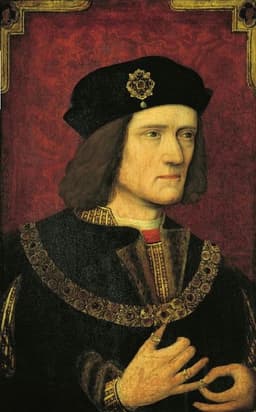
Richard III of England
Emperor · Medieval
48.2Total

Sarki Muhammadu Korau
Emperor · Medieval
52.6Total
Basic Information
Born
1452
1490
Died
1485
1540
Era
Medieval
Medieval
Nationality
England
Katsina
Occupation
Emperor
Emperor
Civilization
Western
Other
Score Comparison
Military (10%)
40.0
45.0
Political (20%)
36.5
45.1
Influence (20%)
57.2
54.9
Legacy (20%)
54.0
47.5
Leadership (15%)
38.1
65.0
Strategy (15%)
52.5
60.0
TOTAL
48.2
52.6
Richard III of England — Complete Timeline
1471 AD
Battle of TewkesburyWar◆ Major
Richard, then Duke of Gloucester, commanded the vanguard of Edward IV's army at Tewkesbury, defeating the Lancastrian forces. This victory led to the death of Edward of Westminster, Henry VI's son, and the end of the Lancastrian line.
Wars of the RosesBattleVictory
Impact: national
1483 AD
Buckingham's RebellionWar◆ Major
Henry Stafford, Duke of Buckingham, led a rebellion against Richard III, aiming to place Henry Tudor on the throne. The rebellion failed, and Buckingham was executed, but it demonstrated significant opposition to Richard's rule.
RebellionOppositionTudor
Impact: nationaldestructive
Accession as Richard IIIPolitical Action
Richard III was crowned king of England after Parliament declared Edward V illegitimate. His accession followed the imprisonment of the Princes in the Tower and was controversial, leading to accusations of usurpation and murder.
CoronationUsurpationYorkist
Impact: national
1485 AD
Battle of Bosworth FieldWar
Richard III was killed in battle against Henry Tudor's forces at Bosworth Field. His death ended the Plantagenet dynasty and the Wars of the Roses, allowing Henry Tudor to become King Henry VII.
BattleDeathEnd of Dynasty
Impact: nationaltragic
Sarki Muhammadu Korau — Complete Timeline
1513 AD
Conquest of Katsina by SonghaiWar◆ Major
Sarki Muhammadu Korau, the warrior king of Katsina, was defeated by the Songhai Empire under Askia Mohammed I. Katsina was incorporated into the Songhai Empire as a vassal state, ending its independence.
ConquestSonghaiKatsina
Impact: regionaltragic
1520 AD
Rebellion Against Songhai RuleWar◆ Major
Sarki Muhammadu Korau led a rebellion against Songhai rule in Katsina. The rebellion was suppressed by the Songhai forces, and Korau was likely killed or captured, solidifying Songhai control over the region.
RebellionSonghaiKatsina
Impact: regionaldestructive
Expert Analysis
Origins
Richard III of England was born on October 2, 1452, at Fotheringhay Castle, the eighth child of Richard Plantagenet, Duke of York, and Cecily Neville. His father's claim to the throne sparked the Wars of the Roses. Richard was raised in a turbulent noble household, educated in chivalry and military tactics, and spent his youth under the shadow of his older brother Edward IV. In contrast, Sarki Muhammadu Korau was a 15th-century warrior king of the Hausa city-state of Katsina, in what is now northern Nigeria. Little is known of his early life, but he emerged as a leader during a period of expansion by the Songhai Empire, which threatened Hausaland. Korau's background was steeped in the traditions of Hausa warfare and governance, with oral traditions portraying him as a fierce defender of Katsina's independence.
Rise to Power
Richard III rose to prominence through his loyalty to Edward IV. He commanded the vanguard at the Battle of Tewkesbury in 1471, a decisive Yorkist victory that crushed Lancastrian resistance. Following Edward's death in 1483, Richard was named Lord Protector for his young nephew Edward V. However, he quickly moved to secure the throne, having Edward V and his brother declared illegitimate, and was crowned king on July 6, 1483. In contrast, Muhammadu Korau's rise is less documented but came through military prowess. He became Sarki (king) of Katsina, likely through a combination of lineage and battlefield success, as Katsina faced increasing pressure from the Songhai Empire under Askia Mohammed I. Korau's authority was based on his ability to lead warriors and resist external domination.
Leadership & Governance
Richard III's governance was marked by his attempt to centralize royal authority and promote justice, issuing proclamations against corruption and establishing the Council of the North. However, his rule was marred by the disappearance of the Princes in the Tower, which eroded his legitimacy. His leadership score of 38.1 reflects his inability to unite the nobility, as many defected to Henry Tudor. Muhammadu Korau's leadership (score 65.0) was more direct: he led his army in battle and inspired loyalty among his troops. His governance focused on maintaining Katsina's autonomy, but he lacked the institutional tools to build a lasting state. While Richard implemented administrative reforms, Korau's leadership was primarily military, with less emphasis on civil governance.
Triumph & Tragedy
Richard III's greatest triumph was his successful accession and initial consolidation of power, exemplified by the defeat of Buckingham's Rebellion in 1483. His tragedy was the loss of his son Edward in 1484 and his death at Bosworth Field in 1485, where he was the last English king to die in battle. He scored 40.0 in military and 36.5 in political. Muhammadu Korau's triumph was his rebellion against Songhai domination, demonstrating fierce resistance. His tragedy was the failure of that rebellion; he was likely killed when Songhai forces suppressed the uprising, and Katsina was incorporated into the Songhai Empire. His military score of 45.0 and political score of 45.1 reflect his effectiveness in battle but ultimate strategic failure.
Character & Destiny
Richard III was ambitious, calculating, and ruthless, as seen in his seizure of the throne. His decision to eliminate rivals, including the Princes, alienated supporters and sealed his fate. He scored 52.5 in strategy, but his political misjudgments outweighed his tactical skill. Muhammadu Korau was a warrior king, characterized by bravery and defiance. His destiny was shaped by the overwhelming power of Songhai; his rebellion, while heroic, was doomed from the start. Korau's strategy score of 60.0 indicates sound military planning, but his political score of 45.1 shows he lacked the diplomatic means to secure lasting independence.
Legacy
Richard III's legacy is deeply contested, largely due to Shakespeare's portrayal as a villain. In recent years, his rediscovered remains have sparked new interest. His influence score of 57.2 reflects his lasting impact on English history and culture. Muhammadu Korau's legacy is preserved in Hausa oral traditions as a symbol of resistance against foreign domination. His influence score of 54.9 and legacy score of 47.5 indicate a more localized but enduring memory. Neither ruler left enduring institutions, but Richard's brief reign contributed to the end of the Wars of the Roses, while Korau's rebellion exemplified Hausa defiance.
Conclusion
While both rulers faced defeat, Sarki Muhammadu Korau had a slightly greater overall impact, scoring 52.6 against Richard III's 48.2. Korau's higher leadership and strategy scores reflect his effectiveness in mobilizing resistance despite overwhelming odds. Richard's political failures and the controversy surrounding his usurpation diminished his achievements. However, Richard's legacy in English history is more globally recognized due to the cultural resonance of his story. In terms of concrete impact, Korau's role in Hausa history as a defender of independence gives him a clearer positive legacy, whereas Richard's reign ended in failure and dynastic collapse. Thus, Sarki Muhammadu Korau edges ahead in the comparison.
Rankings
🥇
Sarki Muhammadu KorauLeader
Mil: 45.0Pol: 45.1Inf: 54.9
52.6
🥈
Richard III of England
Mil: 40.0Pol: 36.5Inf: 57.2
48.2
+4.4 behind
How This Comparison Works
Algorithm
Each figure is scored on 6 dimensions (0—100 scale) based on structured historical data: Military (10%), Political (20%), Influence (20%), Legacy (20%), Leadership (15%), Strategy (15%). The weighted total produces the final ranking.
Data Sources
Scores are computed from structured sub-indicators in the database. Scale factors adjust for era (Ancient ×0.85, Modern ×1.0) and civilization size (Eastern ×1.05, Other ×0.80) to account for differences in population and military scale.
Maximum 3 Figures
Comparisons are limited to 2—3 figures to ensure readability and statistical meaningfulness.
Error Margins
±5 points per dimension — Sub-scores are derived from historical records with inherent uncertainty. Two figures within 5 points on a dimension should be considered roughly equivalent in that area.
Total Score Accuracy
±3 points overall — The weighted combination of 6 dimensions produces a total score with approximately ±3 points of uncertainty. Differences of less than 3 points are not statistically significant— the figures are effectively tied.
Known Limitations
- Historical records are incomplete and uneven across civilizations
- Figures from oral-tradition societies may be underrepresented
- Occupation labels can misclassify multi-role figures
- Scores measure capability and impact, not moral character
- Quantitative scoring is a comparison tool, not absolute truth
Capability Radar
Military (10%) — Battles & Warfare
Battles
55
45
Win Rate
50
50
Expansion
30
55
Political (20%) — Governance & Reform
Reform
35
40
Diplomacy
30
45
Economy
30
40
Influence (20%) — Cultural & Global Reach
Cultural
45
40
Global
40
30
Legacy (20%) — Historical Impact
Historical
60
45
Longevity
55
40
Leadership (15%) — Power & Stability
Tenure
25
50
Stability
20
50
Strategy (15%) — Tactics & Innovation
Strategy
55
45
Tactics
60
40
Reform
40
35
Similar Comparisons
Comments & Discussion
No comments yet. Be the first to share your thoughts!