Loading...
This comparison has not been analyzed yet.
One-time AI generation (~1 minute). Scores and timeline are already available below.
Tai Wu of Shang vs Wang Mang
Tai Wu of Shang leads by 13.7 pts · 2 figures compared
…
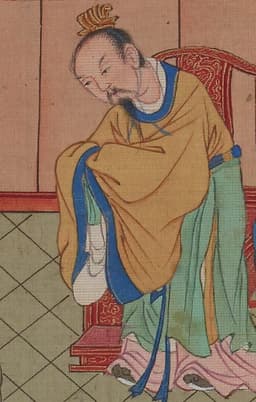
Tai Wu of Shang
Emperor · Ancient
58.5Total

Wang Mang
Emperor · Ancient
44.8Total
Basic Information
Born
-1480
-45
Died
-1400
23
Era
Ancient
Ancient
Nationality
Shang China
China
Occupation
Emperor
Emperor
Civilization
Eastern
Eastern
Score Comparison
Military (10%)
55.0
21.2
Political (20%)
68.0
62.7
Influence (20%)
54.1
50.2
Legacy (20%)
49.2
45.8
Leadership (15%)
80.0
38.1
Strategy (15%)
50.0
35.7
TOTAL
58.5
44.8
Tai Wu of Shang — Complete Timeline
1460 BC
Appointment of Wu Xian as MinisterPolitical Action◆ Major
Tai Wu appointed the virtuous minister Wu Xian, who helped restore moral governance. This appointment is credited with reviving the dynasty's fortunes after a period of decline, emphasizing meritocratic appointments.
Ministerial AppointmentMoral Revival
Impact: regionalconstructive
1450 BC
Moral Revival and Ritual RectificationReform◆ Major
Under Tai Wu's direction, the Shang court reinstituted proper ancestral rituals and moral codes. This reform reversed perceived decadence, restored divine favor, and led to a period of prosperity and stability lasting decades.
Moral ReformRitualProsperity
Impact: regionalconstructive
1400 BC
Long Reign of 75 YearsPolitical Action
Tai Wu reigned for approximately 75 years, the longest of any Shang king. This extended period of stable rule allowed for the consolidation of Shang institutions and the peaceful transmission of power to his successors.
Long ReignStability
Impact: regionalconstructive
Wang Mang — Complete Timeline
7 AD
Wang Mang's Currency ReformsReform◆ Major
Wang Mang introduced a series of complex and frequently changing currency systems, including new coinages and the demonetization of older coins. These reforms caused severe economic disruption, inflation, and widespread hardship.
Currency ReformEconomic CrisisInflation
Impact: nationaldestructive
9 AD
Wang Mang's Land Reform (Wangtian System)Reform◆ Major
Wang Mang nationalized all land, declaring it 'king's land' (wangtian), and abolished private land ownership. He redistributed land to peasant families in an attempt to reduce inequality and stabilize the economy.
Land ReformEconomic PolicySocial Reform
Impact: nationalprogressive
Abolition of SlaveryReform◆ Major
Wang Mang issued an edict abolishing slavery, declaring that all slaves were to be freed and their sale prohibited. This radical measure was met with resistance from the elite and was poorly enforced, contributing to social instability.
Slavery AbolitionSocial ReformHuman Rights
Impact: nationalprogressive
Wang Mang's Coup and Establishment of the Xin DynastyPolitical Action
Wang Mang, a Han dynasty regent, forced the child emperor Liu Ying to abdicate and proclaimed himself emperor, founding the Xin dynasty. This ended the Western Han dynasty and began a period of radical reform.
CoupDynastic ChangeUsurpation
Impact: national
18 AD
Outbreak of the Chimei RebellionWar
Widespread peasant revolts, most notably the Red Eyebrows (Chimei), erupted across China in response to Wang Mang's failed reforms, famine, and conscription. These rebellions rapidly grew into a massive insurgency that destabilized the Xin dynasty.
Peasant RevoltCivil WarRebellion
Impact: nationaldestructive
23 AD
Battle of KunyangWar
A Han loyalist army led by Liu Xiu (later Emperor Guangwu) decisively defeated a much larger Xin dynasty force at Kunyang. This victory broke the back of Wang Mang's military power and paved the way for the restoration of the Han dynasty.
BattleHan RestorationDecisive Victory
Impact: national
Death of Wang Mang in the Fall of Chang'anOther◆ Major
As rebel forces stormed the capital Chang'an, Wang Mang was killed in a melee in the Weiyang Palace. His head was taken and displayed, and the Xin dynasty was extinguished, ending his 14-year reign.
DeathDynasty FallCapital Sacked
Impact: nationaltragic
This comparison has not been analyzed yet.
One-time AI generation (~1 minute). Scores and timeline are already available below.
Rankings
🥇
Tai Wu of ShangLeader
Mil: 55.0Pol: 68.0Inf: 54.1
58.5
🥈
Wang Mang
Mil: 21.2Pol: 62.7Inf: 50.2
44.8
+13.7 behind
How This Comparison Works
Algorithm
Each figure is scored on 6 dimensions (0—100 scale) based on structured historical data: Military (10%), Political (20%), Influence (20%), Legacy (20%), Leadership (15%), Strategy (15%). The weighted total produces the final ranking.
Data Sources
Scores are computed from structured sub-indicators in the database. Scale factors adjust for era (Ancient ×0.85, Modern ×1.0) and civilization size (Eastern ×1.05, Other ×0.80) to account for differences in population and military scale.
Maximum 3 Figures
Comparisons are limited to 2—3 figures to ensure readability and statistical meaningfulness.
Error Margins
±5 points per dimension — Sub-scores are derived from historical records with inherent uncertainty. Two figures within 5 points on a dimension should be considered roughly equivalent in that area.
Total Score Accuracy
±3 points overall — The weighted combination of 6 dimensions produces a total score with approximately ±3 points of uncertainty. Differences of less than 3 points are not statistically significant— the figures are effectively tied.
Known Limitations
- Historical records are incomplete and uneven across civilizations
- Figures from oral-tradition societies may be underrepresented
- Occupation labels can misclassify multi-role figures
- Scores measure capability and impact, not moral character
- Quantitative scoring is a comparison tool, not absolute truth
Capability Radar
Military (10%) — Battles & Warfare
Battles
30
10
Win Rate
30
5
Expansion
20
5
Political (20%) — Governance & Reform
Reform
60
85
Diplomacy
50
40
Economy
50
60
Influence (20%) — Cultural & Global Reach
Cultural
55
40
Global
30
20
Legacy (20%) — Historical Impact
Historical
55
55
Longevity
60
30
Leadership (15%) — Power & Stability
Tenure
85
30
Stability
70
15
Strategy (15%) — Tactics & Innovation
Strategy
25
15
Tactics
25
10
Reform
20
20
Similar Comparisons
Comments & Discussion
No comments yet. Be the first to share your thoughts!