Loading...
This comparison has not been analyzed yet.
One-time AI generation (~1 minute). Scores and timeline are already available below.
Tribhuvan of Nepal vs Ugyen Wangchuck
Ugyen Wangchuck leads by 3.0 pts · 2 figures compared
…
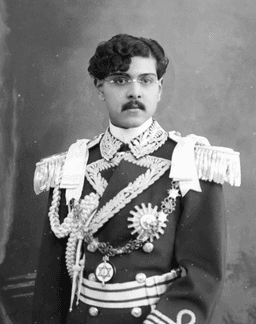
Tribhuvan of Nepal
Emperor · Modern
53.4Total

Ugyen Wangchuck
Emperor · Modern
56.4Total
Basic Information
Born
1906
1862
Died
1955
1926
Era
Modern
Modern
Nationality
Nepal
Bhutan
Occupation
Emperor
Emperor
Civilization
Indian
Indian
Score Comparison
Military (10%)
48.7
14.9
Political (20%)
45.0
78.0
Influence (20%)
54.9
56.4
Legacy (20%)
49.2
49.2
Leadership (15%)
74.6
82.0
Strategy (15%)
45.8
45.0
TOTAL
53.4
56.4
Tribhuvan of Nepal — Complete Timeline
1950 AD
Fled to India to organize opposition to Rana rulePolitical Action
King Tribhuvan, facing suppression by the ruling Rana dynasty, fled to the Indian embassy in Kathmandu and then to India. This act galvanized the Nepali Congress and Indian support, leading to the end of Rana oligarchy.
Rana regimeExileDemocracy movement
Impact: nationalconstructive
1951 AD
Signed the Delhi CompromisePolitical Action◆ Major
Tribhuvan, along with the Nepali Congress and Rana representatives, signed the Delhi Compromise in India. This agreement ended the Rana regime, restored the Shah monarchy, and established a transitional government leading to democratic elections.
DemocracyCompromiseRana regime
Impact: nationalconstructive
Returned to Nepal as sovereign monarchPolitical Action◆ Major
After the Delhi Compromise, King Tribhuvan returned to Nepal from India. He was restored as the sovereign monarch, ending 104 years of Rana hereditary rule and initiating a period of democratic governance.
Monarchy restoredDemocracyRana regime
Impact: nationalconstructive
Ugyen Wangchuck — Complete Timeline
1907 AD
Unification of BhutanPolitical Action
Ugyen Wangchuck was elected as the first hereditary Druk Gyalpo (King) of Bhutan by an assembly of monks, officials, and regional leaders. He unified the warring regions of Bhutan under a central monarchy, ending centuries of internal conflict.
UnificationMonarchyBhutan
Impact: nationalconstructive
Coronation as First Druk GyalpoPolitical Action◆ Major
Ugyen Wangchuck was formally crowned as the first King of Bhutan at Punakha Dzong. This event marked the establishment of the Wangchuck dynasty, which continues to rule Bhutan today.
CoronationDynastyBhutan
Impact: nationalconstructive
1910 AD
Signing of Treaty of PunakhaPolitical Action◆ Major
Ugyen Wangchuck signed the Treaty of Punakha with British India. The treaty recognized Bhutan's internal autonomy while giving Britain control over its foreign affairs, establishing a protectorate relationship that lasted until 1947.
TreatyDiplomacyBritish Empire
Impact: regional
This comparison has not been analyzed yet.
One-time AI generation (~1 minute). Scores and timeline are already available below.
Rankings
🥇
Ugyen WangchuckLeader
Mil: 14.9Pol: 78.0Inf: 56.4
56.4
🥈
Tribhuvan of Nepal
Mil: 48.7Pol: 45.0Inf: 54.9
53.4
+3.0 behind
How This Comparison Works
Algorithm
Each figure is scored on 6 dimensions (0—100 scale) based on structured historical data: Military (10%), Political (20%), Influence (20%), Legacy (20%), Leadership (15%), Strategy (15%). The weighted total produces the final ranking.
Data Sources
Scores are computed from structured sub-indicators in the database. Scale factors adjust for era (Ancient ×0.85, Modern ×1.0) and civilization size (Eastern ×1.05, Other ×0.80) to account for differences in population and military scale.
Maximum 3 Figures
Comparisons are limited to 2—3 figures to ensure readability and statistical meaningfulness.
Error Margins
±5 points per dimension — Sub-scores are derived from historical records with inherent uncertainty. Two figures within 5 points on a dimension should be considered roughly equivalent in that area.
Total Score Accuracy
±3 points overall — The weighted combination of 6 dimensions produces a total score with approximately ±3 points of uncertainty. Differences of less than 3 points are not statistically significant— the figures are effectively tied.
Known Limitations
- Historical records are incomplete and uneven across civilizations
- Figures from oral-tradition societies may be underrepresented
- Occupation labels can misclassify multi-role figures
- Scores measure capability and impact, not moral character
- Quantitative scoring is a comparison tool, not absolute truth
Capability Radar
Military (10%) — Battles & Warfare
Battles
29
5
Win Rate
31
5
Expansion
34
20
Political (20%) — Governance & Reform
Reform
70
75
Diplomacy
65
80
Economy
30
60
Influence (20%) — Cultural & Global Reach
Cultural
30
50
Global
30
30
Legacy (20%) — Historical Impact
Historical
55
55
Longevity
40
50
Leadership (15%) — Power & Stability
Tenure
49
70
Stability
40
70
Strategy (15%) — Tactics & Innovation
Strategy
36
10
Tactics
40
5
Reform
45
15
Similar Comparisons
Comments & Discussion
No comments yet. Be the first to share your thoughts!