Loading...
Vajiravudh vs Vimaladharmasuriya I
Vajiravudh leads by 6.6 pts · 2 figures compared
…

Vajiravudh
Emperor · Modern
56.8Total
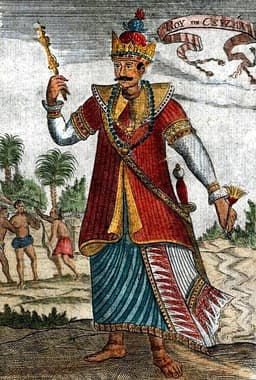
Vimaladharmasuriya I
Emperor · Modern
50.2Total
Basic Information
Born
1881
1592
Died
1925
1604
Era
Modern
Modern
Nationality
Thailand
Sri Lanka
Occupation
Emperor
Emperor
Civilization
Eastern
Indian
Score Comparison
Military (10%)
45.0
30.0
Political (20%)
68.0
54.7
Influence (20%)
55.7
51.8
Legacy (20%)
44.2
41.7
Leadership (15%)
74.0
64.0
Strategy (15%)
60.0
60.0
TOTAL
56.8
50.2
Vajiravudh — Complete Timeline
1910 AD
Promotion of Thai NationalismPolitical Action◆ Major
Vajiravudh, as King Rama VI, promoted a strong sense of Thai nationalism through speeches, writings, and policies. He emphasized loyalty to the nation, religion, and monarchy. His nationalism was aimed at unifying the country and resisting Western colonial influence.
NationalismMonarchyThai Identity
Impact: nationalconstructive
1911 AD
Creation of the Wild Tiger CorpsPolitical Action
Vajiravudh established the Wild Tiger Corps, a paramilitary organization loyal to the king. The corps was intended to counterbalance the regular army and promote royalist sentiment. It was controversial and seen as a tool to consolidate personal power.
ParamilitaryRoyalistPower Consolidation
Impact: national
1913 AD
Adoption of the Surname SystemReform
Vajiravudh introduced the use of surnames for all Thai citizens, a reform modeled on Western practices. The law required every family to adopt a surname, which helped in administrative record-keeping and promoted a sense of family identity.
Surname ReformAdministrationWesternization
Impact: nationalconstructive
1917 AD
Establishment of Chulalongkorn UniversityCultural◆ Major
Vajiravudh founded Chulalongkorn University, Thailand's first university, named after his father. The university was established to modernize education and train civil servants. It became a leading institution for higher education in Thailand.
EducationUniversityModernization
Impact: nationalconstructive
1921 AD
Introduction of Compulsory EducationReform◆ Major
Vajiravudh enacted the Compulsory Education Act, requiring all children to attend primary school. The reform aimed to increase literacy and create a more educated populace. It laid the foundation for Thailand's modern education system.
Education ReformLiteracyCompulsory Education
Impact: nationalconstructive
Vimaladharmasuriya I — Complete Timeline
1592 AD
Establishment of Kandy as CapitalPolitical Action◆ Major
Vimaladharmasuriya I established Kandy as the capital of the Sinhalese kingdom. He fortified the city and made it the center of resistance against Portuguese expansion.
CapitalFoundationResistance
Impact: nationalconstructive
1594 AD
Battle of DantureWar
Vimaladharmasuriya I's forces ambushed and defeated a Portuguese army at Danture. The Portuguese commander, Pedro Lopes de Sousa, was killed, and the Kandyan kingdom secured its independence.
BattlePortugueseIndependence
Impact: regional
1595 AD
Restoration of Buddhism in KandyPolitical Action◆ Major
Vimaladharmasuriya I restored Buddhism as the state religion in the Kandyan kingdom. He brought the Tooth Relic of the Buddha to Kandy and built a temple to house it, reviving Buddhist traditions.
BuddhismRestorationRelic
Impact: nationalconstructive
Construction of the Temple of the Tooth in KandyCultural◆ Major
Vimaladharmasuriya I built the first Temple of the Tooth in Kandy to house the sacred Tooth Relic. This established Kandy as the primary Buddhist center in Sri Lanka.
ArchitectureBuddhismRelic
Impact: nationalconstructive
Expert Analysis
Origins
**Vajiravudh** (Rama VI) was born on January 1, 1881, in Bangkok, Thailand, as the son of King Chulalongkorn (Rama V) and Queen Saovabha Phongsri. He was educated in England at Sandhurst and Oxford, exposing him to Western ideas of nationalism and governance. His upbringing in a modernizing kingdom shaped his vision for a unified Thai state.
**Vimaladharmasuriya I** (also known as Konnapu Bandara) was born around 1560 in the Kandyan Kingdom, present-day Sri Lanka. He was the son of a noble family (possibly a prince) and rose to power after the death of King Rajasinha I. His early life was marked by the conflict between the Sinhalese kingdoms and Portuguese colonial forces. He was trained in warfare and diplomacy, crucial for the survival of Kandy.
Rise to Power
**Vajiravudh** ascended the throne on October 23, 1910, upon the death of his father. His rise was smooth due to the absolute monarchy system. However, he faced challenges from conservative factions and the military. He used his position to promote Thai nationalism, introducing policies like the surname system (1913) and compulsory education (1921). His creation of the Wild Tiger Corps (1911) was a move to secure personal loyalty and counterbalance the regular army.
**Vimaladharmasuriya I** came to power around 1590 after a period of instability. He seized the throne from a rival, possibly his brother, and consolidated control over the Kandyan highlands. His key turning point was the Battle of Danture (1594), where he ambushed and defeated a Portuguese army led by Pedro Lopes de Sousa. This victory solidified his rule and made him a symbol of resistance. He then established Kandy as his capital and fortified it against future attacks.
Leadership & Governance
**Vajiravudh** governed as an absolute monarch but with a modernizing agenda. He promoted a centralized state and Thai identity, often using his literary works to instill patriotism. He established Chulalongkorn University (1917) to modernize education and introduced the Compulsory Education Act. However, his governance was criticized for financial mismanagement and favoritism. His leadership style was autocratic but reformist, scoring 74.0 in leadership.
**Vimaladharmasuriya I** ruled as a traditional Sinhalese king, focusing on military defense and religious restoration. He restored Buddhism as the state religion and brought the Tooth Relic to Kandy, building the Temple of the Tooth (c. 1595). His governance was decentralized, relying on local chieftains. He successfully defended Kandy from Portuguese invasions, but his rule did not extend far beyond the highlands. His leadership score is 64.0.
Triumph & Tragedy
**Vajiravudh's** greatest success was the promotion of Thai nationalism, which laid the foundation for modern Thailand. His educational reforms increased literacy and created a more educated populace. However, his financial policies led to economic strain, and his Wild Tiger Corps created friction with the regular army. He died in 1925, leaving a mixed legacy of national pride but fiscal instability.
**Vimaladharmasuriya I's** triumph was the victory at Danture, which halted Portuguese expansion into the interior. His establishment of Kandy as a Buddhist center preserved Sinhalese culture. However, his kingdom remained isolated and economically weak. After his death around 1604, Kandy faced renewed Portuguese attacks. His failure to secure a lasting peace with the Portuguese led to continued conflict.
Character & Destiny
**Vajiravudh** was intellectual and progressive, but also extravagant and indecisive. His love for the arts and literature shaped his policies, but his financial mismanagement undermined his reforms. He was a nationalist but also an absolutist, which limited political participation. His character led to a mixed legacy: admired for cultural revival but criticized for economic woes.
**Vimaladharmasuriya I** was a skilled military tactician and devout Buddhist. He was pragmatic, using guerrilla warfare to defeat a superior enemy. However, his focus on defense and religion may have hindered economic development. His destiny was tied to the survival of Kandy, which he preserved but could not strengthen against future colonial threats.
Legacy
**Vajiravudh** left a lasting impact on Thai identity. His nationalist policies, including the use of surnames and compulsory education, are still part of Thai society. Chulalongkorn University remains a leading institution. However, his economic policies are less celebrated. His overall legacy score is 44.2.
**Vimaladharmasuriya I's** legacy is centered on the Temple of the Tooth, a key Buddhist site, and the memory of resistance against colonialism. He is a national hero in Sri Lanka, but his impact is more localized. His legacy score is 41.7.
Conclusion
While both kings had significant but different impacts, Vajiravudh's influence is broader and more enduring. His nationalist and educational reforms shaped a nation, while Vimaladharmasuriya I's resistance was crucial but limited to a region. With a total score of 56.8 vs 50.2, Vajiravudh had greater impact on modern state-building. However, Vimaladharmasuriya I's defense of Kandy preserved a cultural heritage that remains vital. The data supports Vajiravudh as the more influential figure in terms of lasting institutional change.
Rankings
🥇
VajiravudhLeader
Mil: 45.0Pol: 68.0Inf: 55.7
56.8
🥈
Vimaladharmasuriya I
Mil: 30.0Pol: 54.7Inf: 51.8
50.2
+6.6 behind
How This Comparison Works
Algorithm
Each figure is scored on 6 dimensions (0—100 scale) based on structured historical data: Military (10%), Political (20%), Influence (20%), Legacy (20%), Leadership (15%), Strategy (15%). The weighted total produces the final ranking.
Data Sources
Scores are computed from structured sub-indicators in the database. Scale factors adjust for era (Ancient ×0.85, Modern ×1.0) and civilization size (Eastern ×1.05, Other ×0.80) to account for differences in population and military scale.
Maximum 3 Figures
Comparisons are limited to 2—3 figures to ensure readability and statistical meaningfulness.
Error Margins
±5 points per dimension — Sub-scores are derived from historical records with inherent uncertainty. Two figures within 5 points on a dimension should be considered roughly equivalent in that area.
Total Score Accuracy
±3 points overall — The weighted combination of 6 dimensions produces a total score with approximately ±3 points of uncertainty. Differences of less than 3 points are not statistically significant— the figures are effectively tied.
Known Limitations
- Historical records are incomplete and uneven across civilizations
- Figures from oral-tradition societies may be underrepresented
- Occupation labels can misclassify multi-role figures
- Scores measure capability and impact, not moral character
- Quantitative scoring is a comparison tool, not absolute truth
Capability Radar
Military (10%) — Battles & Warfare
Battles
0
45
Win Rate
0
60
Expansion
0
25
Political (20%) — Governance & Reform
Reform
60
35
Diplomacy
45
45
Economy
40
30
Influence (20%) — Cultural & Global Reach
Cultural
50
30
Global
25
20
Legacy (20%) — Historical Impact
Historical
45
35
Longevity
30
25
Leadership (15%) — Power & Stability
Tenure
55
40
Stability
35
35
Strategy (15%) — Tactics & Innovation
Strategy
0
50
Tactics
0
55
Reform
10
30
Similar Comparisons
Comments & Discussion
No comments yet. Be the first to share your thoughts!