Loading...
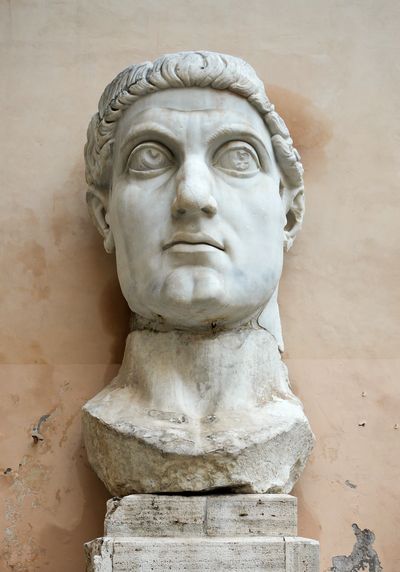
Constantine the Great
AncientEmperorRoman Empire272 — 337
罗马皇帝,米兰敕令使基督教合法化,建立君士坦丁堡,深刻改变了欧洲和世界历史。
Compare Constantine the Great with another historical figure:
Quick Facts
Born
272
Died
337
Country
Roman Empire
Era
Ancient
Occupation
Emperor
Score Overview
Military (10%)78
Political (20%)82
Influence (20%)75
Legacy (20%)70
Leadership (15%)80
Strategy (15%)72
Total Score75.5
Constantine the Great — Complete Timeline
312 AD
Battle of the Milvian BridgeWar◆ Major
Constantine defeated his rival Maxentius at the Milvian Bridge near Rome. According to tradition, Constantine saw a vision of a cross in the sky with the words 'In this sign, conquer.' The victory made Constantine the sole ruler of the Western Roman Empire and led to his conversion to Christianity.
Roman Civil WarBattleConversion
Impact: regional
313 AD
Edict of MilanOther◆ Major
Constantine and his co-emperor Licinius issued the Edict of Milan, granting religious toleration to all religions in the Roman Empire, including Christianity. The edict ended the persecution of Christians, restored confiscated church property, and established Christianity as a legally recognized religion.
Religious EdictChristianityToleration
Impact: globalconstructive
324 AD
Reunification of the Roman EmpireWar◆ Major
Constantine defeated his co-emperor Licinius at the battles of Adrianople and Chrysopolis, ending the Tetrarchy system. He became the sole ruler of the entire Roman Empire, reuniting the Western and Eastern halves under his control. This reunification was the last time the Roman Empire was united under a single ruler.
Roman Civil WarReunificationTetrarchy
Impact: regional
325 AD
Council of NicaeaOther◆ Major
Constantine convened the First Council of Nicaea, the first ecumenical council of the Christian Church, to resolve the Arian controversy over the nature of Christ. The council produced the Nicene Creed, affirming the divinity of Christ and establishing a unified Christian doctrine. Constantine presided over the council.
Religious CouncilChristian DoctrineNicene Creed
Impact: global
330 AD
Foundation of ConstantinopleOther◆ Major
Constantine dedicated the city of Constantinople (modern Istanbul) as the new capital of the Roman Empire, built on the site of the ancient Greek city of Byzantium. The city was strategically located on the Bosporus strait, controlling trade routes between Europe and Asia. It became the capital of the Eastern Roman Empire for over a thousand years.
City FoundationCapitalByzantine Empire
Impact: globalconstructive
Detailed Scores
▶View all detailed scores
Military
Strategy
7
Tactics
7
Battles
7
Army Scale
7
War Impact
7
Political
Governance
6
Reform
7
Stability
6
Policy
7
Power
7
Influence
History
8
Global
7
Culture
8
Ideology
8
Legacy
7
People often compare with
See how Constantine the Great stacks up against other historical figures
Popular Comparisons
Constantine the Great vs Augustus
vs Augustus86
Constantine the Great vs Qin Shi Huang
vs Qin Shi Huang85
Constantine the Great vs Cyrus the Great
vs Cyrus the Great84
Constantine the Great vs Ashoka the Great
vs Ashoka the Great76
Constantine the Great vs Trajan
vs Trajan76
Constantine the Great vs Theodosius I
vs Theodosius I76