Loading...
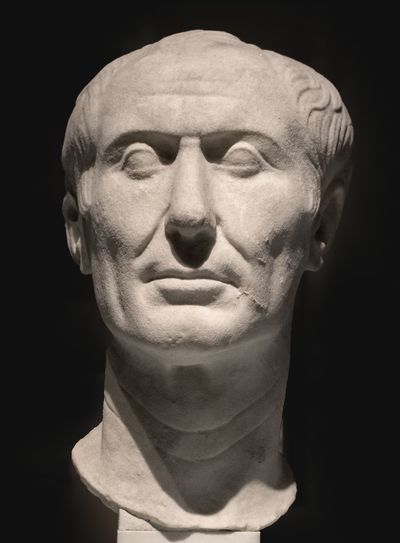
Julius Caesar
AncientGeneralRoman Republic-100 — -44
罗马共和国末期杰出的军事统帅和政治家,为罗马帝国的建立奠定了基础。
Compare Julius Caesar with another historical figure:
Quick Facts
Born
100 BCE
Died
44 BCE
Country
Roman Republic
Era
Ancient
Occupation
General
Score Overview
Military (10%)88
Political (20%)78
Influence (20%)85
Legacy (20%)82
Leadership (15%)80
Strategy (15%)85
Total Score82.8
Julius Caesar — Complete Timeline
58 BC
Gallic WarsWar◆ Major
Caesar, as proconsul of Gaul, launched a series of campaigns that conquered all of Gaul (modern France, Belgium, and parts of Switzerland). He fought numerous battles, including against the Helvetii, the Belgae, and the Gallic chieftain Vercingetorix. The wars brought immense wealth and a loyal army to Caesar.
Gallic WarsConquestRoman Expansion
Impact: regional
49 BC
Crossing the RubiconPolitical Action◆ Major
Caesar led Legio XIII across the Rubicon River into Italy, defying the Roman Senate's order to disband his army. This act triggered a civil war against Pompey and the Optimates, ultimately leading to Caesar's dictatorship and the end of the Roman Republic.
Roman Civil WarEnd of RepublicPower Struggle
Impact: global
48 BC
Battle of PharsalusWar◆ Major
Caesar's outnumbered army defeated the larger forces of Pompey the Great at Pharsalus in Greece. Caesar's tactical use of a reserve line to counter Pompey's cavalry charge proved decisive. Pompey fled to Egypt, where he was assassinated, leaving Caesar as the undisputed master of the Roman world.
Roman Civil WarBattleDecisive Victory
Impact: regional
44 BC
Appointment as Dictator for LifePolitical Action◆ Major
The Roman Senate appointed Caesar dictator perpetuo (dictator for life), granting him unprecedented personal power. This move concentrated military, legislative, and judicial authority in one person, effectively ending the Roman Republic's traditional system of checks and balances and alarming many senators.
DictatorshipEnd of RepublicPower Consolidation
Impact: regionaldestructive
Assassination on the Ides of MarchPolitical Action◆ Major
A group of Roman senators, led by Marcus Junius Brutus and Gaius Cassius Longinus, stabbed Caesar to death at a meeting of the Senate in the Theatre of Pompey. The assassination was intended to restore the Republic, but instead triggered another civil war that led to the rise of the Roman Empire.
AssassinationRoman PoliticsEnd of Republic
Impact: globaldestructive
Detailed Scores
▶View all detailed scores
Military
Strategy
8
Tactics
8
Battles
8
Army Scale
8
War Impact
8
Political
Governance
7
Reform
7
Stability
7
Policy
7
Power
8
Influence
History
8
Global
8
Culture
8
Ideology
8
Legacy
8
People often compare with
See how Julius Caesar stacks up against other historical figures
Popular Comparisons
Julius Caesar vs Alexander the Great
vs Alexander the Great85
Julius Caesar vs Cao Cao
vs Cao Cao78
Julius Caesar vs Gaius Marius
vs Gaius Marius73
Julius Caesar vs Jiang Ziya
vs Jiang Ziya70
Julius Caesar vs Hamilcar Barca
vs Hamilcar Barca69
Julius Caesar vs Gnaeus Pompeius Magnus
vs Gnaeus Pompeius Magnus67