Loading...
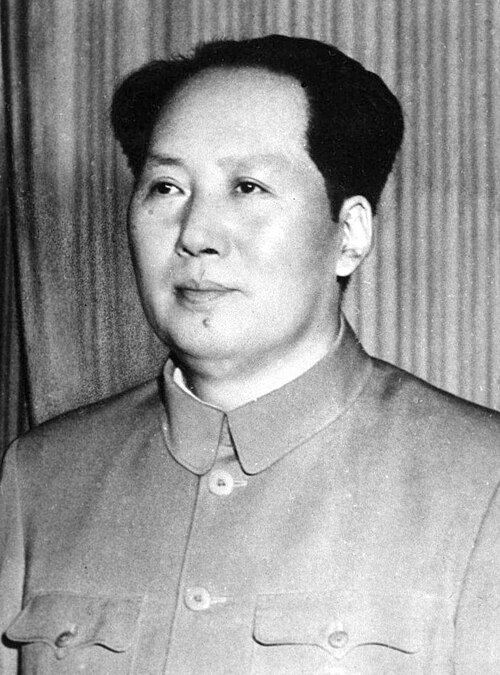
Mao Zedong
ModernPoliticianChina1893 — 1976
Founding father of the People Republic of China.
Compare Mao Zedong with another historical figure:
Quick Facts
Born
1893
Died
1976
Country
China
Era
Modern
Occupation
Politician
Score Overview
Military (10%)75
Political (20%)88
Influence (20%)85
Legacy (20%)70
Leadership (15%)85
Strategy (15%)72
Total Score79.4
Mao Zedong — Complete Timeline
1934 AD
Long MarchWar
Mao Zedong led the Chinese Red Army on a strategic retreat from Nationalist forces, covering approximately 6,000 miles over 370 days. The march solidified Mao's leadership within the Chinese Communist Party and became a foundational myth of the Communist revolution.
Chinese Civil WarCommunist RevolutionRetreat
Impact: national
1949 AD
Proclamation of the People's Republic of ChinaPolitical Action
Mao Zedong declared the founding of the People's Republic of China from Tiananmen Gate in Beijing. This ended the Chinese Civil War and established Communist rule over mainland China, with Mao as Chairman of the Central People's Government.
Founding of PRCCommunist VictoryRevolution
Impact: global
1958 AD
Great Leap ForwardReform◆ Major
Mao launched a campaign to rapidly industrialize China and collectivize agriculture. The policy led to widespread mismanagement, resulting in a famine that caused an estimated 15-45 million deaths between 1959 and 1961.
FamineIndustrializationCollectivization
Impact: nationaldestructive
1960 AD
Sino-Soviet SplitPolitical Action◆ Major
Mao's ideological differences with Soviet leader Nikita Khrushchev led to a breakdown in relations between China and the Soviet Union. The split ended the Sino-Soviet alliance and reshaped global Cold War dynamics, with China pursuing an independent path.
Cold WarIdeological ConflictAlliance Breakdown
Impact: global
1966 AD
Cultural RevolutionPolitical Action
Mao initiated a sociopolitical movement to purge capitalist and traditional elements from Chinese society. The Red Guard youth groups attacked intellectuals and officials, leading to widespread violence, destruction of cultural artifacts, and an estimated 1-2 million deaths.
Political PurgeSocial UpheavalRed Guard
Impact: nationaldestructive
1971 AD
Ping-Pong DiplomacyCultural◆ Major
Mao approved an invitation for the U.S. table tennis team to visit China, initiating a thaw in Sino-American relations. This cultural exchange paved the way for President Nixon's visit to China in 1972 and the eventual normalization of diplomatic ties.
DiplomacyU.S.-China RelationsCultural Exchange
Impact: globalconstructive
Detailed Scores
▶View all detailed scores
Military
Strategy
7
Tactics
7
Battles
7
Army Scale
7
War Impact
8
Political
Governance
8
Reform
8
Stability
8
Policy
8
Power
8
Influence
History
8
Global
8
Culture
8
Ideology
9
Legacy
8
People often compare with
See how Mao Zedong stacks up against other historical figures
Popular Comparisons
Mao Zedong vs Mustafa Kemal Ataturk
vs Mustafa Kemal Ataturk80
Mao Zedong vs Abraham Lincoln
vs Abraham Lincoln78
Mao Zedong vs George Washington
vs George Washington77
Mao Zedong vs Ruhollah Khomeini
vs Ruhollah Khomeini75
Mao Zedong vs Winston Churchill
vs Winston Churchill72
Mao Zedong vs Franklin D. Roosevelt
vs Franklin D. Roosevelt71