Loading...
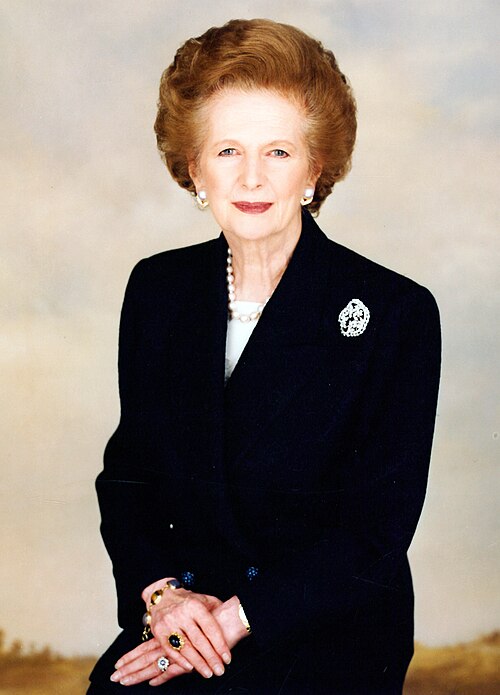
Margaret Thatcher
ModernPoliticianUnited Kingdom1925 — ?
First female British prime minister, the Iron Lady.
Compare Margaret Thatcher with another historical figure:
Quick Facts
Born
1925
Country
United Kingdom
Era
Modern
Occupation
Politician
Score Overview
Military (10%)55
Political (20%)88
Influence (20%)88
Legacy (20%)68
Leadership (15%)80
Strategy (15%)45
Total Score74.2
Margaret Thatcher — Complete Timeline
1979 AD
Became the first female Prime Minister of the United KingdomPolitical Action◆ Major
Thatcher led the Conservative Party to victory in the general election, becoming Britain's first female prime minister. Her government pursued a radical agenda of economic liberalization, privatization, and reduction of trade union power.
ElectionFirst Female PMConservatism
Impact: nationalconstructive
1982 AD
Waged the Falklands WarWar◆ Major
Thatcher ordered a military task force to retake the Falkland Islands after Argentina invaded. The British forces succeeded after a 10-week conflict. The victory boosted Thatcher's popularity and her government's standing, leading to her re-election in 1983.
Falklands WarMilitary ConflictSovereignty
Impact: regional
1984 AD
Privatized state-owned industriesReform◆ Major
Thatcher's government sold off major state-owned enterprises, including British Telecom, British Gas, and British Airways, to private investors. This program of privatization was a central part of her economic policy, aimed at increasing efficiency and reducing public debt.
PrivatizationEconomic ReformFree Market
Impact: nationalconstructive
1985 AD
Defeated the miners' strikePolitical Action◆ Major
Thatcher's government faced a year-long strike by the National Union of Mineworkers led by Arthur Scargill. The government stockpiled coal and used police to prevent picketing. The strike collapsed, weakening trade union power and enabling further pit closures.
Trade UnionsStrikeCoal Mining
Impact: nationaldestructive
1986 AD
Signed the Single European ActPolitical Action◆ Major
Thatcher signed the Single European Act, which reformed the European Economic Community and set the goal of a single market by 1992. Despite her Eurosceptic views, she supported this act, which expanded qualified majority voting and European integration.
European UnionSingle MarketIntegration
Impact: regionalconstructive
Detailed Scores
▶View all detailed scores
Military
Strategy
6
Tactics
5
Battles
6
Army Scale
5
War Impact
6
Political
Governance
7
Reform
7
Stability
7
Policy
8
Power
8
Influence
History
9
Global
8
Culture
9
Ideology
9
Legacy
9
People often compare with
See how Margaret Thatcher stacks up against other historical figures
Popular Comparisons
Margaret Thatcher vs Diego Portales
vs Diego Portales55
Margaret Thatcher vs Edward Seaga
vs Edward Seaga54
Margaret Thatcher vs Veluthampi Dalawa
vs Veluthampi Dalawa48
Margaret Thatcher vs Kudirat Abiola
vs Kudirat Abiola48
Margaret Thatcher vs Martin Fayulu
vs Martin Fayulu40