Loading...
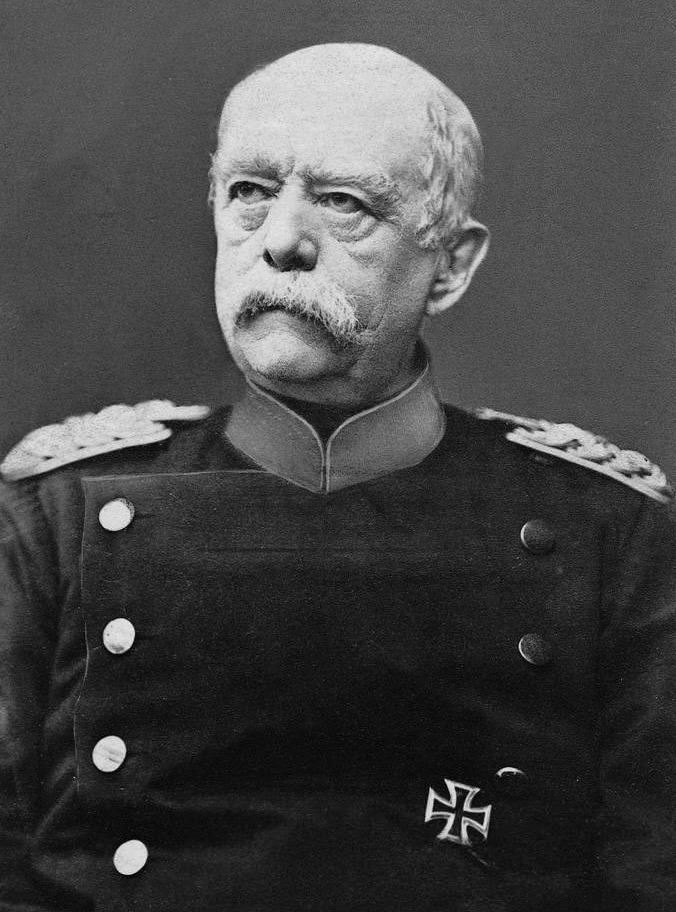
Otto von Bismarck
ModernPoliticianGermany1815 — 1898
德意志帝国第一任首相,铁血政策统一德国,建立了欧洲第一个社会福利体系。
Compare Otto von Bismarck with another historical figure:
Quick Facts
Born
1815
Died
1898
Country
Germany
Era
Modern
Occupation
Politician
Score Overview
Military (10%)55
Political (20%)85
Influence (20%)82
Legacy (20%)40
Leadership (15%)80
Strategy (15%)50
Total Score65.8
Otto von Bismarck — Complete Timeline
1870 AD
Franco-Prussian WarWar
Bismarck provoked France into declaring war by editing the Ems Dispatch to appear insulting. The resulting conflict saw Prussia and its allies decisively defeat France, leading to the fall of Napoleon III, the capture of Paris, and the annexation of Alsace-Lorraine.
WarProvocationAnnexation
Impact: globaldestructive
1871 AD
Unification of Germany ProclaimedPolitical Action
Following the Franco-Prussian War, Bismarck orchestrated the proclamation of the German Empire in the Hall of Mirrors at Versailles. King Wilhelm I of Prussia was declared German Emperor, uniting the German states under Prussian leadership and establishing the Second Reich.
UnificationGerman EmpireNationalism
Impact: globalconstructive
1878 AD
Enactment of the Anti-Socialist LawsPolitical Action◆ Major
After two assassination attempts on Kaiser Wilhelm I, Bismarck pushed through laws banning socialist organizations, publications, and meetings. The laws remained in force until 1890, suppressing the Social Democratic Party while Bismarck simultaneously introduced welfare reforms to undercut its appeal.
RepressionSocialismWelfare State
Impact: nationaldestructive
Congress of BerlinPolitical Action◆ Major
Bismarck hosted the Congress of Berlin to revise the Treaty of San Stefano and resolve the Eastern Crisis. He acted as 'honest broker,' reducing Russian gains, granting independence to Romania, Serbia, and Montenegro, and placing Bosnia-Herzegovina under Austro-Hungarian administration.
DiplomacyBalkansBalance of Power
Impact: global
1883 AD
Establishment of the Welfare StateReform◆ Major
Bismarck introduced the Health Insurance Bill (1883), Accident Insurance Bill (1884), and Old Age and Disability Insurance Bill (1889). These laws created the first modern welfare state, providing workers with social security and aiming to reduce support for socialist movements.
Social ReformWelfareInsurance
Impact: globalprogressive
1890 AD
Dismissal as ChancellorPolitical Action◆ Major
Emperor Wilhelm II forced Bismarck to resign due to policy disagreements, particularly over anti-socialist laws and foreign policy. Bismarck's departure marked the end of an era, leading to a more aggressive German foreign policy and the eventual unraveling of his alliance system.
ResignationWilhelm IIPolicy Shift
Impact: global
Detailed Scores
▶View all detailed scores
Military
Strategy
6
Tactics
5
Battles
5
Army Scale
5
War Impact
6
Political
Governance
7
Reform
7
Stability
7
Policy
7
Power
8
Influence
History
9
Global
8
Culture
8
Ideology
9
Legacy
8
People often compare with
See how Otto von Bismarck stacks up against other historical figures
Popular Comparisons
Otto von Bismarck vs Mustafa Kemal Ataturk
vs Mustafa Kemal Ataturk80
Otto von Bismarck vs Mao Zedong
vs Mao Zedong79
Otto von Bismarck vs Abraham Lincoln
vs Abraham Lincoln78
Otto von Bismarck vs George Washington
vs George Washington77
Otto von Bismarck vs Winston Churchill
vs Winston Churchill72
Otto von Bismarck vs Franklin D. Roosevelt
vs Franklin D. Roosevelt71