Loading...
Abd al-Mumin vs Napoleon Bonaparte
Napoleon Bonaparte leads by 6.2 pts · 2 figures compared
…
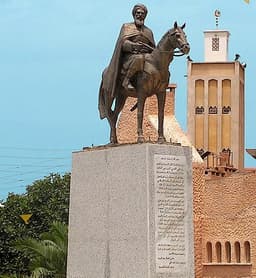
Abd al-Mumin
Emperor · Medieval
64.7Total

Napoleon Bonaparte
General · Modern
70.9Total
Basic Information
Born
1094
1769
Died
1163
1821
Era
Medieval
Modern
Nationality
Almohad Caliphate
France
Occupation
Emperor
General
Civilization
Middle Eastern
Western
Score Comparison
Military (10%)
78.5
94.0
Political (20%)
70.0
72.0
Influence (20%)
58.3
40.0
Legacy (20%)
52.0
80.0
Leadership (15%)
79.8
78.0
Strategy (15%)
68.0
90.0
TOTAL
64.7
70.9
Abd al-Mumin — Complete Timeline
1130 AD
Proclamation as CaliphPolitical Action
After the death of Ibn Tumart, Abd al-Mumin was proclaimed caliph of the Almohad movement. He consolidated the Berber tribes of the High Atlas under Almohad doctrine, establishing the foundation for a new dynasty that would challenge Almoravid rule.
Almohad CaliphateSuccessionDynasty Foundation
Impact: regionalconstructive
1147 AD
Conquest of MarrakeshWar◆ Major
Abd al-Mumin captured Marrakesh, the capital of the Almoravid Empire, after a prolonged siege. The Almoravid ruler Ishaq ibn Ali was killed, and the city became the Almohad capital, marking the end of Almoravid rule in North Africa.
Almohad ConquestMarrakeshAlmoravid Fall
Impact: regionaldestructive
1152 AD
Conquest of the MaghrebWar◆ Major
Abd al-Mumin extended Almohad control across the Maghreb, conquering cities such as Fez, Tlemcen, and Algiers. He defeated local Berber dynasties and unified the region from the Atlantic to Tripolitania under a single centralized administration.
Maghreb UnificationAlmohad ExpansionBerber Conquest
Impact: regionalconstructive
1154 AD
Invasion of Al-AndalusWar◆ Major
Abd al-Mumin launched a campaign into Al-Andalus, capturing cities including C
Al-AndalusAlmohad ExpansionIberian Campaign
Impact: regionalconstructive
1156 AD
Establishment of Almohad AdministrationReform◆ Major
Abd al-Mumin implemented a centralized administrative system across his empire, appointing governors and judges loyal to the Almohad doctrine. He standardized taxation and military organization, creating a stable state structure that lasted for decades.
Administrative ReformAlmohad StateCentralization
Impact: regionalconstructive
Napoleon Bonaparte — Complete Timeline
1799 AD
Coup of 18 BrumaireOther◆ Major
Napoleon Bonaparte, with support from his brother Lucien and key political figures, overthrew the Directory in a bloodless coup. He established the Consulate with himself as First Consul, effectively becoming the ruler of France. This event ended the French Revolution's most unstable period.
French RevolutionCoupRise to Power
Impact: regional
1804 AD
Promulgation of the Napoleonic CodeOther◆ Major
Napoleon enacted the Civil Code of the French, known as the Napoleonic Code, a comprehensive set of laws that replaced the fragmented feudal legal systems. The code established legal equality, protected property rights, and secularized law. It became the basis for legal systems in many European and world countries.
Legal ReformNapoleonic CodeCivil Law
Impact: globalconstructive
1805 AD
Battle of AusterlitzWar◆ Major
Napoleon's Grande Arm
Napoleonic WarsBattleDecisive Victory
Impact: global
1812 AD
Invasion of RussiaWar◆ Major
Napoleon led the Grande Arm
Napoleonic WarsInvasionDisaster
Impact: globaldestructive
1815 AD
Battle of WaterlooWar◆ Major
Napoleon's French army was defeated by the combined forces of the Duke of Wellington's Anglo-Allied army and Gebhard Leberecht von Bl
Napoleonic WarsBattleFinal Defeat
Impact: globaldestructive
Expert Analysis
abd-al-mumin-vs-napoleon-bonaparte
### The Emperor and the Caliph
On a windswept June day in 1815, a man who had once ruled Europe from the Pyrenees to the Vistula stood defeated on a muddy field in Belgium. Napoleon Bonaparte, his grand army shattered, would spend his final years in exile on a remote Atlantic island. Almost seven centuries earlier, in the spring of 1147, another conqueror watched his soldiers pour through the gates of Marrakesh, the glittering capital of a rival empire. Abd al-Mumin, a Berber tribesman who had risen from obscurity, was about to forge a dynasty that would dominate North Africa and Spain for generations. Both men remade their worlds. Why did one end in lonely exile while the other died in power, his empire intact?
### Origins
Napoleon was born in 1769 on Corsica, an island that had only recently become French. His family were minor nobility, but in the rigid hierarchy of the ancien régime, they were nobodies. Young Napoleon arrived at a military academy speaking French with a thick Italian accent, mocked by his aristocratic classmates. The French Revolution, which erupted when he was twenty, shattered the old order and opened a path for talent. For a brilliant, ambitious outsider, it was the opportunity of a lifetime.
Abd al-Mumin’s origins were even humbler. Born around 1094 in a small Berber village in what is now Algeria, he was the son of a potter. He studied theology and law, and might have lived out his days as a local scholar. But he encountered a charismatic preacher named Ibn Tumart, a reformer who condemned the lax piety of the ruling Almoravid dynasty. Ibn Tumart saw something in the young scholar and made him his successor. When the founder died in 1130, the movement was in crisis. Abd al-Mumin kept the death secret for years, consolidating power while pretending his master still guided them. He understood that in a tribal society, authority had to be earned, not inherited.
### Rise to Power
Napoleon’s ascent was meteoric. In 1793, at just twenty-four, he drove the British out of Toulon and was promoted to brigadier general. Two years later, he crushed a royalist uprising in Paris with a “whiff of grapeshot” — a moment that caught the attention of the revolutionary government. His 1796 Italian campaign was a masterpiece of speed and audacity, splitting Austrian armies and dictating peace terms. By 1799, he was First Consul of France. He was thirty.
Abd al-Mumin’s rise was slower and more brutal. After his secret proclamation as caliph in 1130, he spent nearly two decades fighting a grinding war against the Almoravids. He learned to weld fractious Berber tribes into a disciplined army, using religious fervor as a unifying force. The turning point came in 1147, when he captured Marrakesh after a long siege. The last Almoravid ruler, Ishaq, was killed. Abd al-Mumin then systematically conquered the Maghreb — Fez, Tlemcen, Algiers — defeating rival chieftains and absorbing their warriors. He did not merely win battles; he built a coalition.
### Leadership & Governance
Napoleon governed through genius and force of will. His Napoleonic Code standardized French law, abolished feudalism, and enshrined merit over birth. He built roads, reformed education, and created the Bank of France. But his system depended entirely on him. He appointed his brothers as kings of conquered states, a nepotism that bred resentment. His marshals were brilliant but loyal only to victory. When Napoleon lost, they abandoned him.
Abd al-Mumin ruled through structure. He established a centralized administration with appointed governors and judges, but he also respected local traditions. He integrated Berber and Arab elites into his government, creating a shared identity under the banner of Almohad religious reform. His military strategy was patient: he secured his North African base before crossing into Spain. In 1154, he captured Córdoba and Seville, completing the conquest of Al-Andalus. Unlike Napoleon, he never overreached. He knew an empire required foundations, not just conquests.
### Triumph & Tragedy
Napoleon’s greatest moment was Austerlitz in 1805, where he destroyed a combined Russian-Austrian army in a battle still studied in war colleges. His tragedy was the 1812 invasion of Russia. He marched 600,000 men into the snow and returned with fewer than 100,000. He never recovered. Exiled to Elba, he escaped and raised another army, only to be crushed at Waterloo in 1815. His ambition had no brakes.
Abd al-Mumin’s triumph was the conquest of Marrakesh, which made him master of the Maghreb. His tragedy was subtler: he died in 1163 before fully consolidating his Spanish holdings. But his empire did not collapse. His son Abu Yaqub Yusuf succeeded him peacefully, continuing the dynasty for another century. Abd al-Mumin built a system that outlasted him.
### Character & Destiny
Napoleon was restless, brilliant, and incapable of stopping. “I am not a man,” he once said, “but a thing.” He saw himself as a force of history, driven to reshape Europe. His personality was his weapon and his flaw. He trusted no one completely, and in the end, no one trusted him.
Abd al-Mumin was patient, calculating, and devout. He understood that power in the Islamic world required legitimacy — religious, tribal, and dynastic. He presented himself as the restorer of true faith, not a conqueror. His humility was strategic. He never forgot his potter father.
### Legacy
Napoleon’s legacy is everywhere: modern law codes, national boundaries, the very idea of the “career open to talent.” But his empire vanished within a decade. He is remembered as a titan who fell, a romantic tragedy.
Abd al-Mumin’s legacy is less known in the West but equally profound. The Almohad Empire he founded unified North Africa and Spain under a single rule for the first time since the Umayyads. His administrative reforms influenced later empires. He is remembered as a builder, not a destroyer.
### Conclusion
One man conquered the world and lost it. Another conquered a world and kept it. The difference was not talent — both were extraordinary. It was patience. Napoleon wanted everything, immediately. Abd al-Mumin wanted something lasting, and he was willing to wait. In the end, the caliph who rose from a potter’s hut built an empire that outlasted the emperor who had ruled from the Kremlin to the Nile. The lesson is not that ambition is dangerous. It is that ambition without restraint is a fire that consumes its owner.
Rankings
🥇
Napoleon BonaparteLeader
Mil: 94.0Pol: 72.0Inf: 40.0
70.9
🥈
Abd al-Mumin
Mil: 78.5Pol: 70.0Inf: 58.3
64.7
+6.2 behind
How This Comparison Works
Algorithm
Each figure is scored on 6 dimensions (0—100 scale) based on structured historical data: Military (10%), Political (20%), Influence (20%), Legacy (20%), Leadership (15%), Strategy (15%). The weighted total produces the final ranking.
Data Sources
Scores are computed from structured sub-indicators in the database. Scale factors adjust for era (Ancient ×0.85, Modern ×1.0) and civilization size (Eastern ×1.05, Other ×0.80) to account for differences in population and military scale.
Maximum 3 Figures
Comparisons are limited to 2—3 figures to ensure readability and statistical meaningfulness.
Error Margins
±5 points per dimension — Sub-scores are derived from historical records with inherent uncertainty. Two figures within 5 points on a dimension should be considered roughly equivalent in that area.
Total Score Accuracy
±3 points overall — The weighted combination of 6 dimensions produces a total score with approximately ±3 points of uncertainty. Differences of less than 3 points are not statistically significant— the figures are effectively tied.
Known Limitations
- Historical records are incomplete and uneven across civilizations
- Figures from oral-tradition societies may be underrepresented
- Occupation labels can misclassify multi-role figures
- Scores measure capability and impact, not moral character
- Quantitative scoring is a comparison tool, not absolute truth
Capability Radar
Military (10%) — Battles & Warfare
Battles
85
95
Win Rate
90
90
Expansion
90
95
Political (20%) — Governance & Reform
Reform
85
95
Diplomacy
70
80
Economy
75
85
Influence (20%) — Cultural & Global Reach
Cultural
65
85
Global
55
90
Legacy (20%) — Historical Impact
Historical
70
95
Longevity
60
90
Leadership (15%) — Power & Stability
Tenure
80
85
Stability
70
70
Strategy (15%) — Tactics & Innovation
Strategy
85
95
Tactics
80
98
Reform
75
92
Similar Comparisons
Comments & Discussion
No comments yet. Be the first to share your thoughts!