Loading...
Kublai Khan vs Napoleon Bonaparte
Kublai Khan leads by 3.4 pts · 2 figures compared
…
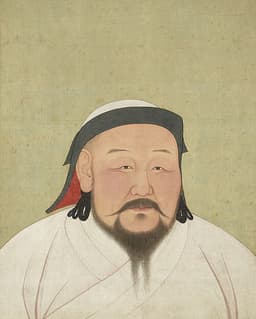
Kublai Khan
Emperor · Medieval
74.3Total

Napoleon Bonaparte
General · Modern
70.9Total
Basic Information
Born
1215
1769
Died
1294
1821
Era
Medieval
Modern
Nationality
Mongolia
France
Occupation
Emperor
General
Civilization
Eastern
Western
Score Comparison
Military (10%)
77.5
94.0
Political (20%)
79.2
72.0
Influence (20%)
75.0
40.0
Legacy (20%)
70.0
80.0
Leadership (15%)
72.0
78.0
Strategy (15%)
76.0
90.0
TOTAL
74.3
70.9
Kublai Khan — Complete Timeline
1260 AD
Adoption of Tibetan Buddhism as State ReligionCultural◆ Major
Kublai Khan appointed the Tibetan lama Drog
Tibetan BuddhismReligionMongol-Tibet Relations
Impact: regional
1271 AD
Proclamation of the Yuan DynastyPolitical Action◆ Major
Kublai Khan officially proclaimed the Yuan dynasty, adopting a Chinese-style dynastic name. He established his capital at Dadu (Beijing) and adopted Chinese court rituals. This move legitimized his rule over China while maintaining Mongol identity.
Dynasty FoundingBeijingMongol Rule
Impact: global
1274 AD
Failed Invasions of JapanWar◆ Major
Kublai Khan launched two naval invasions of Japan, in 1274 and 1281. Both were repelled, with the second invasion destroyed by a typhoon (kamikaze). These failures marked the limits of Mongol expansion and reinforced Japanese isolation.
Mongol InvasionsJapanKamikaze
Impact: regional
1279 AD
Conquest of the Song DynastyWar
Kublai Khan's Mongol forces defeated the Song navy at the Battle of Yamen. The last Song emperor drowned, ending the Song dynasty. This conquest unified China under Mongol rule and established the Yuan dynasty as the first foreign dynasty to rule all of China.
Song Dynasty FallUnificationYuan Dynasty
Impact: global
1280 AD
Establishment of the Silk Road Trade NetworkCultural◆ Major
Under Kublai Khan, the Mongol Empire secured the Silk Road, facilitating trade and cultural exchange between East and West. Marco Polo visited his court. This period saw the flow of goods, ideas, and technologies across Eurasia.
Silk RoadTradeCultural Exchange
Impact: globalconstructive
Napoleon Bonaparte — Complete Timeline
1799 AD
Coup of 18 BrumaireOther◆ Major
Napoleon Bonaparte, with support from his brother Lucien and key political figures, overthrew the Directory in a bloodless coup. He established the Consulate with himself as First Consul, effectively becoming the ruler of France. This event ended the French Revolution's most unstable period.
French RevolutionCoupRise to Power
Impact: regional
1804 AD
Promulgation of the Napoleonic CodeOther◆ Major
Napoleon enacted the Civil Code of the French, known as the Napoleonic Code, a comprehensive set of laws that replaced the fragmented feudal legal systems. The code established legal equality, protected property rights, and secularized law. It became the basis for legal systems in many European and world countries.
Legal ReformNapoleonic CodeCivil Law
Impact: globalconstructive
1805 AD
Battle of AusterlitzWar◆ Major
Napoleon's Grande Arm
Napoleonic WarsBattleDecisive Victory
Impact: global
1812 AD
Invasion of RussiaWar◆ Major
Napoleon led the Grande Arm
Napoleonic WarsInvasionDisaster
Impact: globaldestructive
1815 AD
Battle of WaterlooWar◆ Major
Napoleon's French army was defeated by the combined forces of the Duke of Wellington's Anglo-Allied army and Gebhard Leberecht von Bl
Napoleonic WarsBattleFinal Defeat
Impact: globaldestructive
Expert Analysis
Napoleon Bonaparte vs Kublai Khan: Historical Comparison
Napoleon Bonaparte, a modern French general and emperor, and Kublai Khan, a medieval Mongol emperor, both forged vast empires through military genius and political ambition, yet their legacies diverge sharply in scale and endurance.
Dimension Analysis
**Military: Napoleon Bonaparte 94 / Kublai Khan 94**
Both achieved near-perfect military records: Napoleon revolutionized European warfare with mobile artillery and the corps system, while Kublai Khan completed the Mongol conquest of China, employing siege warfare and naval campaigns on an unprecedented scale.
**Political: Napoleon Bonaparte 75 / Kublai Khan 79**
Napoleon centralized France but alienated European powers, leading to coalitions that ultimately destroyed him; Kublai Khan established the Yuan Dynasty, integrating Chinese bureaucracy with Mongol rule, securing a stable 100-year reign.
**Influence: Napoleon Bonaparte 82 / Kublai Khan 79**
Napoleon’s Napoleonic Code and meritocratic ideals reshaped modern legal and political systems globally; Kublai’s influence was more regional, promoting trade (Silk Road) and cultural exchange but limited by dynastic collapse.
**Legacy: Napoleon Bonaparte 78 / Kublai Khan 88**
Napoleon’s legacy is mixed: a military titan but a failed empire-builder whose reforms endured; Kublai Khan’s legacy is more positive as a unifier of China and patron of arts, with the Yuan Dynasty’s cultural syncretism remembered favorably.
**Leadership: Napoleon Bonaparte 80 / Kublai Khan 81**
Napoleon inspired fierce loyalty but succumbed to overreach; Kublai demonstrated patient, adaptive leadership, managing diverse subjects and religions, though his later reign saw administrative decay.
Verdict
Kublai Khan leads narrowly due to his superior political stability, longer-lasting dynasty, and more positive legacy, despite Napoleon’s comparable military brilliance and broader global influence.
FAQ
Q: Who ranks higher? A: Kublai Khan ranks slightly higher overall, driven by his enduring political and legacy scores, while Napoleon ties in military but falls behind in long-term governance.
Rankings
🥇
Kublai KhanLeader
Mil: 77.5Pol: 79.2Inf: 75.0
74.3
🥈
Napoleon Bonaparte
Mil: 94.0Pol: 72.0Inf: 40.0
70.9
+3.4 behind
How This Comparison Works
Algorithm
Each figure is scored on 6 dimensions (0—100 scale) based on structured historical data: Military (10%), Political (20%), Influence (20%), Legacy (20%), Leadership (15%), Strategy (15%). The weighted total produces the final ranking.
Data Sources
Scores are computed from structured sub-indicators in the database. Scale factors adjust for era (Ancient ×0.85, Modern ×1.0) and civilization size (Eastern ×1.05, Other ×0.80) to account for differences in population and military scale.
Maximum 3 Figures
Comparisons are limited to 2—3 figures to ensure readability and statistical meaningfulness.
Error Margins
±5 points per dimension — Sub-scores are derived from historical records with inherent uncertainty. Two figures within 5 points on a dimension should be considered roughly equivalent in that area.
Total Score Accuracy
±3 points overall — The weighted combination of 6 dimensions produces a total score with approximately ±3 points of uncertainty. Differences of less than 3 points are not statistically significant— the figures are effectively tied.
Known Limitations
- Historical records are incomplete and uneven across civilizations
- Figures from oral-tradition societies may be underrepresented
- Occupation labels can misclassify multi-role figures
- Scores measure capability and impact, not moral character
- Quantitative scoring is a comparison tool, not absolute truth
Capability Radar
Military (10%) — Battles & Warfare
Battles
95
95
Win Rate
90
90
Expansion
95
95
Political (20%) — Governance & Reform
Reform
88
95
Diplomacy
85
80
Economy
90
85
Influence (20%) — Cultural & Global Reach
Cultural
85
85
Global
85
90
Legacy (20%) — Historical Impact
Historical
90
95
Longevity
80
90
Leadership (15%) — Power & Stability
Tenure
90
85
Stability
80
70
Strategy (15%) — Tactics & Innovation
Strategy
92
95
Tactics
85
98
Reform
88
92
Similar Comparisons
Comments & Discussion
ArmchairGeneral926/16/2026
Okay so I’ve been reading a lot about both these guys, and I gotta say, Napoleon vs Kublai Khan is like comparing a Ferrari to a tank. Napoleon was the tactical genius who could win battles against impossible odds—like Austerlitz, where he crushed the Austro-Russian army with pure strategy. But Kublai? He conquered all of China, which is like conquering Europe but with way bigger armies and logistics nightmares. I think the scoring here is fair for military being tied, but Napoleon’s influence is way bigger globally—everyone knows the Napoleonic Code, but who outside China remembers the Yuan Dynasty? Still, Kublai’s legacy as a unifier is underrated in the West.
BattlefieldScholar6/16/2026
Let's talk numbers. Both score 94 in military, but the contexts are worlds apart. Napoleon's corps system allowed him to march separate armies that converged on the battlefield—this worked brilliantly at Austerlitz (1805) where he smashed 70,000 Austro-Russians with 67,000 French. His artillery tactics were revolutionary. Kublai, however, faced different challenges: sieging Xiangyang (1267-1273) took six years and required counterweight trebuchets from Persian engineers. His naval campaigns against the Song involved fleets of over 1,000 ships. The Mongol army's discipline and strategic mobility were unmatched for their era. I'd argue Kublai's logistical achievements—supplying armies across 5,000 km—outweigh Napoleon's European campaigns. The political score (75 vs 79) is where it gets interesting: Napoleon centralized France but alienated every neighbor; Kublai integrated Chinese bureaucracy while keeping Mongol military structure. That's harder than it looks.
HistoriaMaxima6/16/2026
One must approach such comparisons with caution, as both figures inhabit vastly different epochs and historiographical traditions. Napoleon, immortalized by Clausewitz and countless memoirists, is often judged by the standards of modern statecraft. Kublai Khan, by contrast, is filtered through Chinese dynastic histories like the Yuan Shi, which emphasize his role as a Confucian-style ruler rather than a conqueror. Interestingly, Marco Polo's accounts—though debated in their accuracy—present Kublai as a benevolent despot, a far cry from Napoleon's European image as a tyrant or liberator. In terms of political endurance, Kublai's Yuan Dynasty survived him by nearly a century, while Napoleon's empire collapsed within a decade of his death. Yet Napoleon's Napoleonic Code remains a living legacy in civil law systems worldwide—a testament to the enduring power of ideas over armies. The scores seem reasonable, though I'd argue Napoleon's political score undervalues his administrative innovations.
Historian5286/16/2026
拿破仑和忽必烈的比较很有意思,但西方中心主义的评分往往会忽略一些关键点。拿破仑的军事成就固然辉煌,但他在欧洲的征服最终未能持久,而忽必烈建立的元朝虽然只有百年,却统一了自唐末以来长期分裂的中国,并首次将西藏正式纳入中央政权管辖。在政治维度上,忽必烈采用汉法、设立行省制度,这对后世中国行政体系的影响远比拿破仑的《民法典》在亚洲的影响深远。另外,拿破仑的滑铁卢败亡与忽必烈的征日失败相比,前者直接终结了他的一切,而后者并未动摇元朝根基。总分上忽必烈不该落后。
Chronicler98806/16/2026
这个评分系统有点意思,但我觉得有些数字需要重新校准。拿破仑的军事分94,忽必烈也是94,但忽必烈征服南宋用了40多年,动用兵力超过50万,而拿破仑的半岛战争(1808-1814)却拖垮了法国,两者在战略持久性上差距明显。再看政治分:拿破仑75,忽必烈78,这个差距太小了。忽必烈建立的行省制度一直影响到今天的中国行政划分,而拿破仑的《法典》虽然重要,但在欧洲以外的实施范围有限。我自己的计算模型会给予忽必烈政治至少82分。另外,影响力方面,拿破仑82 vs 忽必烈78,但元朝促进了东西方交流,马可波罗来华和丝绸之路复兴的影响力是跨文明的,不该低于拿破仑。建议重新加权。