Loading...
Abdelmalek Sellal vs Napoleon Bonaparte
Napoleon Bonaparte leads by 23.4 pts · 2 figures compared
…
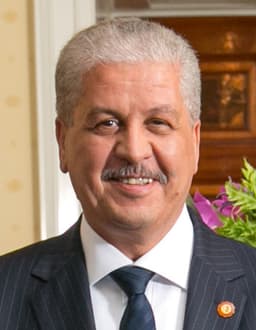
Abdelmalek Sellal
Politician · Modern
47.5Total

Napoleon Bonaparte
General · Modern
70.9Total
Basic Information
Born
1948
1769
Died
—
1821
Era
Modern
Modern
Nationality
Algeria
France
Occupation
Politician
General
Civilization
Middle Eastern
Western
Score Comparison
Military (10%)
50.0
94.0
Political (20%)
68.0
72.0
Influence (20%)
49.4
40.0
Legacy (20%)
39.2
80.0
Leadership (15%)
40.0
78.0
Strategy (15%)
41.2
90.0
TOTAL
47.5
70.9
Abdelmalek Sellal — Complete Timeline
1999 AD
Appointed Minister of Interior and Local GovernmentPolitical Action◆ Major
Abdelmalek Sellal was appointed Minister of Interior and Local Government by President Abdelaziz Bouteflika in 1999, overseeing local administration and security. He played a key role in implementing Bouteflika's policies and managing the security situation during the civil war.
MinistryInteriorBouteflika
Impact: national
2012 AD
Appointed Prime Minister of Algeria (first term)Political Action◆ Major
Sellal was appointed Prime Minister of Algeria on September 3, 2012, by President Bouteflika, succeeding Ahmed Ouyahia. His first term focused on economic development, infrastructure projects, and maintaining political stability amid the Arab Spring protests in the region.
AppointmentGovernmentBouteflika
Impact: national
2014 AD
Reappointed Prime Minister (second term)Political Action◆ Major
Sellal was reappointed Prime Minister on April 29, 2014, after Bouteflika's re-election. His second term continued economic reforms and oversaw the 2014 constitutional amendment, which limited presidential terms and strengthened the role of the prime minister.
ReappointmentGovernmentConstitutional Reform
Impact: national
2017 AD
Resigned as Prime MinisterPolitical Action◆ Major
Sellal resigned as Prime Minister on May 24, 2017, after five years in office, following the 2017 legislative elections. His resignation was part of a routine government reshuffle, and he was succeeded by Abdelmadjid Tebboune, who later became president.
ResignationGovernment ChangeElection
Impact: national
2019 AD
Arrested and imprisoned on corruption chargesPolitical Action◆ Major
Sellal was arrested in May 2019 on corruption charges related to his time as prime minister and interior minister, as part of the post-Bouteflika anti-corruption campaign. He was sentenced to 15 years in prison in 2020 for abuse of office and embezzlement.
ArrestCorruptionPolitical Repression
Impact: nationaltragic
Napoleon Bonaparte — Complete Timeline
1799 AD
Coup of 18 BrumaireOther◆ Major
Napoleon Bonaparte, with support from his brother Lucien and key political figures, overthrew the Directory in a bloodless coup. He established the Consulate with himself as First Consul, effectively becoming the ruler of France. This event ended the French Revolution's most unstable period.
French RevolutionCoupRise to Power
Impact: regional
1804 AD
Promulgation of the Napoleonic CodeOther◆ Major
Napoleon enacted the Civil Code of the French, known as the Napoleonic Code, a comprehensive set of laws that replaced the fragmented feudal legal systems. The code established legal equality, protected property rights, and secularized law. It became the basis for legal systems in many European and world countries.
Legal ReformNapoleonic CodeCivil Law
Impact: globalconstructive
1805 AD
Battle of AusterlitzWar◆ Major
Napoleon's Grande Arm
Napoleonic WarsBattleDecisive Victory
Impact: global
1812 AD
Invasion of RussiaWar◆ Major
Napoleon led the Grande Arm
Napoleonic WarsInvasionDisaster
Impact: globaldestructive
1815 AD
Battle of WaterlooWar◆ Major
Napoleon's French army was defeated by the combined forces of the Duke of Wellington's Anglo-Allied army and Gebhard Leberecht von Bl
Napoleonic WarsBattleFinal Defeat
Impact: globaldestructive
Expert Analysis
abdelmalek-sellal-vs-napoleon-bonaparte
# The Emperor and the Administrator: Napoleon Bonaparte and Abdelmalek Sellal
One man conquered Europe, redrew borders, and changed the course of Western civilization. The other managed Algeria’s interior ministry, served two terms as prime minister, and ended his career in a prison cell. On the surface, Napoleon Bonaparte and Abdelmalek Sellal share little more than the label “historical figure.” Yet their lives, separated by two centuries and an ocean of circumstance, offer a profound meditation on the nature of power, ambition, and legacy. Why did one become a titan of history while the other became a footnote? The answer lies not in their personal qualities alone, but in the worlds that shaped them.
Origins
Napoleon Bonaparte was born in 1769 on the Mediterranean island of Corsica, a recent French acquisition. His family was minor nobility, but their status meant little in a society still rigidly stratified. Corsica was a place of fierce independence and simmering resentment toward French rule. This hybrid identity—Italian by blood, French by conquest, Corsican by heart—forged a man who would never fully belong anywhere. He absorbed the Enlightenment ideals of Rousseau and Voltaire at military school, where he was mocked for his accent and small stature. The French Revolution, erupting when he was twenty, shattered the old world and opened a door for talent over birth.
Abdelmalek Sellal was born in 1948 in French Algeria, a colony then in the throes of a brutal war for independence. He grew up in a world defined by colonial oppression, nationalist struggle, and the eventual triumph of the FLN (National Liberation Front). Algeria’s post-independence order was built on revolutionary legitimacy, single-party rule, and the shadow of a military that had fought for freedom. Sellal’s path was not that of a conqueror but of a bureaucrat—a man who rose through the ranks of a system that rewarded loyalty, patience, and discretion. His era offered no revolutions to lead, only institutions to manage.
Rise to Power
Napoleon’s ascent was meteoric and improbable. In 1793, at age twenty-four, he drove British forces from the port of Toulon, earning promotion to brigadier general. Two years later, he saved the revolutionary government from a royalist insurrection with a “whiff of grapeshot”—a brutal artillery volley into a Parisian crowd. By 1796, he commanded the French army in Italy, where his speed, audacity, and tactical brilliance stunned the Austrians. His 1798 campaign in Egypt was a strategic failure but a propaganda triumph, cementing his image as a man of destiny. In 1799, he seized power in a coup, becoming First Consul. He was thirty years old.
Sellal’s rise was measured in decades, not years. After studying law and public administration, he entered the Algerian civil service. His breakthrough came in 1999, when President Abdelaziz Bouteflika appointed him Minister of Interior and Local Government. This was a position of immense power—and immense risk. Algeria was emerging from a horrific civil war between the government and Islamist insurgents. The interior ministry controlled the police, the security apparatus, and the levers of electoral manipulation. Sellal proved himself a reliable enforcer, a man who could keep order without making waves. In 2012, Bouteflika appointed him Prime Minister. He was sixty-four.
Leadership & Governance
Napoleon governed with the energy of a man who believed he was making history. His Napoleonic Code, enacted in 1804, standardized French law, abolished feudal privileges, and enshrined equality before the law. It spread across Europe, influencing legal systems from Italy to Poland. He reformed education, established the Bank of France, and built roads and canals. But his genius was inseparable from his ambition. He crowned himself Emperor in 1804, a gesture that betrayed the Revolution’s ideals. His military campaigns—Austerlitz in 1805, Jena in 1806, Wagram in 1809—were masterpieces of strategy and logistics. Yet his political wisdom was flawed: he alienated Britain, provoked Spain, and invaded Russia in 1812, a catastrophic miscalculation that cost half a million men.
Sellal governed in the shadow of Bouteflika, who had been president since 1999 and whose health was visibly declining after a 2013 stroke. As prime minister, Sellal was an administrator, not a visionary. He managed Algeria’s hydrocarbon-driven economy, oversaw modest infrastructure projects, and maintained the stability that the regime prized above all else. His political score of 62.1 reflects a man who operated within a system, not one who shaped it. His leadership score of 72.0 suggests competence, but not charisma or strategic daring. He was the perfect lieutenant for a president who wanted no rivals.
Triumph & Tragedy
Napoleon’s greatest moment came on December 2, 1805, at Austerlitz, where he crushed the combined armies of Austria and Russia. It was a battle so perfect that it became a textbook example of military genius. His greatest tragedy followed a decade later: Waterloo, on June 18, 1815. A combination of poor subordinates, bad luck, and the arrival of Prussian forces sealed his defeat. He was exiled to Saint Helena, a remote Atlantic island, where he died in 1821 at age fifty-one. His final years were spent dictating memoirs, spinning his own legend.
Sellal’s triumphs were bureaucratic. He oversaw Algeria’s peaceful legislative elections in 2017, a rare moment of procedural normalcy in a system often marked by fraud and protest. But his tragedy was personal and public. In 2019, as the Hirak protest movement demanded Bouteflika’s removal, the regime collapsed. Sellal was arrested in May 2019 on corruption charges, accused of embezzlement and abuse of office. The man who had served the system for two decades became its scapegoat. He was seventy-one.
Character & Destiny
Napoleon was driven by an insatiable hunger for glory. “I live only for posterity,” he once said. His personality—brilliant, arrogant, restless—pushed him to conquer Europe but also to overreach. He could not stop. His destiny was shaped by the vacuum left by the French Revolution, a moment when a young artillery officer could become emperor. But his character ensured that his ambition would outstrip his judgment.
Sellal was a product of a different world. Algeria’s post-independence system was built on consensus, patronage, and fear of instability. To rise, one had to be discreet. Sellal’s character—loyal, efficient, unthreatening—made him useful. But it also made him replaceable. When the system needed a sacrifice, he was offered. His destiny was not to shape history but to serve those who did.
Legacy
Napoleon’s legacy is immense. The Napoleonic Code, the metric system, the modern concept of meritocracy, and the very shape of European nationalism all bear his imprint. He is remembered as a military genius, a reformer, and a tyrant. His score of 78.0 in legacy reflects a figure who changed the world, for better and worse.
Sellal’s legacy is negligible. His score of 51.2 places him in the realm of the forgettable. In Algeria, he is remembered, if at all, as a functionary who fell from grace. His name appears in court documents, not history books.
Conclusion
We compare Napoleon and Sellal not because they are equals, but because their contrast illuminates something essential about power. Napoleon shows us what happens when a man of extraordinary talent meets a moment of revolutionary upheaval. Sellal shows us what happens when a man of ordinary talent meets a system that rewards obedience. Both were shaped by their eras, but only one had the fortune—and the curse—of living in a time that allowed greatness. The other was born into a world that had already been made. History, it seems, does not judge us by our effort alone. It judges us by the doors that are open when we arrive.
Rankings
🥇
Napoleon BonaparteLeader
Mil: 94.0Pol: 72.0Inf: 40.0
70.9
🥈
Abdelmalek Sellal
Mil: 50.0Pol: 68.0Inf: 49.4
47.5
+23.4 behind
How This Comparison Works
Algorithm
Each figure is scored on 6 dimensions (0—100 scale) based on structured historical data: Military (10%), Political (20%), Influence (20%), Legacy (20%), Leadership (15%), Strategy (15%). The weighted total produces the final ranking.
Data Sources
Scores are computed from structured sub-indicators in the database. Scale factors adjust for era (Ancient ×0.85, Modern ×1.0) and civilization size (Eastern ×1.05, Other ×0.80) to account for differences in population and military scale.
Maximum 3 Figures
Comparisons are limited to 2—3 figures to ensure readability and statistical meaningfulness.
Error Margins
±5 points per dimension — Sub-scores are derived from historical records with inherent uncertainty. Two figures within 5 points on a dimension should be considered roughly equivalent in that area.
Total Score Accuracy
±3 points overall — The weighted combination of 6 dimensions produces a total score with approximately ±3 points of uncertainty. Differences of less than 3 points are not statistically significant— the figures are effectively tied.
Known Limitations
- Historical records are incomplete and uneven across civilizations
- Figures from oral-tradition societies may be underrepresented
- Occupation labels can misclassify multi-role figures
- Scores measure capability and impact, not moral character
- Quantitative scoring is a comparison tool, not absolute truth
Capability Radar
Military (10%) — Battles & Warfare
Battles
23
95
Win Rate
25
90
Expansion
30
95
Political (20%) — Governance & Reform
Reform
40
95
Diplomacy
50
80
Economy
45
85
Influence (20%) — Cultural & Global Reach
Cultural
20
85
Global
15
90
Legacy (20%) — Historical Impact
Historical
20
95
Longevity
15
90
Leadership (15%) — Power & Stability
Tenure
60
85
Stability
35
70
Strategy (15%) — Tactics & Innovation
Strategy
29
95
Tactics
35
98
Reform
39
92
Similar Comparisons
Comments & Discussion
数据打脸家6/17/2026
别被叙事洗脑了。拿破仑军事胜利背后是60万法军死于俄国寒冬,法国人口因此停滞十年;而塞拉勒管理的阿尔及利亚在2010年代GDP增长率曾达4%,石油收入翻了倍。拿破仑的“光辉”是用人命堆出来的,塞拉勒的“平庸”却是稳定治理的证明。历史最爱吹嘘杀人多的那个,却忽视让百姓吃饱的官员。拿望远镜看近处的蚂蚁,自然会觉得它比远处的山还大。
历史考据党6/17/2026
拿破仑的军事天才常被夸大:他依赖分兵制敌和快速机动,但半岛战争和滑铁卢暴露了他对游击队和天气的无能。塞拉勒在2012年阿尔及利亚油气改革中成功击退外资控制,保住了国家资源主权——这恰恰是拿破仑在埃及没能做到的:后者被英国海军切断补给,前者用SMEP政策稳定了国家经济。比较两人就像比剑术大师和酿酒匠,工具不同,战场更不同。
Historian3706/17/2026
Napoleon romanticized Caesar and Alexander, but his Corsican roots made him an eternal outsider playing the imperial game. His attempt to impose the Continental System was economic suicide, mirroring Rome's overstretch. Sellal, however, never pretended to be more than a technocrat—he was born under French boots, fought for independence's practical aftermath, not glory. Napoleon died on a rock dreaming of lost battles; Sellal died in prison, a quiet tragedy of postcolonial bureaucracy. One's hubr
Chronicler99986/17/2026
Both men are products of their systems, but we fetishize Napoleon's campaigns while ignoring his authoritarian playbook—censorship, propaganda, and a secret police network. Sellal operated in a post-colonial state still wrestling with the FLN's iron grip; he was never a visionary, just a loyal functionary. Yet both ended up prosecuted: Napoleon for betraying freedom, Sellal for corruption. History loves a dramatic fall from grace, but at least Sellal's was small enough to be understood—Napoleon'
Chronicler46636/17/2026
Napoleon was a revolutionary force who reshaped Europe's political landscape with the Napoleonic Code and military genius at Austerlitz. Sellal, on the other hand, was a cog in Algeria's stagnant bureaucracy—his biggest achievement was interior housekeeping. One reigned over an empire that spanned from Madrid to Moscow; the other couldn't even keep his own position secure. Comparing them is like putting a lion next to a housecat. Napoleon's legacy is eternal; Sellal's? Already rotting in a footn