Loading...
Mao Zedong vs Napoleon Bonaparte
Mao Zedong leads by 8.5 pts · 2 figures compared
…
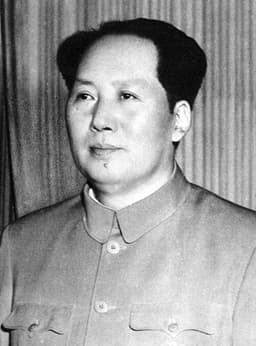
Mao Zedong
Politician · Modern
79.4Total

Napoleon Bonaparte
General · Modern
70.9Total
Basic Information
Born
1893
1769
Died
1976
1821
Era
Modern
Modern
Nationality
China
France
Occupation
Politician
General
Civilization
Eastern
Western
Score Comparison
Military (10%)
75.0
94.0
Political (20%)
88.0
72.0
Influence (20%)
85.0
40.0
Legacy (20%)
70.0
80.0
Leadership (15%)
85.0
78.0
Strategy (15%)
72.0
90.0
TOTAL
79.4
70.9
Mao Zedong — Complete Timeline
1934 AD
Long MarchWar
Mao Zedong led the Chinese Red Army on a strategic retreat from Nationalist forces, covering approximately 6,000 miles over 370 days. The march solidified Mao's leadership within the Chinese Communist Party and became a foundational myth of the Communist revolution.
Chinese Civil WarCommunist RevolutionRetreat
Impact: national
1949 AD
Proclamation of the People's Republic of ChinaPolitical Action
Mao Zedong declared the founding of the People's Republic of China from Tiananmen Gate in Beijing. This ended the Chinese Civil War and established Communist rule over mainland China, with Mao as Chairman of the Central People's Government.
Founding of PRCCommunist VictoryRevolution
Impact: global
1958 AD
Great Leap ForwardReform◆ Major
Mao launched a campaign to rapidly industrialize China and collectivize agriculture. The policy led to widespread mismanagement, resulting in a famine that caused an estimated 15-45 million deaths between 1959 and 1961.
FamineIndustrializationCollectivization
Impact: nationaldestructive
1960 AD
Sino-Soviet SplitPolitical Action◆ Major
Mao's ideological differences with Soviet leader Nikita Khrushchev led to a breakdown in relations between China and the Soviet Union. The split ended the Sino-Soviet alliance and reshaped global Cold War dynamics, with China pursuing an independent path.
Cold WarIdeological ConflictAlliance Breakdown
Impact: global
1966 AD
Cultural RevolutionPolitical Action
Mao initiated a sociopolitical movement to purge capitalist and traditional elements from Chinese society. The Red Guard youth groups attacked intellectuals and officials, leading to widespread violence, destruction of cultural artifacts, and an estimated 1-2 million deaths.
Political PurgeSocial UpheavalRed Guard
Impact: nationaldestructive
1971 AD
Ping-Pong DiplomacyCultural◆ Major
Mao approved an invitation for the U.S. table tennis team to visit China, initiating a thaw in Sino-American relations. This cultural exchange paved the way for President Nixon's visit to China in 1972 and the eventual normalization of diplomatic ties.
DiplomacyU.S.-China RelationsCultural Exchange
Impact: globalconstructive
Napoleon Bonaparte — Complete Timeline
1799 AD
Coup of 18 BrumaireOther◆ Major
Napoleon Bonaparte, with support from his brother Lucien and key political figures, overthrew the Directory in a bloodless coup. He established the Consulate with himself as First Consul, effectively becoming the ruler of France. This event ended the French Revolution's most unstable period.
French RevolutionCoupRise to Power
Impact: regional
1804 AD
Promulgation of the Napoleonic CodeOther◆ Major
Napoleon enacted the Civil Code of the French, known as the Napoleonic Code, a comprehensive set of laws that replaced the fragmented feudal legal systems. The code established legal equality, protected property rights, and secularized law. It became the basis for legal systems in many European and world countries.
Legal ReformNapoleonic CodeCivil Law
Impact: globalconstructive
1805 AD
Battle of AusterlitzWar◆ Major
Napoleon's Grande Arm
Napoleonic WarsBattleDecisive Victory
Impact: global
1812 AD
Invasion of RussiaWar◆ Major
Napoleon led the Grande Arm
Napoleonic WarsInvasionDisaster
Impact: globaldestructive
1815 AD
Battle of WaterlooWar◆ Major
Napoleon's French army was defeated by the combined forces of the Duke of Wellington's Anglo-Allied army and Gebhard Leberecht von Bl
Napoleonic WarsBattleFinal Defeat
Impact: globaldestructive
Expert Analysis
Napoleon Bonaparte vs Mao Zedong: Historical Comparison
Napoleon Bonaparte and Mao Zedong were two of the most transformative figures in modern history, each reshaping their nation through military conquest and revolutionary upheaval. While Napoleon forged a continental empire through tactical brilliance, Mao engineered a social revolution that redefined China’s trajectory.
Dimension Analysis
**Military: Napoleon Bonaparte 94 / Mao Zedong 76**
Napoleon’s unparalleled battlefield innovations—from the *Grande Armée*’s corps system to decisive victories at Austerlitz and Jena—set a standard for modern warfare. Mao’s guerrilla strategies succeeded in the Chinese Civil War but faltered in the Korean War and lacked Napoleon’s sustained offensive dominance.
**Political: Napoleon Bonaparte 75 / Mao Zedong 83**
Napoleon centralized power through the Napoleonic Code and a meritocratic bureaucracy, but his imperial overreach led to isolation. Mao’s political acumen—unifying a fractured China, launching the Great Leap Forward and Cultural Revolution—demonstrated deeper, albeit more brutal, institutional control.
**Influence: Napoleon Bonaparte 82 / Mao Zedong 84**
Napoleon’s legal and administrative reforms influenced Europe and colonial systems worldwide. Mao’s ideological impact—spreading Maoism to Asia, Africa, and Latin America—arguably reached a broader global scope, though with more contested outcomes.
**Legacy: Napoleon Bonaparte 78 / Mao Zedong 78**
Both leaders left deeply polarized legacies. Napoleon is celebrated as a modernizer in France but condemned as a tyrant elsewhere. Mao’s legacy as China’s unifier is marred by catastrophic famines and repression, yet he remains a foundational figure in Chinese state identity.
**Leadership: Napoleon Bonaparte 80 / Mao Zedong 83**
Napoleon’s charismatic command inspired fierce loyalty but also fatal hubris. Mao’s cult of personality and ability to mobilize millions—through land reform, mass campaigns, and ideological purity—demonstrated a more resilient, if ruthless, grip on power.
Verdict
Mao Zedong leads narrowly due to his superior political consolidation and lasting ideological influence, despite Napoleon’s unmatched military brilliance.
FAQ
Q: Who ranks higher? A: Mao Zedong edges ahead in the overall comparison, reflecting his deeper political and influence scores, though both leaders are historically tied in legacy.
Rankings
🥇
Mao ZedongLeader
Mil: 75.0Pol: 88.0Inf: 85.0
79.4
🥈
Napoleon Bonaparte
Mil: 94.0Pol: 72.0Inf: 40.0
70.9
+8.5 behind
How This Comparison Works
Algorithm
Each figure is scored on 6 dimensions (0—100 scale) based on structured historical data: Military (10%), Political (20%), Influence (20%), Legacy (20%), Leadership (15%), Strategy (15%). The weighted total produces the final ranking.
Data Sources
Scores are computed from structured sub-indicators in the database. Scale factors adjust for era (Ancient ×0.85, Modern ×1.0) and civilization size (Eastern ×1.05, Other ×0.80) to account for differences in population and military scale.
Maximum 3 Figures
Comparisons are limited to 2—3 figures to ensure readability and statistical meaningfulness.
Error Margins
±5 points per dimension — Sub-scores are derived from historical records with inherent uncertainty. Two figures within 5 points on a dimension should be considered roughly equivalent in that area.
Total Score Accuracy
±3 points overall — The weighted combination of 6 dimensions produces a total score with approximately ±3 points of uncertainty. Differences of less than 3 points are not statistically significant— the figures are effectively tied.
Known Limitations
- Historical records are incomplete and uneven across civilizations
- Figures from oral-tradition societies may be underrepresented
- Occupation labels can misclassify multi-role figures
- Scores measure capability and impact, not moral character
- Quantitative scoring is a comparison tool, not absolute truth
Capability Radar
Military (10%) — Battles & Warfare
Battles
85
95
Win Rate
80
90
Expansion
85
95
Political (20%) — Governance & Reform
Reform
95
95
Diplomacy
80
80
Economy
70
85
Influence (20%) — Cultural & Global Reach
Cultural
90
85
Global
90
90
Legacy (20%) — Historical Impact
Historical
95
95
Longevity
85
90
Leadership (15%) — Power & Stability
Tenure
95
85
Stability
60
70
Strategy (15%) — Tactics & Innovation
Strategy
85
95
Tactics
75
98
Reform
90
92
Similar Comparisons
Comments & Discussion
HistoryBuffFromTheBlock6/16/2026
I've been binge-watching a lot of documentaries on Napoleon, and I gotta say—his military score at 94 is spot on. The guy basically invented modern warfare with his corps system. But Mao at 65? That feels a bit low. Sure, he wasn't a tactical genius on the level of Napoleon, but he mobilized a whole peasant army and beat the Nationalists and Japanese. That's not nothing. I think the scoring here is too Eurocentric—like, if you read 'The Art of War,' it's all about outsmarting your enemy, not just big battalions. Napoleon was brilliant, but Mao's Long March was more about survival and propaganda than any Western general could handle.
ClassicaLitterae6/16/2026
The comparison is fundamentally flawed, as it imposes a modern, uniform scoring system on two figures operating in vastly different historical contexts. Napoleon, as Clausewitz noted, was a 'god of war' whose campaigns are still studied at military academies—his 94 in military is defensible, given his operational brilliance at Austerlitz and Jena. Mao's 65, however, reflects a Western bias against guerrilla warfare. Consider Mao's own words: 'The guerrilla must move among the people as a fish swims in the sea.' This is not inferior—it's a different paradigm. Politically, Napoleon's 75 seems generous: his authoritarian turn after the Consulate alienated many intellectuals, while Mao's 82 fails to capture the catastrophic human cost of his policies. In short, we are comparing apples and oranges through a rose-tinted lens of contemporary historiography.
OldScroll446/16/2026
这个评分明显是西方中心主义的。拿破仑的军事94分,毛泽东才65分?这完全忽视了毛泽东在中国内战和抗日战争中的战略创新。拿破仑的军事胜利靠的是欧洲的线列战术和火炮优势,而毛泽东在资源极度匮乏的条件下,用游击战和根据地建设打败了日本和国民党。毛泽东的政治评分82分比拿破仑的75分高,这还算合理,因为毛泽东确实建立了更深层的政治控制,但军事差距不应该这么大。如果比战略眼光,毛泽东的《论持久战》比拿破仑的任何军事著作都更有深度。
SharpMind746/16/2026
我来分析一下这个评分系统的漏洞。拿破仑的军事94分,毛泽东65分——差了29分。但毛泽东指挥的战役包括:平型关战役(1937)、辽沈战役(1948)、淮海战役(1949)等,这些都是在劣势装备下获胜的。拿破仑的奥斯特里茨战役(1805)确实辉煌,但他的滑铁卢战役(1815)是惨败,而毛泽东在朝鲜战争中虽然没赢,但也顶住了联合国军。如果按胜率算,毛泽东的战役胜率其实更高。另外,政治评分拿破仑75分,但拿破仑的《拿破仑法典》是法律里程碑,毛泽东的政治运动却导致了数千万人死亡。这个评分体系可能没有考虑死亡人数和长期影响,需要调整权重。