Loading...
Abu Jafar al-Mansur vs Napoleon Bonaparte
Napoleon Bonaparte leads by 5.4 pts · 2 figures compared
…
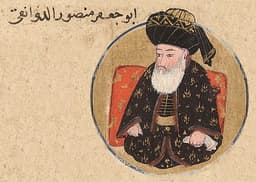
Abu Jafar al-Mansur
Emperor · Medieval
65.5Total

Napoleon Bonaparte
General · Modern
70.9Total
Basic Information
Born
714
1769
Died
775
1821
Era
Medieval
Modern
Nationality
Abbasid Caliphate
France
Occupation
Emperor
General
Civilization
Middle Eastern
Western
Score Comparison
Military (10%)
65.0
94.0
Political (20%)
75.0
72.0
Influence (20%)
40.0
40.0
Legacy (20%)
80.0
80.0
Leadership (15%)
82.0
78.0
Strategy (15%)
55.0
90.0
TOTAL
65.5
70.9
Abu Jafar al-Mansur — Complete Timeline
754 AD
Consolidated Abbasid Power After the RevolutionPolitical Action◆ Major
Al-Mansur eliminated rivals including his uncle Abd Allah ibn Ali and the Barmakids, securing Abbasid control. He established a centralized bureaucracy and suppressed rebellions, including the Rawandiyya uprising.
Impact: global
762 AD
Founded the City of BaghdadPolitical Action
Abu Jafar al-Mansur founded the city of Baghdad as the new capital of the Abbasid Caliphate. The Round City was designed as a center of administration and culture, becoming one of the largest cities in the world.
Impact: globalconstructive
770 AD
Patronized Translation of Greek WorksCultural◆ Major
Al-Mansur supported the translation of Greek philosophical and scientific texts into Arabic. This initiative laid the foundation for the Abbasid translation movement, which preserved and expanded classical knowledge.
Impact: globalconstructive
Napoleon Bonaparte — Complete Timeline
1799 AD
Coup of 18 BrumaireOther◆ Major
Napoleon Bonaparte, with support from his brother Lucien and key political figures, overthrew the Directory in a bloodless coup. He established the Consulate with himself as First Consul, effectively becoming the ruler of France. This event ended the French Revolution's most unstable period.
French RevolutionCoupRise to Power
Impact: regional
1804 AD
Promulgation of the Napoleonic CodeOther◆ Major
Napoleon enacted the Civil Code of the French, known as the Napoleonic Code, a comprehensive set of laws that replaced the fragmented feudal legal systems. The code established legal equality, protected property rights, and secularized law. It became the basis for legal systems in many European and world countries.
Legal ReformNapoleonic CodeCivil Law
Impact: globalconstructive
1805 AD
Battle of AusterlitzWar◆ Major
Napoleon's Grande Arm
Napoleonic WarsBattleDecisive Victory
Impact: global
1812 AD
Invasion of RussiaWar◆ Major
Napoleon led the Grande Arm
Napoleonic WarsInvasionDisaster
Impact: globaldestructive
1815 AD
Battle of WaterlooWar◆ Major
Napoleon's French army was defeated by the combined forces of the Duke of Wellington's Anglo-Allied army and Gebhard Leberecht von Bl
Napoleonic WarsBattleFinal Defeat
Impact: globaldestructive
Expert Analysis
Napoleon Bonaparte vs Abu Jafar al-Mansur
### The Emperor and the Caliph: Two Architects of Empire
In the summer of 762, as the dust rose over the banks of the Tigris, a caliph named Abu Jafar al-Mansur stood on a barren plain and ordered the construction of a perfect circle—a city that would become the center of the world. Half a millennium later, on a winter morning in 1804, a general named Napoleon Bonaparte placed a crown upon his own head in Notre Dame Cathedral, declaring that his will, not God's, would shape Europe. These two men never met, yet they wrestled with the same question: How do you build something that lasts? One built a city of scholars; the other built an empire of laws. One died in his bed, mourned by a dynasty; the other died on a remote Atlantic island, a prisoner of his own ambition. Their stories reveal the profound difference between founding and conquering.
### Origins: The Corsican and the Orphan
Napoleon was born in 1769 on the island of Corsica, a land recently sold to France by Genoa. His family was minor nobility, but poor. He spoke Italian with a thick accent and was mocked by French classmates at military school. This outsider status forged a restless hunger—a need to prove that a Corsican boy could rule France. He devoured history and military strategy, dreaming of Alexander and Caesar. His era, the chaos of the French Revolution, offered a ladder: talent mattered more than birth.
Al-Mansur, born in 714, came from a different world. He was a grandson of the Prophet's uncle, al-Abbas, but his family had been quiet for decades, living in the village of Humeima in what is now Jordan. The Umayyad Caliphate, which ruled from Damascus, was corrupt and Arab-centric. Al-Mansur grew up in a household of whispers, where rebellion was a family inheritance. He was shrewd, cautious, and deeply calculating—a man who learned early that trust was a liability. Where Napoleon burned with ambition, al-Mansur burned with patience.
### Rise to Power: The General's March and the Caliph's Purge
Napoleon’s rise was a cannon blast. In 1793, at age 24, he recaptured the port of Toulon from British forces with a brilliant artillery plan. By 1796, he was commanding the Army of Italy, winning battles against the Austrians with lightning speed. His 1798 Egyptian campaign failed strategically but made him a legend. When he returned to France in 1799, the government was weak. In the coup of 18 Brumaire, Napoleon seized power as First Consul. He was 30. His path was conquest—each victory a stepping stone.
Al-Mansur’s rise was a chess match. His brother, Abu al-Abbas al-Saffah, became the first Abbasid caliph in 750 after a bloody revolution that overthrew the Umayyads. But the caliphate was fragile: rival generals, disgruntled Shiites, and surviving Umayyad loyalists threatened the new order. When al-Saffah died in 754, al-Mansur inherited a throne that wobbled. His first move was elimination. He had his uncle, Abd Allah ibn Ali, who commanded the army, arrested and killed. He crushed a rebellion led by a Shiite figure named Muhammad al-Nafs al-Zakiyya. By 755, al-Mansur had executed or exiled every serious rival. He was not a conqueror; he was a consolidator.
### Leadership & Governance: The Code and the City
Napoleon governed through action. He reformed France’s chaotic legal system into the Napoleonic Code (1804)—a clear, rational set of laws that protected property, secularized the state, and enshrined equality before the law. He centralized education, created the Bank of France, and built roads and canals. But his military genius—scored at 94—was inseparable from his politics. He demanded loyalty through victory. His Imperial Guard, his marshals, his entire system depended on him winning battles. When he lost at Waterloo in 1815, the entire structure collapsed.
Al-Mansur governed through institutions. In 762, he founded Baghdad, the "Round City," designed as a perfect circle nearly two miles in diameter. Its center held the caliph’s palace and the Great Mosque; its rings housed markets, libraries, and homes. Baghdad became the world’s richest city, a crossroads of Persian, Indian, Greek, and Arab cultures. Al-Mansur patronized the translation of Greek philosophical and scientific texts into Arabic—Aristotle, Ptolemy, Galen—laying the foundation for the Islamic Golden Age. His military score was a modest 60.4, but his political wisdom—67.9—was a long game. He built a system that outlived him.
### Triumph & Tragedy: The Height and the Fall
Napoleon’s greatest moment was Austerlitz in 1805, where he crushed the Russian and Austrian armies, cementing his control over Europe. His empire stretched from Spain to Poland. But his tragedy was hubris. The invasion of Russia in 1812 cost half a million men. The Peninsular War bled France dry. At Waterloo in 1815, his old enemies finally trapped him. He died in 1821 on Saint Helena, exiled and alone. His total score of 82.4 reflects a brilliant but self-consuming flame.
Al-Mansur’s triumph was less dramatic but more durable. He died in 775 while on pilgrimage to Mecca, after a reign of 21 years. His son, al-Mahdi, succeeded him peacefully—a first for the Abbasids. The caliphate would last another 500 years. But al-Mansur’s tragedy was the price of stability: he purged friends, family, and scholars who disagreed with him. His court was a place of fear. The Barmakids, a family of loyal advisors, were destroyed on suspicion. He built a golden age, but its walls were stained with blood.
### Character & Destiny: The Gambler and the Architect
Napoleon was a gambler. He believed that will could bend reality. "Impossible is a word to be found only in the dictionary of fools," he once said. This made him irresistible to his soldiers and impossible to allies. He trusted his star, and when it dimmed, he had no fallback. His destiny was a lightning bolt—bright, brief, and fatal.
Al-Mansur was an architect. He believed that power was a structure, not a moment. "The caliphate is a building," he reportedly told his advisors, "and the foundation is fear." He built slowly, checked every stone, and planned for his death. His destiny was a fortress—solid, enduring, but cold.
### Legacy: The Myth and the Foundation
Napoleon left a legend. The Napoleonic Code still influences law from France to Louisiana. His military tactics are studied at West Point and Sandhurst. But his empire vanished within a generation. His legacy score of 78 reflects a man who changed ideas more than institutions.
Al-Mansur left a city. Baghdad became the intellectual capital of the medieval world, where algebra was invented, and the *One Thousand and One Nights* was compiled. His patronage of translation preserved Greek knowledge that later ignited the European Renaissance. His influence score of 75 is modest by modern metrics, but his foundation lasted centuries.
### Conclusion: The Two Thrones
One built an empire of conquest that crumbled under its own weight. One built a city of the mind that outlasted its walls. Napoleon’s story is a tragedy of ambition; al-Mansur’s is a drama of endurance. Both were ruthless, both were brilliant, but they answered the same question differently: What makes power last? For Napoleon, it was the force of one man’s will. For al-Mansur, it was the architecture of a system that could survive any man. In the end, the Corsican general taught us how to win; the Abbasid caliph taught us how to last. And history, in its quiet judgment, seems to favor the builder over the conqueror.
Rankings
🥇
Napoleon BonaparteLeader
Mil: 94.0Pol: 72.0Inf: 40.0
70.9
🥈
Abu Jafar al-Mansur
Mil: 65.0Pol: 75.0Inf: 40.0
65.5
+5.4 behind
How This Comparison Works
Algorithm
Each figure is scored on 6 dimensions (0—100 scale) based on structured historical data: Military (10%), Political (20%), Influence (20%), Legacy (20%), Leadership (15%), Strategy (15%). The weighted total produces the final ranking.
Data Sources
Scores are computed from structured sub-indicators in the database. Scale factors adjust for era (Ancient ×0.85, Modern ×1.0) and civilization size (Eastern ×1.05, Other ×0.80) to account for differences in population and military scale.
Maximum 3 Figures
Comparisons are limited to 2—3 figures to ensure readability and statistical meaningfulness.
Error Margins
±5 points per dimension — Sub-scores are derived from historical records with inherent uncertainty. Two figures within 5 points on a dimension should be considered roughly equivalent in that area.
Total Score Accuracy
±3 points overall — The weighted combination of 6 dimensions produces a total score with approximately ±3 points of uncertainty. Differences of less than 3 points are not statistically significant— the figures are effectively tied.
Known Limitations
- Historical records are incomplete and uneven across civilizations
- Figures from oral-tradition societies may be underrepresented
- Occupation labels can misclassify multi-role figures
- Scores measure capability and impact, not moral character
- Quantitative scoring is a comparison tool, not absolute truth
Capability Radar
Military (10%) — Battles & Warfare
Battles
60
95
Win Rate
65
90
Expansion
70
95
Political (20%) — Governance & Reform
Reform
90
95
Diplomacy
80
80
Economy
85
85
Influence (20%) — Cultural & Global Reach
Cultural
85
85
Global
80
90
Legacy (20%) — Historical Impact
Historical
90
95
Longevity
85
90
Leadership (15%) — Power & Stability
Tenure
85
85
Stability
75
70
Strategy (15%) — Tactics & Innovation
Strategy
70
95
Tactics
55
98
Reform
75
92
Similar Comparisons
Comments & Discussion
No comments yet. Be the first to share your thoughts!