Loading...
Adad-apla-iddina vs Napoleon Bonaparte
Napoleon Bonaparte leads by 32.4 pts · 2 figures compared
…
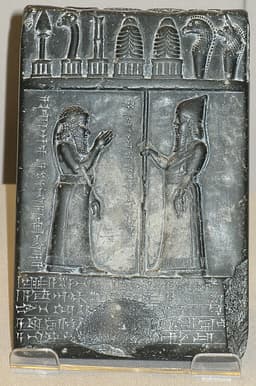
Adad-apla-iddina
Emperor · Ancient
38.5Total

Napoleon Bonaparte
General · Modern
70.9Total
Basic Information
Born
-1067
1769
Died
-1046
1821
Era
Ancient
Modern
Nationality
Babylon
France
Occupation
Emperor
General
Civilization
Middle Eastern
Western
Score Comparison
Military (10%)
10.2
94.0
Political (20%)
37.9
72.0
Influence (20%)
45.5
40.0
Legacy (20%)
36.7
80.0
Leadership (15%)
45.0
78.0
Strategy (15%)
45.0
90.0
TOTAL
38.5
70.9
Adad-apla-iddina — Complete Timeline
1060 BC
Temple Restoration ProgramReform◆ Major
Adad-apla-iddina undertook a program to restore and rebuild temples across Babylonia, including the Esagila in Babylon and the Ezida in Borsippa. These efforts aimed to revive religious practices and stabilize the kingdom after the disruptions of the Bronze Age collapse.
Temple RestorationReligious RevivalBabylonia
Impact: nationalconstructive
Napoleon Bonaparte — Complete Timeline
1799 AD
Coup of 18 BrumaireOther◆ Major
Napoleon Bonaparte, with support from his brother Lucien and key political figures, overthrew the Directory in a bloodless coup. He established the Consulate with himself as First Consul, effectively becoming the ruler of France. This event ended the French Revolution's most unstable period.
French RevolutionCoupRise to Power
Impact: regional
1804 AD
Promulgation of the Napoleonic CodeOther◆ Major
Napoleon enacted the Civil Code of the French, known as the Napoleonic Code, a comprehensive set of laws that replaced the fragmented feudal legal systems. The code established legal equality, protected property rights, and secularized law. It became the basis for legal systems in many European and world countries.
Legal ReformNapoleonic CodeCivil Law
Impact: globalconstructive
1805 AD
Battle of AusterlitzWar◆ Major
Napoleon's Grande Arm
Napoleonic WarsBattleDecisive Victory
Impact: global
1812 AD
Invasion of RussiaWar◆ Major
Napoleon led the Grande Arm
Napoleonic WarsInvasionDisaster
Impact: globaldestructive
1815 AD
Battle of WaterlooWar◆ Major
Napoleon's French army was defeated by the combined forces of the Duke of Wellington's Anglo-Allied army and Gebhard Leberecht von Bl
Napoleonic WarsBattleFinal Defeat
Impact: globaldestructive
Expert Analysis
adad-apla-iddina-vs-napoleon-bonaparte
# The Emperor and the Builder: Two Paths to Immortality
In the winter of 1808, Napoleon Bonaparte stood on a balcony in Madrid, watching his Grand Army march through the Spanish capital. He was thirty-nine years old, master of Europe from the Atlantic to the Vistula, and he believed he could see the future. Three thousand years earlier, another ruler stood on a ziggurat in Babylon, surveying a very different kind of empire—one built not on cannon and cavalry but on clay bricks and temple dedications. Adad-apla-iddina, king of Babylon from 1067 to 1046 BC, could never have imagined a man like Napoleon. Yet both faced the same fundamental question: how does a ruler leave a mark that outlasts his own breath?
Origins
Napoleon was born in 1769 on the island of Corsica, a recent French acquisition with a fierce sense of its own identity. His family was minor nobility, poor enough to know hunger but connected enough to send him to French military schools. The boy who arrived at Brienne-le-Château spoke Italian-accented French and was mocked by his classmates. He carried that humiliation like a blade.
Adad-apla-iddina emerged from a very different world. Babylon in the eleventh century BC was a city in decline, squeezed between Assyrian pressure and Aramaean migrations. The king's origins remain obscure—he may not have been of royal blood at all. What is certain is that he inherited a kingdom whose temples had fallen into ruin, whose gods were believed to have abandoned their people. In Mesopotamia, that was the worst omen of all.
The contrast is instructive. Napoleon grew up in the ferment of Enlightenment thought, where a man could remake himself through will and talent. Adad-apla-iddina lived in a world where the past was sacred, where a king's primary duty was not to conquer but to maintain the cosmic order. The Corsican wanted to change the world. The Babylonian wanted to restore it.
Rise to Power
Napoleon's ascent was meteoric and violent. The French Revolution had shattered the old aristocratic order, creating opportunities for ambitious young officers. In 1793, at the age of twenty-four, he drove the British out of Toulon and was promoted to brigadier general. By 1796 he commanded the Army of Italy, winning battles that seemed impossible against the Austrians. His political score of 75.0 reflects a man who understood that military glory alone was not enough—he needed to control the state itself.
Adad-apla-iddina's path to power is lost to history. He appears in the record already crowned, already king. There are no dramatic sieges, no coup d'état, no famous last words. He simply assumed the throne of a struggling kingdom and began the slow, patient work of rebuilding. His political score of 42.8 suggests a ruler constrained by tradition and circumstance, unable to break free from the weight of Babylonian precedent.
Leadership & Governance
Napoleon governed through sheer force of personality. His leadership score of 80.0 and military score of 94.0 reflect a man who led from the front, who could inspire soldiers to die for him, who rewrote the laws of war. The Napoleonic Code, implemented in 1804, standardized French law and influenced legal systems across Europe. He appointed prefects, built roads, established the Bank of France, and created a system of public education. But he also centralized power in his own hands, suppressed dissent, and crowned himself emperor in 1804.
Adad-apla-iddina governed through piety. His temple restoration program, begun around 1060 BC, focused on the Esagila, the great temple of Marduk in Babylon. He also repaired the Ezida in Borsippa and other sanctuaries across Babylonia. This was not mere religious observance—it was political genius. By restoring the gods' houses, he was restoring the legitimacy of the kingship itself. His military score of 39.0 and leadership score of 35.1 suggest he was no warrior, but his strategy score of 57.9 hints at a different kind of wisdom: the understanding that in an age of decline, survival is a form of victory.
Triumph & Tragedy
Napoleon's greatest moment came in December 1805 at Austerlitz, where he crushed the combined armies of Austria and Russia. It was a masterpiece of tactical deception, a battle still studied in military academies today. His worst came ten years later at Waterloo, where a combination of Prussian reinforcements, British stubbornness, and his own miscalculations ended his empire. He died in exile on Saint Helena in 1821, a prisoner of the British.
Adad-apla-iddina's triumphs were quieter. The restored temples of Babylon stood as testaments to his reign, physical proof that the gods had not abandoned Mesopotamia. But his tragedy was that he could not stop the decline. The Aramaean incursions continued. The Assyrian threat grew. He died in 1046 BC after a reign of twenty-one years, and within a generation Babylon would fall into chaos. His legacy score of 48.6 suggests that his works, however noble, could not withstand the forces arrayed against them.
Character & Destiny
Napoleon was driven by an insatiable hunger for glory. "I live only for posterity," he once said, and he meant it. His character was a paradox—a reformer who became a tyrant, a liberator who enslaved nations, a genius who could not stop. He believed that destiny was something to be seized, not accepted.
Adad-apla-iddina appears to have been a conservative in the truest sense: a man who sought to preserve what remained rather than reach for what could be. His character was shaped by the belief that the past was better than the present, that the duty of a king was to restore rather than innovate. He accepted his destiny as a caretaker of a fading civilization.
Legacy
Napoleon's legacy is everywhere. The Napoleonic Code, the metric system, the modern concept of meritocracy, the very shape of European borders—all bear his mark. But he also left a trail of war dead that would not be surpassed until the twentieth century. His total score of 82.4 reflects a figure of immense, ambiguous impact.
Adad-apla-iddina's legacy is more fragile. His name appears in king lists and archaeological reports. The temples he restored have long since crumbled. His total score of 48.3 places him among history's lesser lights. Yet there is something poignant in his story—a reminder that not all leadership is about conquest, that rebuilding can be as noble as building, that sometimes the greatest act of defiance is simply to maintain what has been given.
Conclusion
We remember Napoleon because he changed the world. We nearly forget Adad-apla-iddina because he tried to save it. But perhaps the Babylonian king understood something the Corsican never did: that empires pass, that glory fades, that the most enduring monuments are not made of stone or law but of the quiet, daily work of preservation. Napoleon reached for immortality and found only exile. Adad-apla-iddina accepted mortality and, in his own way, achieved a kind of permanence—his name still spoken, his temples still remembered, three thousand years after he first knelt before the gods of Babylon.
Rankings
🥇
Napoleon BonaparteLeader
Mil: 94.0Pol: 72.0Inf: 40.0
70.9
🥈
Adad-apla-iddina
Mil: 10.2Pol: 37.9Inf: 45.5
38.5
+32.4 behind
How This Comparison Works
Algorithm
Each figure is scored on 6 dimensions (0—100 scale) based on structured historical data: Military (10%), Political (20%), Influence (20%), Legacy (20%), Leadership (15%), Strategy (15%). The weighted total produces the final ranking.
Data Sources
Scores are computed from structured sub-indicators in the database. Scale factors adjust for era (Ancient ×0.85, Modern ×1.0) and civilization size (Eastern ×1.05, Other ×0.80) to account for differences in population and military scale.
Maximum 3 Figures
Comparisons are limited to 2—3 figures to ensure readability and statistical meaningfulness.
Error Margins
±5 points per dimension — Sub-scores are derived from historical records with inherent uncertainty. Two figures within 5 points on a dimension should be considered roughly equivalent in that area.
Total Score Accuracy
±3 points overall — The weighted combination of 6 dimensions produces a total score with approximately ±3 points of uncertainty. Differences of less than 3 points are not statistically significant— the figures are effectively tied.
Known Limitations
- Historical records are incomplete and uneven across civilizations
- Figures from oral-tradition societies may be underrepresented
- Occupation labels can misclassify multi-role figures
- Scores measure capability and impact, not moral character
- Quantitative scoring is a comparison tool, not absolute truth
Capability Radar
Military (10%) — Battles & Warfare
Battles
5
95
Win Rate
5
90
Expansion
5
95
Political (20%) — Governance & Reform
Reform
40
95
Diplomacy
30
80
Economy
30
85
Influence (20%) — Cultural & Global Reach
Cultural
20
85
Global
10
90
Legacy (20%) — Historical Impact
Historical
20
95
Longevity
20
90
Leadership (15%) — Power & Stability
Tenure
30
85
Stability
25
70
Strategy (15%) — Tactics & Innovation
Strategy
5
95
Tactics
5
98
Reform
5
92
Similar Comparisons
Comments & Discussion
BrickOverCannon6/17/2026
Napoleon conquered Europe in a decade; Adad-apla-iddina spent 21 years rebuilding Babylon’s walls and temples. One left a trail of 600,000 dead in Russia alone, the other left cuneiform records of grain distribution to the poor. Give me the builder over the butcher any day. Military glory fades; clay tablets telling of justice last millennia. Napoleon is just a footnote to this Babylonian king.
EurasianSkeptic6/17/2026
Let’s not romanticize an obscure Bronze Age king who ruled a shrinking city-state for two decades. We have barely 50 texts from Adad-apla-iddina’s reign—he’s famous only because his records survived by accident. Napoleon’s career is documented in millions of pages; we can judge his actual impact. This comparison is pure survivorship bias. One man reshaped modern Europe; the other is trivia for Assyriologists.
石匠论史6/17/2026
拿坡仑用大炮轰开欧洲大门,阿达德-阿普拉-伊迪纳却在巴比伦用泥砖和供品筑起精神城墙。前者留下了滑铁卢的一败涂地,后者在末代亚述的压力下重建了马尔杜克神庙,让巴比伦文明多撑了几世纪。战争是易碎的虚名,而祈祷与砖石才是真正的遗产。我押宝巴比伦王,他的耐心比法国皇帝的野心更长久。
古典小辫子6/17/2026
拿破仑?不过是法兰西版的阿达德-阿普拉-伊迪纳罢了。两人都是动乱年代的篡位者:一个靠军校和政变上位,一个从泥板记载的“某人”变成城邦之主。但拿破仑只学会了用现代术语包装古老野心,而巴比伦王至少知道在伊沙尔门铭刻“我恢复了祭祀”时,这是对神与民的双重承诺。皇帝的虚荣心写在铜像上,真实的历史刻在黏土里。
暴君档案馆6/17/2026
别拿拿破仑的军事天才来压一个九流小国的守成之君。阿达德-阿普拉-伊迪纳在位时,巴比伦城已萎缩到不足平方千米,他还能留下28年的建设记录,已经算奇迹。拿破仑呢?他打下的帝国20年就崩了,连他的法典都被后世修改得面目全非。一个用功业改写历史,一个用沉默活过历史。我更喜欢后者的坚持——至少在泥板里,他没谎报军情。