Loading...
Adolf of Nassau vs Louis VIII of France
Adolf of Nassau leads by 1.4 pts · 2 figures compared
…
Adolf of Nassau
Emperor · Medieval
40.0Total

Louis VIII of France
Emperor · Medieval
38.6Total
Basic Information
Born
1255
1187
Died
1298
1226
Era
Medieval
Medieval
Nationality
Holy Roman Empire
France
Occupation
Emperor
Emperor
Civilization
Western
Western
Score Comparison
Military (10%)
50.0
25.0
Political (20%)
30.7
27.9
Influence (20%)
47.9
49.4
Legacy (20%)
37.5
38.3
Leadership (15%)
31.2
39.0
Strategy (15%)
43.7
41.7
TOTAL
40.0
38.6
Adolf of Nassau — Complete Timeline
1292 AD
Elected King of GermanyPolitical Action◆ Major
Adolf of Nassau was elected King of Germany by the prince-electors, succeeding Rudolf of Habsburg. His election was supported by the Archbishop of Mainz and other electors who sought to limit Habsburg influence.
ElectionGerman KingdomNassau
Impact: regional
1294 AD
Purchased the Landgraviate of ThuringiaPolitical Action
Adolf of Nassau purchased the Landgraviate of Thuringia from the Wettin dynasty. This acquisition expanded his territorial base but was criticized by the prince-electors for using imperial funds without their consent.
Territorial AcquisitionThuringiaControversy
Impact: regional
1298 AD
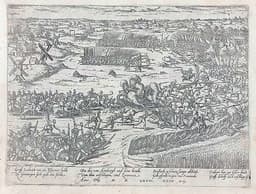
Killed at the Battle of GöllheimWar◆ Major
Adolf of Nassau was killed in battle against Albert I of Habsburg at G
BattleDeathHabsburg
Impact: regionaltragic
Deposed by the Prince-ElectorsPolitical Action◆ Major
Adolf of Nassau was deposed by the prince-electors, who accused him of misgovernance and violating imperial laws. This deposition was unprecedented and led to the election of Albert I of Habsburg as his successor.
DepositionGerman KingdomHabsburg
Impact: regionaldestructive
Louis VIII of France — Complete Timeline
1216 AD
Invasion of EnglandWar◆ Major
Louis VIII led a French invasion of England at the invitation of English barons rebelling against King John. He was proclaimed King of England in London but failed to consolidate control after John's death and the barons' shift of allegiance to Henry III.
InvasionEnglish Civil WarCapetian
Impact: regional
1217 AD
Treaty of LambethPolitical Action◆ Major
Louis VIII signed the Treaty of Lambeth, formally abandoning his claim to the English throne. He renounced his invasion and received a financial settlement, ending the First Barons' War and securing peace between France and England.
TreatyPeaceCapetian
Impact: regional
1226 AD
Albigensian Crusade CampaignsWar◆ Major
Louis VIII led a royal campaign in the Albigensian Crusade against the Cathars in southern France. He captured Avignon and several strongholds, extending Capetian authority into Languedoc, but died before completing the conquest.
CrusadeCatharTerritorial Expansion
Impact: regionaldestructive
Expert Analysis
Origins
Adolf of Nassau was born around 1255 into the House of Nassau, a comital family in the Holy Roman Empire. Little is known of his early life, but he inherited the County of Nassau and expanded his territories through marriage and purchase. His rise was facilitated by the prince-electors, who sought a king less powerful than the Habsburgs.
Louis VIII of France, born on 5 September 1187, was the eldest son of King Philip II Augustus and Isabelle of Hainaut. He was raised in the Capetian court and groomed for kingship. His early military experience came from campaigns against the English and in the Albigensian Crusade.
Rise to Power
Adolf was elected King of Germany on 5 May 1292, succeeding Rudolf I of Habsburg. His election was supported by Archbishop Siegfried of Cologne and other electors who hoped he would be pliable. However, Adolf quickly sought to assert his authority, purchasing the Landgraviate of Thuringia in 1294 for 12,000 marks, which alienated the electors.
Louis VIII became king on 14 July 1223 upon his father's death. He had already proven himself militarily, notably in the 1216 invasion of England at the invitation of rebellious barons. He was proclaimed king in London but was forced to retreat after the death of King John and the subsequent Treaty of Lambeth in 1217, where he renounced his claim for 10,000 marks.
Leadership & Governance
Adolf's governance was marked by territorial expansion through purchase and marriage, but he failed to build a stable power base. He alienated the electors by ignoring their interests and was accused of misgovernance. His deposition in 1298 was unprecedented, showing his political score of 30.7 reflects his inability to manage the complex imperial politics.
Louis VIII's reign lasted only three years (1223-1226), but he continued his father's centralization policies. He enacted the Ordinance of 1225 prohibiting Jews from lending money at interest and supported the Inquisition. His leadership score of 39.0 is modest, but he effectively extended royal authority into Languedoc during the Albigensian Crusade, capturing Avignon in 1226.
Triumph & Tragedy
Adolf's greatest success was the acquisition of Thuringia, which expanded his territory. However, his deposition and death at the Battle of Göllheim on 2 July 1298 were his downfall. He was killed by Albert I of Habsburg, and his body was buried in Speyer Cathedral. His military score of 50.0 reflects his death in battle, but his overall score of 40.0 is low due to political failure.
Louis VIII's triumph was leading the Albigensian Crusade, which brought much of southern France under royal control. His tragedy was his early death on 8 November 1226 from dysentery, leaving his young son Louis IX to rule. His invasion of England initially succeeded but ended in failure at the Treaty of Lambeth, giving him a military score of 25.0.
Character & Destiny
Adolf was ambitious but politically inept. His decision to purchase Thuringia without consulting the electors showed a lack of political acumen. His destiny was sealed by his deposition and death, a result of his failure to secure alliances. Historians regard him as a weak king who could not adapt to the electoral system.
Louis VIII was a capable military leader but died before he could fully implement his policies. His character was shaped by his father's example, but he lacked Philip's longevity. His early death meant his legacy was largely overshadowed by his son, Saint Louis. Louis VIII's influence score of 49.4 is higher than Adolf's 47.9, reflecting his role in the Crusade and the expansion of Capetian power.
Legacy
Adolf's legacy is primarily negative: he was the first German king to be deposed by electors, setting a precedent for future depositions. His reign demonstrated the fragility of royal power in the Holy Roman Empire. His score of 37.5 for legacy reflects his obscurity.
Louis VIII's legacy is more substantial. He solidified Capetian control over Languedoc, paving the way for his son's reign. His short rule saw the beginning of the French crown's involvement in the Albigensian Crusade, which ended in 1229. His legacy score of 38.3 is slightly higher than Adolf's, but both are low compared to more successful medieval rulers.
Conclusion
Adolf of Nassau scores 40.0 overall, while Louis VIII scores 38.6, a gap of 1.4 points. However, this numerical difference does not reflect their relative impact. Louis VIII's actions had lasting consequences for France, particularly the extension of royal authority into the south, while Adolf's deposition was a momentary disruption. Despite his lower total score, Louis VIII had greater influence on the course of history. His son Louis IX became a saint and a model medieval king, while Adolf's line faded. Therefore, Louis VIII of France had a greater impact than Adolf of Nassau.
Rankings
🥇
Adolf of NassauLeader
Mil: 50.0Pol: 30.7Inf: 47.9
40.0
🥈
Louis VIII of France
Mil: 25.0Pol: 27.9Inf: 49.4
38.6
+1.4 behind
How This Comparison Works
Algorithm
Each figure is scored on 6 dimensions (0—100 scale) based on structured historical data: Military (10%), Political (20%), Influence (20%), Legacy (20%), Leadership (15%), Strategy (15%). The weighted total produces the final ranking.
Data Sources
Scores are computed from structured sub-indicators in the database. Scale factors adjust for era (Ancient ×0.85, Modern ×1.0) and civilization size (Eastern ×1.05, Other ×0.80) to account for differences in population and military scale.
Maximum 3 Figures
Comparisons are limited to 2—3 figures to ensure readability and statistical meaningfulness.
Error Margins
±5 points per dimension — Sub-scores are derived from historical records with inherent uncertainty. Two figures within 5 points on a dimension should be considered roughly equivalent in that area.
Total Score Accuracy
±3 points overall — The weighted combination of 6 dimensions produces a total score with approximately ±3 points of uncertainty. Differences of less than 3 points are not statistically significant— the figures are effectively tied.
Known Limitations
- Historical records are incomplete and uneven across civilizations
- Figures from oral-tradition societies may be underrepresented
- Occupation labels can misclassify multi-role figures
- Scores measure capability and impact, not moral character
- Quantitative scoring is a comparison tool, not absolute truth
Capability Radar
Military (10%) — Battles & Warfare
Battles
30
35
Win Rate
20
40
Expansion
15
40
Political (20%) — Governance & Reform
Reform
10
10
Diplomacy
15
25
Economy
10
10
Influence (20%) — Cultural & Global Reach
Cultural
10
15
Global
5
10
Legacy (20%) — Historical Impact
Historical
15
20
Longevity
10
10
Leadership (15%) — Power & Stability
Tenure
25
15
Stability
10
10
Strategy (15%) — Tactics & Innovation
Strategy
20
35
Tactics
25
30
Reform
10
10
Similar Comparisons
Comments & Discussion
No comments yet. Be the first to share your thoughts!