Loading...
Ahmad Shah I Wali vs Napoleon Bonaparte
Napoleon Bonaparte leads by 19.2 pts · 2 figures compared
…
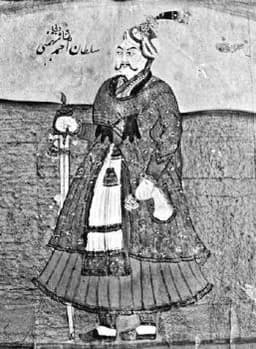
Ahmad Shah I Wali
Emperor · Medieval
51.7Total

Napoleon Bonaparte
General · Modern
70.9Total
Basic Information
Born
1422
1769
Died
1436
1821
Era
Medieval
Modern
Nationality
India
France
Occupation
Emperor
General
Civilization
Indian
Western
Score Comparison
Military (10%)
40.0
94.0
Political (20%)
48.0
72.0
Influence (20%)
51.0
40.0
Legacy (20%)
42.5
80.0
Leadership (15%)
74.0
78.0
Strategy (15%)
60.0
90.0
TOTAL
51.7
70.9
Ahmad Shah I Wali — Complete Timeline
1424 AD
Relocation of the Bahmani capital to BidarPolitical Action
Ahmad Shah I Wali moved the Bahmani capital from Gulbarga to Bidar, a more defensible location. He constructed a new fort and palace complex in Bidar, which became the political center of the sultanate.
Capital MoveUrban Development
Impact: regionalconstructive
1425 AD
War against the Vijayanagara EmpireWar◆ Major
Ahmad Shah I Wali launched a successful campaign against the Vijayanagara Empire, capturing the fort of Mudgal. The victory expanded Bahmani territory in the Raichur Doab.
WarVijayanagaraTerritorial Expansion
Impact: regional
1428 AD
Construction of the Bidar FortCultural◆ Major
Ahmad Shah I Wali oversaw the construction of the Bidar Fort, a massive defensive structure with seven gates and extensive ramparts. The fort became the seat of Bahmani power for over a century.
ArchitectureFortification
Impact: regionalconstructive
1430 AD
Suppression of the rebellion of the Bahmani noblesPolitical Action
Ahmad Shah I Wali crushed a rebellion by powerful Bahmani nobles who opposed his centralization of authority. The rebels were defeated, and their leaders were executed or exiled.
RebellionInternal Conflict
Impact: nationaldestructive
Napoleon Bonaparte — Complete Timeline
1799 AD
Coup of 18 BrumaireOther◆ Major
Napoleon Bonaparte, with support from his brother Lucien and key political figures, overthrew the Directory in a bloodless coup. He established the Consulate with himself as First Consul, effectively becoming the ruler of France. This event ended the French Revolution's most unstable period.
French RevolutionCoupRise to Power
Impact: regional
1804 AD
Promulgation of the Napoleonic CodeOther◆ Major
Napoleon enacted the Civil Code of the French, known as the Napoleonic Code, a comprehensive set of laws that replaced the fragmented feudal legal systems. The code established legal equality, protected property rights, and secularized law. It became the basis for legal systems in many European and world countries.
Legal ReformNapoleonic CodeCivil Law
Impact: globalconstructive
1805 AD
Battle of AusterlitzWar◆ Major
Napoleon's Grande Arm
Napoleonic WarsBattleDecisive Victory
Impact: global
1812 AD
Invasion of RussiaWar◆ Major
Napoleon led the Grande Arm
Napoleonic WarsInvasionDisaster
Impact: globaldestructive
1815 AD
Battle of WaterlooWar◆ Major
Napoleon's French army was defeated by the combined forces of the Duke of Wellington's Anglo-Allied army and Gebhard Leberecht von Bl
Napoleonic WarsBattleFinal Defeat
Impact: globaldestructive
Expert Analysis
ahmad-shah-i-wali-vs-napoleon-bonaparte
### The Emperor and the Sultan: Two Paths to Power, Two Ends of Glory
History loves a dramatic contrast. Imagine, for a moment, two men, each standing at the apex of their power. One, a short, intense Corsican, surveys a map of Europe in the Tuileries Palace, his hand tracing the conquest of a continent. The other, a sultan in the Deccan, stands on the ramparts of a newly built fort in Bidar, looking out over a realm he has just consolidated. Both are rulers, both are warriors, yet their names echo through the centuries with vastly different resonance. Why does one become a universal symbol of ambition and genius, while the other remains a footnote in a regional history? The answer lies not just in their deeds, but in the worlds they inherited and the choices they made within them.
### Origins: The Corsican Upstart and the Bahmani Prince
Napoleon Bonaparte was born in 1769 on the island of Corsica, a place only recently annexed by France. His family was minor nobility, but his world was one of upheaval and opportunity. The French Revolution had shattered the old order, creating a vacuum where talent, not birth, could ascend. This was a world of radical ideas, mass armies, and a continent in flux. Napoleon, a brilliant artillery officer, was a child of this chaos.
Ahmad Shah I Wali, born in 1422, inhabited a different universe. He was the son of a Bahmani sultan, inheriting a position in a stable, if fractious, medieval Islamic kingdom in the Deccan plateau of India. His world was one of established hierarchies, courtly intrigue, and a constant, grinding war with the neighboring Hindu Vijayanagara Empire. His opportunities were not those of a revolutionary, but of a consolidator. He was born into power, not to seize it from a crumbling world.
### Rise to Power: From the Siege of Toulon to the Throne of Bidar
Napoleon’s rise was a meteor. In 1793, at the age of 24, he distinguished himself at the Siege of Toulon, a turning point that launched his career. He then crushed a royalist uprising in Paris in 1795, earning the trust of the revolutionary government. His breathtaking Italian campaign of 1796-97 made him a national hero. By 1799, he had staged a coup d’état and made himself First Consul. His path was one of relentless ambition, seizing every opportunity the Revolution provided.
Ahmad Shah I Wali’s rise was more linear. He ascended to the throne of the Bahmani Sultanate in 1422 upon the death of his father, Sultan Taj ud-Din Firuz Shah. There was no coup, no dramatic battlefield that made him. His key turning point was a political one: the decision in 1424 to relocate the capital from Gulbarga to Bidar. This was not a seizure of power, but a strategic move to strengthen it, choosing a more defensible location to secure his dynasty. It was the act of a careful administrator, not a conquering hero.
### Leadership & Governance: The Code and the Fortress
As a leader, Napoleon was a force of nature. He was a military genius of the highest order—his strategic scores of 93 and military score of 94 speak to a mind that could orchestrate armies across a continent. He reorganized France through the Napoleonic Code, a legal system that enshrined equality before the law and property rights, a revolutionary achievement that outlasted his empire. He was a master of propaganda, a charismatic commander who inspired fanatical loyalty. Yet his political wisdom was flawed; his score of 75 reflects an arrogance that led him to overreach.
Ahmad Shah I Wali was a builder, not a conqueror. His military and strategy scores (49.9 and 54.5) are modest, but his leadership score of 80.3 reveals a different kind of strength. He centralized authority by crushing a rebellion of powerful nobles in 1430, a ruthless act of political consolidation. His greatest achievement was the construction of the Bidar Fort in 1428, a massive defensive structure with seven gates and extensive fortifications. He also promoted Islamic culture in his court. His governance was about fortifying what he had, not expanding endlessly. He was a warden of a kingdom, not an emperor of the world.
### Triumph & Tragedy: Waterloo and the Fort of Mudgal
Napoleon’s greatest triumph was his peak in 1805-1807, when he crushed Austria, Prussia, and Russia, and crowned himself Emperor of Europe. His greatest tragedy was the catastrophic invasion of Russia in 1812, followed by his final, crushing defeat at Waterloo in 1815. His ambition, which had been his engine, became his undoing. He died in exile on the remote island of Saint Helena in 1821.
Ahmad Shah I Wali’s triumph was more contained. In 1425, he launched a successful campaign against the Vijayanagara Empire, capturing the fort of Mudgal. It was a victory, but not a world-changing one. His tragedy was perhaps the lack of a grand one. He died in 1436, his reign a period of relative stability and consolidation. There was no dramatic fall, no exile. His story ends not with a bang, but with a quiet transition.
### Character & Destiny: The Unquenchable Fire and the Steady Hand
Napoleon’s character was a volcano. He was driven by an unquenchable fire, a belief that he was a man of destiny. “Impossible is a word to be found only in the dictionary of fools,” he once said. This belief propelled him to greatness and doomed him to ruin. He could not stop. His decisions were shaped by a restless ambition that saw no borders.
Ahmad Shah I Wali’s character was that of a steady hand. He was a sultan who understood the limits of his power. His decision to move the capital and build a fort show a man who thought defensively, who wanted to secure his legacy, not expand it into infinity. He was a pragmatist, not a visionary. His personality was shaped by the medieval world of courtly politics, where survival was the ultimate victory.
### Legacy: A Continent’s Memory and a Fort’s Shadow
Napoleon’s legacy is immense. He is remembered as one of history’s greatest military commanders, a reformer whose Napoleonic Code influenced legal systems across Europe and the world. His name is synonymous with ambition and genius. His influence score of 82 and legacy of 78 reflect a man who changed the course of Western civilization.
Ahmad Shah I Wali’s legacy is local. He is remembered in the Deccan for his fort, his capital, and his consolidation of the Bahmani Sultanate. His influence score of 66.1 and legacy of 54.8 show a figure of regional importance, but not a world-historical one. The Bidar Fort still stands, a silent monument to his reign, but his name is largely unknown outside of Indian history.
### Conclusion: The Scale of the Stage
In the end, the difference between Napoleon and Ahmad Shah I Wali is not a matter of talent, but of stage. Napoleon was born into a revolutionary Europe that was ripe for a world-conqueror. The continent was his canvas, and he painted upon it with armies of hundreds of thousands. Ahmad Shah I Wali was born into a medieval sultanate, where the game was survival, not conquest. His world was smaller, his resources more limited, his ambitions necessarily more contained. Both were effective leaders in their own contexts, but one played on a global stage, the other on a regional one. History remembers the man who shook the world, not the one who fortified his kingdom. And perhaps, that is the truest measure of the difference between a legend and a footnote.
Rankings
🥇
Napoleon BonaparteLeader
Mil: 94.0Pol: 72.0Inf: 40.0
70.9
🥈
Ahmad Shah I Wali
Mil: 40.0Pol: 48.0Inf: 51.0
51.7
+19.2 behind
How This Comparison Works
Algorithm
Each figure is scored on 6 dimensions (0—100 scale) based on structured historical data: Military (10%), Political (20%), Influence (20%), Legacy (20%), Leadership (15%), Strategy (15%). The weighted total produces the final ranking.
Data Sources
Scores are computed from structured sub-indicators in the database. Scale factors adjust for era (Ancient ×0.85, Modern ×1.0) and civilization size (Eastern ×1.05, Other ×0.80) to account for differences in population and military scale.
Maximum 3 Figures
Comparisons are limited to 2—3 figures to ensure readability and statistical meaningfulness.
Error Margins
±5 points per dimension — Sub-scores are derived from historical records with inherent uncertainty. Two figures within 5 points on a dimension should be considered roughly equivalent in that area.
Total Score Accuracy
±3 points overall — The weighted combination of 6 dimensions produces a total score with approximately ±3 points of uncertainty. Differences of less than 3 points are not statistically significant— the figures are effectively tied.
Known Limitations
- Historical records are incomplete and uneven across civilizations
- Figures from oral-tradition societies may be underrepresented
- Occupation labels can misclassify multi-role figures
- Scores measure capability and impact, not moral character
- Quantitative scoring is a comparison tool, not absolute truth
Capability Radar
Military (10%) — Battles & Warfare
Battles
45
95
Win Rate
50
90
Expansion
40
95
Political (20%) — Governance & Reform
Reform
50
95
Diplomacy
45
80
Economy
40
85
Influence (20%) — Cultural & Global Reach
Cultural
30
85
Global
15
90
Legacy (20%) — Historical Impact
Historical
35
95
Longevity
20
90
Leadership (15%) — Power & Stability
Tenure
55
85
Stability
50
70
Strategy (15%) — Tactics & Innovation
Strategy
45
95
Tactics
40
98
Reform
35
92
Similar Comparisons
Comments & Discussion
TheCorsicanGrenadier6/17/2026
The real contrast isn’t military genius—it’s institutional legacy. Napoleon created the Napoleonic Code and reformed France’s entire legal system; Ahmad Shah built some forts and fought endless petty wars. One reshaped the modern world, the other barely held together a shaky sultanate. Scale matters. Napoleon was a hurricane; Ahmad Shah was a local squall. History writes in different font sizes, and this comparison is category error dressed up as analysis.
DeccanSand6/17/2026
你们西方中心论真是没救了。艾哈邁德沙阿在比達爾建的水利系統至今還在用,他整編的巴赫曼尼軍隊打敗了維賈亞納加爾帝國的十萬大軍。拿破崙的滑鐵盧一敗塗地,艾哈邁德沙阿治理了三十多年沒有一場敗仗。誰更有統治力一目了然。你們只看地圖大小,不看治理深度。
MetricsMaven6/17/2026
Comparing raw stats: Napoleon conquered 720,000 square miles of Europe, fought over 60 battles, and lost only 7. Ahmad Shah might have held maybe 60,000 square miles and fought roughly 15 major campaigns. The Napoleonic Wars killed around 3-4 million people; Ahmad Shah’s conflicts likely resulted in 100,000 casualties tops. This isn’t close—it’s a featherweight versus a heavyweight. The only reason this comparison exists is the “exotic underdog” bias among pop historians.
古卷书生6/17/2026
小心,别被土地面积給騙了。拿坡崙是工業革命後火藥帝國的代表,艾哈邁德沙阿的時代還在用大象和弓箭。他的錢幣改革統一了德干貨幣體系,波斯語史書說他「使商旅不持兵刃而走千里」。拿破崙留下的是戰火廢墟,艾哈邁德留下的和平秩序。誰更高明?要看文明標準,而非地圖的邊界。