Loading...
This comparison has not been analyzed yet.
One-time AI generation (~1 minute). Scores and timeline are already available below.
Ajit Singh of Marwar vs Karni Singh of Bikaner
Ajit Singh of Marwar leads by 3.9 pts · 2 figures compared
…
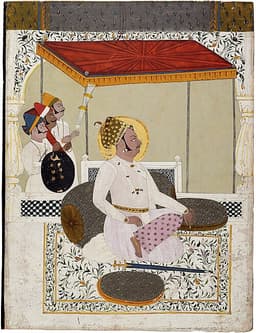
Ajit Singh of Marwar
Emperor · Modern
51.0Total

Karni Singh of Bikaner
Emperor · Modern
47.1Total
Basic Information
Born
1679
1924
Died
1724
—
Era
Modern
Modern
Nationality
India
India
Occupation
Emperor
Emperor
Civilization
Indian
Indian
Score Comparison
Military (10%)
40.0
40.7
Political (20%)
54.7
46.6
Influence (20%)
51.0
49.4
Legacy (20%)
41.7
37.5
Leadership (15%)
74.0
64.0
Strategy (15%)
45.0
47.2
TOTAL
51.0
47.1
Ajit Singh of Marwar — Complete Timeline
1707 AD
Restored to the Throne of JodhpurPolitical Action◆ Major
After Aurangzeb's death, Ajit Singh was restored to the throne of Jodhpur by the Rathore nobles. He had been exiled as a child after his father Jaswant Singh's death and the Mughal annexation of Marwar.
RestorationMarwarRathore
Impact: regionalconstructive
1708 AD
Conflict with the MughalsWar◆ Major
Ajit Singh led a rebellion against the Mughals under Bahadur Shah I. He recaptured Jodhpur and other territories, asserting Marwar's independence after decades of Mughal control.
RebellionMughal EmpireMarwar
Impact: regional
Alliance with the Rajput ConfederacyPolitical Action◆ Major
Ajit Singh joined a confederation of Rajput states, including Mewar and Amber, to resist Mughal expansion. This alliance temporarily weakened Mughal authority in Rajasthan.
AllianceRajputMughal Empire
Impact: regionalconstructive
1724 AD
AssassinationPolitical Action◆ Major
Ajit Singh was assassinated by his own son, Bakht Singh, in a power struggle. This event plunged Marwar into a succession war and weakened the Rathore dynasty.
AssassinationSuccession CrisisMarwar
Impact: regionaltragic
Karni Singh of Bikaner — Complete Timeline
1943 AD
Accession as Maharaja of BikanerPolitical Action◆ Major
Karni Singh became the Maharaja of Bikaner at age 19, succeeding his father. His reign covered the final years of British rule and the integration of princely states into independent India, requiring him to manage political transition.
SuccessionPrincely StateTransition
Impact: regional
1945 AD
Service in the Indian ArmyWar
Karni Singh served as an officer in the Indian Army, seeing action in World War II and later in the 1947 Indo-Pakistani War. He was awarded the Military Cross for his service, demonstrating his commitment to military duty.
World War IIIndo-Pakistani WarMilitary Service
Impact: national
1949 AD
Integration of Bikaner into the Indian UnionPolitical Action
Karni Singh signed the Instrument of Accession, merging Bikaner into the Dominion of India. He later served as a member of the Lok Sabha (1952-1977) and Rajya Sabha (1977-1982), representing the Bikaner constituency in the Indian Parliament.
Indian IndependenceIntegrationParliament
Impact: national
1955 AD
Advocacy for princely state rights in ParliamentPolitical Action
Karni Singh advocated in Parliament for the rights and privileges of former princely rulers, including the preservation of their titles and privy purses. His efforts reflected the ongoing debate about the integration of princely states into the Indian republic.
ParliamentPrincely StatesPolitical Advocacy
Impact: national
This comparison has not been analyzed yet.
One-time AI generation (~1 minute). Scores and timeline are already available below.
Rankings
🥇
Ajit Singh of MarwarLeader
Mil: 40.0Pol: 54.7Inf: 51.0
51.0
🥈
Karni Singh of Bikaner
Mil: 40.7Pol: 46.6Inf: 49.4
47.1
+3.9 behind
How This Comparison Works
Algorithm
Each figure is scored on 6 dimensions (0—100 scale) based on structured historical data: Military (10%), Political (20%), Influence (20%), Legacy (20%), Leadership (15%), Strategy (15%). The weighted total produces the final ranking.
Data Sources
Scores are computed from structured sub-indicators in the database. Scale factors adjust for era (Ancient ×0.85, Modern ×1.0) and civilization size (Eastern ×1.05, Other ×0.80) to account for differences in population and military scale.
Maximum 3 Figures
Comparisons are limited to 2—3 figures to ensure readability and statistical meaningfulness.
Error Margins
±5 points per dimension — Sub-scores are derived from historical records with inherent uncertainty. Two figures within 5 points on a dimension should be considered roughly equivalent in that area.
Total Score Accuracy
±3 points overall — The weighted combination of 6 dimensions produces a total score with approximately ±3 points of uncertainty. Differences of less than 3 points are not statistically significant— the figures are effectively tied.
Known Limitations
- Historical records are incomplete and uneven across civilizations
- Figures from oral-tradition societies may be underrepresented
- Occupation labels can misclassify multi-role figures
- Scores measure capability and impact, not moral character
- Quantitative scoring is a comparison tool, not absolute truth
Capability Radar
Military (10%) — Battles & Warfare
Battles
45
32
Win Rate
40
32
Expansion
25
35
Political (20%) — Governance & Reform
Reform
30
30
Diplomacy
45
40
Economy
35
30
Influence (20%) — Cultural & Global Reach
Cultural
30
20
Global
15
15
Legacy (20%) — Historical Impact
Historical
35
20
Longevity
25
15
Leadership (15%) — Power & Stability
Tenure
50
40
Stability
40
35
Strategy (15%) — Tactics & Innovation
Strategy
30
40
Tactics
35
39
Reform
20
44
Similar Comparisons
Comments & Discussion
No comments yet. Be the first to share your thoughts!