Loading...
Ajit Singh of Marwar vs Napoleon Bonaparte
Napoleon Bonaparte leads by 19.9 pts · 2 figures compared
…
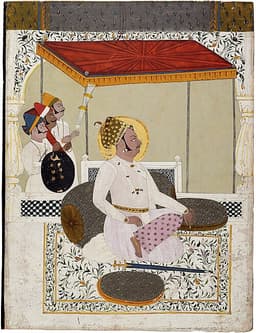
Ajit Singh of Marwar
Emperor · Modern
51.0Total

Napoleon Bonaparte
General · Modern
70.9Total
Basic Information
Born
1679
1769
Died
1724
1821
Era
Modern
Modern
Nationality
India
France
Occupation
Emperor
General
Civilization
Indian
Western
Score Comparison
Military (10%)
40.0
94.0
Political (20%)
54.7
72.0
Influence (20%)
51.0
40.0
Legacy (20%)
41.7
80.0
Leadership (15%)
74.0
78.0
Strategy (15%)
45.0
90.0
TOTAL
51.0
70.9
Ajit Singh of Marwar — Complete Timeline
1707 AD
Restored to the Throne of JodhpurPolitical Action◆ Major
After Aurangzeb's death, Ajit Singh was restored to the throne of Jodhpur by the Rathore nobles. He had been exiled as a child after his father Jaswant Singh's death and the Mughal annexation of Marwar.
RestorationMarwarRathore
Impact: regionalconstructive
1708 AD
Conflict with the MughalsWar◆ Major
Ajit Singh led a rebellion against the Mughals under Bahadur Shah I. He recaptured Jodhpur and other territories, asserting Marwar's independence after decades of Mughal control.
RebellionMughal EmpireMarwar
Impact: regional
Alliance with the Rajput ConfederacyPolitical Action◆ Major
Ajit Singh joined a confederation of Rajput states, including Mewar and Amber, to resist Mughal expansion. This alliance temporarily weakened Mughal authority in Rajasthan.
AllianceRajputMughal Empire
Impact: regionalconstructive
1724 AD
AssassinationPolitical Action◆ Major
Ajit Singh was assassinated by his own son, Bakht Singh, in a power struggle. This event plunged Marwar into a succession war and weakened the Rathore dynasty.
AssassinationSuccession CrisisMarwar
Impact: regionaltragic
Napoleon Bonaparte — Complete Timeline
1799 AD
Coup of 18 BrumaireOther◆ Major
Napoleon Bonaparte, with support from his brother Lucien and key political figures, overthrew the Directory in a bloodless coup. He established the Consulate with himself as First Consul, effectively becoming the ruler of France. This event ended the French Revolution's most unstable period.
French RevolutionCoupRise to Power
Impact: regional
1804 AD
Promulgation of the Napoleonic CodeOther◆ Major
Napoleon enacted the Civil Code of the French, known as the Napoleonic Code, a comprehensive set of laws that replaced the fragmented feudal legal systems. The code established legal equality, protected property rights, and secularized law. It became the basis for legal systems in many European and world countries.
Legal ReformNapoleonic CodeCivil Law
Impact: globalconstructive
1805 AD
Battle of AusterlitzWar◆ Major
Napoleon's Grande Arm
Napoleonic WarsBattleDecisive Victory
Impact: global
1812 AD
Invasion of RussiaWar◆ Major
Napoleon led the Grande Arm
Napoleonic WarsInvasionDisaster
Impact: globaldestructive
1815 AD
Battle of WaterlooWar◆ Major
Napoleon's French army was defeated by the combined forces of the Duke of Wellington's Anglo-Allied army and Gebhard Leberecht von Bl
Napoleonic WarsBattleFinal Defeat
Impact: globaldestructive
Expert Analysis
ajit-singh-of-marwar-vs-napoleon-bonaparte
### The Emperor and the Exile: Two Paths to Power in an Age of Empires
On a June morning in 1815, a French emperor surveyed a muddy field in Belgium, his grand army arrayed for a final, desperate gamble. Half a world away and a century earlier, a Rajput prince, long denied his birthright, watched as the iron gates of a Mughal prison swung open, offering him a throne soaked in blood. Napoleon Bonaparte and Ajit Singh of Marwar never met, yet their stories are bound by a single, haunting question: what does it mean to seize history by the throat, and what happens when history seizes back?
### Origins
Napoleon Bonaparte was born in 1769 on the island of Corsica, a place that had just become French. He was a child of the Enlightenment and a son of the Revolution, a world where old certainties were being dynamited and new ones forged in gunpowder. His family was minor nobility, but his education was a ticket to an army that, by 1789, was more meritocracy than aristocracy. He was a man of his time: ambitious, rational, and utterly convinced that will could reshape the world.
Ajit Singh, born in 1679, emerged from a different crucible. He was a Rathore prince of Marwar, a kingdom in the arid heart of Rajasthan. His world was one of ancient honor, clan loyalty, and a brutal, personal struggle against the Mughal Empire. When he was a child, the Mughal emperor Aurangzeb had his father executed and seized Jodhpur. Ajit Singh was spirited away, raised in secret by Rathore nobles who kept the flame of rebellion alive. He was not a product of a revolutionary age, but of a dynastic one, where power was a birthright stolen by an empire.
### Rise to Power
Napoleon’s ascent was a rocket. He was a young artillery officer who, in 1795, used a "whiff of grapeshot" to crush a royalist uprising, catching the eye of the revolutionary government. By 1796, he was commanding the Army of Italy, winning stunning victories against the Austrians. Each triumph was a stepping stone: the Egyptian campaign, the coup of 18 Brumaire in 1799, and finally, the imperial crown in 1804. His path was built on talent, timing, and the sheer chaos of a continent at war.
Ajit Singh’s path was a slow burn. For decades, he was a symbol, a name whispered in defiance. His rise was not a military campaign but a political resurrection. The key event came in 1707, when Aurangzeb died. The Mughal Empire, strained to its limits, began to fracture. With the tyrant gone, Rathore nobles restored Ajit Singh to the throne of Jodhpur. He did not conquer his kingdom; he reclaimed it through the death of his enemy and the loyalty of his clan. His rise was a restoration, not a revolution.
### Leadership & Governance
Napoleon ruled with a blend of genius and terror. His military strategy was a masterpiece of speed, deception, and crushing concentration of force, earning him a Military score of 94. He redrew the map of Europe, winning battles like Austerlitz (1805) with a tactical brilliance that still stuns historians. Politically, he was a reformer. The Napoleonic Code standardized French law, abolished feudal privileges, and planted the seeds of modern bureaucracy. But his Political score of 75 reflects his fatal flaw: he could not stop. He turned allies into enemies, crowned his brothers, and bled France white for glory.
Ajit Singh’s leadership was a delicate dance. His Military score of 30.5 does not tell the full story. He was not a grand strategist like Napoleon, but he was a survivor. In 1708, he led a rebellion against the new Mughal emperor, Bahadur Shah I, recapturing Jodhpur and its territories. More importantly, he forged an alliance with the Rajput Confederacy, uniting Mewar and Amber against Mughal expansion. His Political score of 56.8 reflects a man who understood that in his world, survival meant coalition, not conquest. He was a king of a small kingdom in a vast empire, and his governance was about preserving honor, not rewriting the rules.
### Triumph & Tragedy
Napoleon’s greatest moment was likely Austerlitz, where he destroyed the armies of Russia and Austria. His tragedy was the Russian campaign of 1812, a catastrophic retreat that cost half a million men. His final defeat at Waterloo in 1815 was a masterpiece of errors, a day when luck and judgment both failed. He died in exile on Saint Helena, a prisoner of the British.
Ajit Singh’s triumph was his restoration. After years of exile, he sat on the throne of his father. His tragedy was a domestic one. In 1724, after a decade of rule, he was assassinated—not by a foreign enemy, but by his own son, Bakht Singh, in a power struggle. The kingdom of Marwar plunged into a succession crisis. His death was a quiet, bloody affair, a palace coup that echoed through the corridors of Jodhpur, not the world stage.
### Character & Destiny
Napoleon was driven by an insatiable hunger. He once said, “Power is my mistress.” His character was a tempest of ambition, intelligence, and ego. He believed he was the master of events, and for a time, he was. But his destiny was shaped by his refusal to compromise. He could not share Europe; he had to own it. This hubris was his undoing.
Ajit Singh was a man of his clan. His character was forged in resistance and loyalty. He did not seek to conquer the Mughals; he sought to be left alone. His destiny was shaped by the ancient rhythms of Rajputana: honor, revenge, and the tragic fragility of dynastic politics. He was not a world-historical figure; he was a local king caught in the gears of a declining empire. His assassination by his son was a tragedy of intimacy, not of scale.
### Legacy
Napoleon’s legacy is a paradox. He is remembered as a tyrant and a reformer, a warmonger and a lawgiver. His Influence score of 82 and Legacy of 78 reflect a man who reshaped Europe. His code, his conquests, his legend—they echo in every modern debate about nationalism, empire, and ambition. He is a figure of awe and caution.
Ajit Singh’s legacy is quieter. His Legacy score of 55.8 is a measure of his obscurity to the wider world. But in Rajasthan, he is remembered as a symbol of Rajput resilience. His story is told in ballads, his name carved into the walls of Mehrangarh Fort. He represents the last gasp of a proud independence before the British Raj swallowed everything. He is a local hero, not a global legend.
### Conclusion
Standing at the edge of their stories, we see two men who seized their moments with ferocious will. Napoleon tried to conquer the world and died alone on a rock. Ajit Singh tried to reclaim his birthright and died by his son’s hand. One changed the map of Europe; the other held a candle against a fading empire. Their differences are not just of scale, but of soul. Napoleon believed in the power of one man to remake the world. Ajit Singh believed in the power of a family to endure it. In the end, history remembers the conqueror, but it is the survivor—even the murdered one—who teaches us how to hold on.
Rankings
🥇
Napoleon BonaparteLeader
Mil: 94.0Pol: 72.0Inf: 40.0
70.9
🥈
Ajit Singh of Marwar
Mil: 40.0Pol: 54.7Inf: 51.0
51.0
+19.9 behind
How This Comparison Works
Algorithm
Each figure is scored on 6 dimensions (0—100 scale) based on structured historical data: Military (10%), Political (20%), Influence (20%), Legacy (20%), Leadership (15%), Strategy (15%). The weighted total produces the final ranking.
Data Sources
Scores are computed from structured sub-indicators in the database. Scale factors adjust for era (Ancient ×0.85, Modern ×1.0) and civilization size (Eastern ×1.05, Other ×0.80) to account for differences in population and military scale.
Maximum 3 Figures
Comparisons are limited to 2—3 figures to ensure readability and statistical meaningfulness.
Error Margins
±5 points per dimension — Sub-scores are derived from historical records with inherent uncertainty. Two figures within 5 points on a dimension should be considered roughly equivalent in that area.
Total Score Accuracy
±3 points overall — The weighted combination of 6 dimensions produces a total score with approximately ±3 points of uncertainty. Differences of less than 3 points are not statistically significant— the figures are effectively tied.
Known Limitations
- Historical records are incomplete and uneven across civilizations
- Figures from oral-tradition societies may be underrepresented
- Occupation labels can misclassify multi-role figures
- Scores measure capability and impact, not moral character
- Quantitative scoring is a comparison tool, not absolute truth
Capability Radar
Military (10%) — Battles & Warfare
Battles
45
95
Win Rate
40
90
Expansion
25
95
Political (20%) — Governance & Reform
Reform
30
95
Diplomacy
45
80
Economy
35
85
Influence (20%) — Cultural & Global Reach
Cultural
30
85
Global
15
90
Legacy (20%) — Historical Impact
Historical
35
95
Longevity
25
90
Leadership (15%) — Power & Stability
Tenure
50
85
Stability
40
70
Strategy (15%) — Tactics & Innovation
Strategy
30
95
Tactics
35
98
Reform
20
92
Similar Comparisons
Comments & Discussion
拼图匠人6/17/2026
仔细看数据,根本没法直接比。拿破仑有一支职业化的近代军队,阿吉特·辛格打的是部落式奇袭。一个统治过7000万人口,一个顶多管过200万人。但重点不是规模——是意志。拿破仑在厄尔巴岛
RajputRider6/17/2026
Napoleon fought for glory, Ajit Singh fought for survival. Waterloo was a choice—he could have stayed Emperor. Ajit Singh was a child when Aurangzeb murdered his father and stole Jodhpur; he spent years in hiding, then clawed back his kingdom through guerrilla warfare. That’s not ambition, that’s vengeance forged in blood. Napoleon’s empire crumbled in one day. Ajit Singh’s held for decades. Give me the exile who never forgot his roots over the Corsican who forgot his.
马背雄狮6/17/2026
拿坡仑靠大炮和法典征服欧洲,阿吉特·辛格靠马刀和血誓守住拉贾斯坦。拿破仑在巴黎搞法典时,阿吉特在梅尔塔的山沟里打游击,用一千骑兵拖住奥朗则布的十万大军。一个追求普世帝国,一个捍卫部落尊严——谁更硬核?你选吧,我站那个骑骆驼的。
HistoryBiter6/17/2026
The summary romanticizes both, but the numbers tell a different story. Napoleon mobilized over 600,000 men for the 1812 invasion alone; Ajit Singh likely never commanded more than 50,000 in his entire career. Napoleon rewrote Europe’s constitutional map; Ajit Singh fought a regional war that barely dented the Mughal collapse. Comparing them is like comparing a tidal wave to a sandstorm—both destructive, but not in the same league. I appreciate the drama, but scale matters.
沙漠狼烟6/17/2026
说阿吉特·辛格跟拿破仑比,简直离谱。拿破仑十三年内横扫欧洲,把神圣罗马帝国拆成碎片;阿吉特打了三十年,最后不过是拿回自己父亲的王位,疆域没扩大一里。一个改变了世界历史的走向,一个只是被动防御。别拿反抗当成征服。要我说,这是拿骆驼骑兵碰瓷法军炮队——勇气可嘉,结果注定。
ScriptorClassicus6/17/2026
Ah, but here’s the crux: Napoleon believed in destiny, Ajit Singh believed in dharma. The French Emperor once said, “Impossible is a word to be found only in the dictionary of fools,” while the Rathore prince fought not to reshape the world but to restore a cosmic order. That’s the difference between a revolutionary and a traditionalist. Napoleon died reading Plutarch; Ajit Singh died amidst his clan. One wanted to be Caesar, the other just wanted to be his father’s son.