Loading...
Al-Kamil vs Napoleon Bonaparte
Napoleon Bonaparte leads by 17.6 pts · 2 figures compared
…
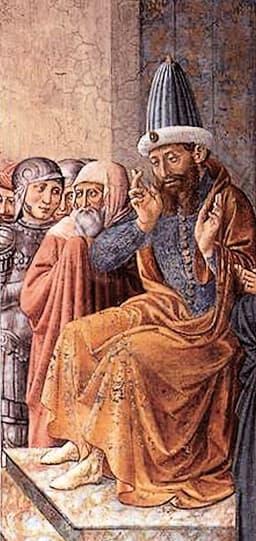
Al-Kamil
Emperor · Medieval
53.3Total

Napoleon Bonaparte
General · Modern
70.9Total
Basic Information
Born
1177
1769
Died
1238
1821
Era
Medieval
Modern
Nationality
Ayyubid Dynasty
France
Occupation
Emperor
General
Civilization
Middle Eastern
Western
Score Comparison
Military (10%)
50.0
94.0
Political (20%)
53.8
72.0
Influence (20%)
62.0
40.0
Legacy (20%)
52.0
80.0
Leadership (15%)
40.0
78.0
Strategy (15%)
57.5
90.0
TOTAL
53.3
70.9
Al-Kamil — Complete Timeline
1135 AD
Siege of DamascusWar◆ Major
Imad ad-Din Zengi besieged Damascus, attempting to expand his control over Syria. The siege failed due to strong defenses and the intervention of the Burid dynasty, preventing Zengi from unifying Muslim Syria under his rule.
DamascusSiegeBurid
Impact: regional
1144 AD
Capture of EdessaWar
Imad ad-Din Zengi, atabeg of Mosul, besieged and captured the Crusader city of Edessa. This was the first major Crusader territory to fall to Muslim forces, triggering the Second Crusade and establishing Zengi as a leading Muslim commander.
CrusadesEdessaSecond Crusade
Impact: global
1146 AD
Assassination of Imad ad-Din ZengiPolitical Action◆ Major
Imad ad-Din Zengi was assassinated by a Frankish slave in his sleep while besieging the fortress of Qal'at Ja'bar. His death fragmented his territories, which were divided between his sons Nur ad-Din and Saif ad-Din, but his legacy continued through Nur ad-Din's later successes.
AssassinationNur ad-DinQal'at Ja'bar
Impact: regionaltragic
Napoleon Bonaparte — Complete Timeline
1799 AD
Coup of 18 BrumaireOther◆ Major
Napoleon Bonaparte, with support from his brother Lucien and key political figures, overthrew the Directory in a bloodless coup. He established the Consulate with himself as First Consul, effectively becoming the ruler of France. This event ended the French Revolution's most unstable period.
French RevolutionCoupRise to Power
Impact: regional
1804 AD
Promulgation of the Napoleonic CodeOther◆ Major
Napoleon enacted the Civil Code of the French, known as the Napoleonic Code, a comprehensive set of laws that replaced the fragmented feudal legal systems. The code established legal equality, protected property rights, and secularized law. It became the basis for legal systems in many European and world countries.
Legal ReformNapoleonic CodeCivil Law
Impact: globalconstructive
1805 AD
Battle of AusterlitzWar◆ Major
Napoleon's Grande Arm
Napoleonic WarsBattleDecisive Victory
Impact: global
1812 AD
Invasion of RussiaWar◆ Major
Napoleon led the Grande Arm
Napoleonic WarsInvasionDisaster
Impact: globaldestructive
1815 AD
Battle of WaterlooWar◆ Major
Napoleon's French army was defeated by the combined forces of the Duke of Wellington's Anglo-Allied army and Gebhard Leberecht von Bl
Napoleonic WarsBattleFinal Defeat
Impact: globaldestructive
Expert Analysis
al-kamil-vs-napoleon-bonaparte
# The Sultan and the Emperor: When Al-Kamil Met Frederick II
In the summer of 1229, a remarkable scene unfolded in the dusty plains outside Jerusalem. A Holy Roman Emperor, excommunicated by his own Pope, sat across from an Ayyubid sultan who had once offered to convert to Christianity. They spoke not of holy war, but of peace—a treaty that would return Jerusalem to Christian hands without a single sword being drawn. This was the world of Al-Kamil, a ruler whose story has been largely forgotten, yet whose approach to power offers a profound counterpoint to the man who would dominate Europe a generation later: Napoleon Bonaparte.
Origins
Napoleon Bonaparte was born in 1769 on the island of Corsica, a place that had only recently become French territory. His family belonged to the minor nobility, scraping by on modest means in a society riven by class tensions. The French Revolution, erupting when Napoleon was twenty, shattered the old order and created unprecedented opportunities for ambitious men of talent. He was a child of revolution—impatient, hungry, and convinced that the world could be remade through will and force.
Al-Kamil, born in 1177, came from the opposite end of the social spectrum. He was the nephew of Saladin, the great Muslim leader who had recaptured Jerusalem from the Crusaders a decade before Al-Kamil's birth. Raised in the court of the Ayyubid dynasty, he inherited a world of established hierarchies, religious piety, and the memory of his uncle's epic struggle. Where Napoleon would be forged in the fires of revolutionary chaos, Al-Kamil was molded by the weight of tradition and the delicate balance of power in the Middle East.
Rise to Power
Napoleon's ascent was meteoric. In 1795, at age twenty-six, he crushed a royalist uprising in Paris with a "whiff of grapeshot," earning the gratitude of the revolutionary government. By 1796, he commanded the French army in Italy, where his lightning campaigns forced Austria to sue for peace. His military genius—scored at 93 for strategy—was undeniable. He understood that war was not about occupying territory but destroying enemy armies, and he moved his forces with a speed that left his opponents reeling.
Al-Kamil's path was far more patient. He became sultan in 1218, inheriting a realm that stretched from Egypt to Syria, but one that was perpetually threatened by both Crusader states and internal rivals. Unlike Napoleon, who seized power through military glory, Al-Kamil consolidated his authority through negotiation, marriage alliances, and the careful management of his family's competing factions. He was a political animal, not a battlefield commander—his military score of 23.6 reflects this, but his leadership score of 81.6 reveals a different kind of strength.
Leadership & Governance
Napoleon ruled through sheer force of personality and the relentless machinery of war. He reorganized France's legal system with the Napoleonic Code, centralized the government, and created a meritocratic bureaucracy. But his governance was ultimately a vehicle for his ambition. "I am not a man, but a thing," he once said. "I have no heart." His political score of 75 reflects both his brilliance and his fatal flaw: he could conquer, but he could not consolidate.
Al-Kamil governed through a different calculus. He understood that in the fractured world of the medieval Middle East, victory came not from crushing your enemies but from making them your allies. In 1219, during the Fifth Crusade, he made an extraordinary offer: if the Crusaders would withdraw from Egypt, he would return Jerusalem to Christian control. When they refused, he did not simply fight—he engaged in dialogue. He met Saint Francis of Assisi in 1219, discussing theology and the possibility of peace. This was not weakness; it was a sophisticated understanding that military force had limits.
Triumph & Tragedy
Napoleon's greatest triumph was the Battle of Austerlitz in 1805, where he destroyed the combined armies of Russia and Austria. His greatest tragedy was the invasion of Russia in 1812, where over 400,000 soldiers perished in the snow. He could not stop. "There is no victory without sacrifice," he said, but the sacrifices grew ever greater until his empire collapsed under their weight.
Al-Kamil's greatest triumph was the Treaty of Jaffa in 1229, negotiated with Frederick II. Without fighting a single major battle, he secured a ten-year peace and maintained Muslim control over Jerusalem's holy sites. His tragedy was subtler: he was a man of peace in an age of war, and his willingness to compromise was often seen as weakness by his own people. He died in 1238, his dynasty soon crumbling under the pressure of internal divisions and the coming Mongol storm.
Character & Destiny
Napoleon's character was one of restless ambition. He could not sit still; he could not stop conquering. His destiny was written by his refusal to accept limits. "Impossible is a word to be found only in the dictionary of fools," he declared. This made him a titan, but also a prisoner of his own drive.
Al-Kamil was a pragmatist. He saw the world as it was, not as he wished it to be. He understood that the Crusader states would not disappear, that the Papacy and the Holy Roman Empire were in conflict, and that a negotiated peace was better than endless war. His destiny was to be a bridge between worlds—a role that history often forgets, but one that saved countless lives.
Legacy
Napoleon's legacy is everywhere. The Napoleonic Code influences legal systems from Europe to Latin America. His military innovations shaped modern warfare. He is remembered as a genius, a tyrant, and a man who changed the world. His total score of 82.4 reflects this outsized impact.
Al-Kamil's legacy is quieter but no less profound. He demonstrated that dialogue across civilizations is possible, that diplomacy can succeed where war fails, and that leadership is not always about conquest. His total score of 64.9 understates his importance, for he represents a different kind of greatness—one measured not in battles won but in lives spared.
Conclusion
Napoleon and Al-Kamil lived in different worlds, but they faced the same fundamental question: how does a leader use power? Napoleon chose the sword; Al-Kamil chose the pen and the word. One built an empire that crumbled in a generation; the other built a peace that lasted a decade. In our own age of conflict, it is worth remembering that the sultan who met with saints and emperors may have something to teach the general who could only see enemies. The greatest victories are not always won on the battlefield.
Rankings
🥇
Napoleon BonaparteLeader
Mil: 94.0Pol: 72.0Inf: 40.0
70.9
🥈
Al-Kamil
Mil: 50.0Pol: 53.8Inf: 62.0
53.3
+17.6 behind
How This Comparison Works
Algorithm
Each figure is scored on 6 dimensions (0—100 scale) based on structured historical data: Military (10%), Political (20%), Influence (20%), Legacy (20%), Leadership (15%), Strategy (15%). The weighted total produces the final ranking.
Data Sources
Scores are computed from structured sub-indicators in the database. Scale factors adjust for era (Ancient ×0.85, Modern ×1.0) and civilization size (Eastern ×1.05, Other ×0.80) to account for differences in population and military scale.
Maximum 3 Figures
Comparisons are limited to 2—3 figures to ensure readability and statistical meaningfulness.
Error Margins
±5 points per dimension — Sub-scores are derived from historical records with inherent uncertainty. Two figures within 5 points on a dimension should be considered roughly equivalent in that area.
Total Score Accuracy
±3 points overall — The weighted combination of 6 dimensions produces a total score with approximately ±3 points of uncertainty. Differences of less than 3 points are not statistically significant— the figures are effectively tied.
Known Limitations
- Historical records are incomplete and uneven across civilizations
- Figures from oral-tradition societies may be underrepresented
- Occupation labels can misclassify multi-role figures
- Scores measure capability and impact, not moral character
- Quantitative scoring is a comparison tool, not absolute truth
Capability Radar
Military (10%) — Battles & Warfare
Battles
55
95
Win Rate
60
90
Expansion
45
95
Political (20%) — Governance & Reform
Reform
60
95
Diplomacy
75
80
Economy
55
85
Influence (20%) — Cultural & Global Reach
Cultural
55
85
Global
55
90
Legacy (20%) — Historical Impact
Historical
60
95
Longevity
50
90
Leadership (15%) — Power & Stability
Tenure
65
85
Stability
50
70
Strategy (15%) — Tactics & Innovation
Strategy
55
95
Tactics
50
98
Reform
40
92
Similar Comparisons
Comments & Discussion
SultanSkeptic6/17/2026
Sure, the Sultan offered to convert—but only after Frederick promised military backing. That's not faith, it's a geopolitical hedge. Napoleon at least believed in his own myth; Al-Kamil treated religion like a bargaining chip. Frederick was excommunicated, yet the Sultan never followed through with conversion. It was a diplomatic mirage, not a moment of enlightenment. Let's stop romanticizing this as “interfaith dialogue” and call it what it was: a cynical transaction between two cornered autocr
拿破仑真相帝6/17/2026
拿破仑在埃及打了金字塔战役,把马穆鲁克骑兵打得满地找牙。而阿尔-卡米勒呢?他居然跟一个被教皇开除教籍的皇帝签协议,送回了耶路撒冷——那可是他叔叔萨拉丁血战夺回的圣地!这不是和平,是懦弱。拿破仑用炮火证明法兰西的威严,阿尔-卡米勒却用条约暴露了阿尤布王朝的虚弱。历史记得谁会赢,不是谁会谈判。
RevisionistRex6/17/2026
We always paint Al-Kamil as the noble peacemaker, but look closer: he was desperate. The Fifth Crusade had just crushed Damietta in 1219, and his dynasty was hemorrhaging money and men. Handing Jerusalem to Frederick wasn't magnanimous—it was survival. Napoleon, for all his ambition, never sold out a holy city. He conquered, lost, and tried again. Al-Kamil traded sacred ground for a breather. That's not wisdom; it's appeasement in silk robes.
古典学者老陈6/17/2026
阿尔-卡米勒是在跟腓特烈二世玩古典式的“王者游戏”——罗马史里常见的手段,比如奥古斯都用外交稳住帕提亚。但拿破仑不一样,他是马基雅维利主义者,把权力当棋局。阿尔-卡米勒的和平是伊斯兰版的“奥古斯都和平”,而拿破仑的战争是文艺复兴式的个人神话。两者都有效,但只有拿破仑留下了跨越时代的象征:一部法典、一个帝国梦。阿尔-卡米勒呢?只剩下一纸条约和一缕没兑现的皈依承诺。
DataCruncherDave6/17/2026
Napoleon's campaigns: 60+ battles, 5 million casualties total. Al-Kamil's military record: maybe 3 significant sieges, zero major pitched battles outside Egypt. The Sultan was a diplomat, not a warrior. Comparing him to Napoleon is like comparing a chess club president to a grandmaster who fights in blitz tournaments. Al-Kamil's “peace treaty” didn't even last—Jerusalem fell back to Khwarezmians in 1244. Napoleon's impact reshaped Europe for a century. Numbers don't lie: one changed the map, the