Loading...
Al-Zahir vs Tecun Uman
Tecun Uman leads by 3.0 pts · 2 figures compared
…
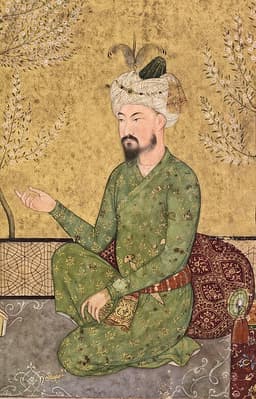
Al-Zahir
Emperor · Medieval
37.3Total
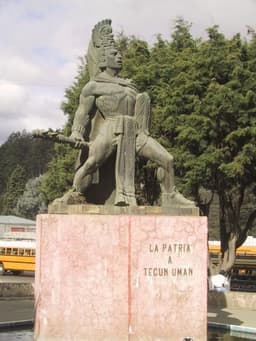
Tecun Uman
Emperor · Medieval
40.3Total
Basic Information
Born
1176
1500
Died
1226
1524
Era
Medieval
Medieval
Nationality
Abbasid Caliphate
Kiche
Occupation
Emperor
Emperor
Civilization
Middle Eastern
Other
Score Comparison
Military (10%)
20.0
21.2
Political (20%)
32.1
26.4
Influence (20%)
46.3
54.9
Legacy (20%)
36.7
47.5
Leadership (15%)
34.6
31.2
Strategy (15%)
45.0
39.6
TOTAL
37.3
40.3
Tecun Uman — Complete Timeline
1524 AD
Led K'iche' Resistance Against SpanishWar◆ Major
Tecun Uman commanded the K'iche' Maya army in battle against Spanish conquistador Pedro de Alvarado in the Guatemalan highlands. He led thousands of warriors in an attempt to defend the K'iche' kingdom from Spanish invasion.
Spanish ConquestMaya ResistanceBattle
Impact: regional
Battle of El PinarWar
Tecun Uman fought in the Battle of El Pinar against Pedro de Alvarado's forces. The K'iche' were defeated due to Spanish cavalry and firearms. Tecun Uman was killed in the battle, according to Maya accounts, by Alvarado himself.
Spanish ConquestBattleDefeat
Impact: regionaltragic
Expert Analysis
Origins
Al-Zahir was born around 1176 as Abu Nasr Muhammad, son of the Abbasid Caliph al-Nasir. He grew up in the opulent court of Baghdad, receiving a traditional Islamic education in theology, law, and statecraft. His father's long reign (1180–1225) meant Al-Zahir reached middle age before ascending the throne. In contrast, Tecun Uman was born in the late 15th century in the highlands of Guatemala, likely into the royal lineage of the K'iche' Maya. He was trained as a warrior from youth, learning the arts of war, leadership, and the spiritual traditions of his people. While Al-Zahir's early life was one of privilege and preparation for rule, Tecun Uman's was shaped by the growing threat of Spanish invasion, which would define his destiny.
Rise to Power
Al-Zahir became caliph in 1225 upon the death of his father, al-Nasir. His rise was a matter of dynastic succession rather than personal achievement. He inherited the Abbasid Caliphate, which by then had lost most of its political power to the Seljuks and other regional dynasties, though it retained religious prestige. Al-Zahir's reign was brief, lasting less than a year until his death in 1226. He attempted no major reforms or military campaigns. Tecun Uman, by contrast, rose to prominence as the ruler of the K'iche' Maya kingdom, one of the most powerful states in Mesoamerica. He led the resistance against Spanish conquistador Pedro de Alvarado in 1524. His leadership was recognized by his people, and he commanded thousands of warriors in the defense of their homeland. The turning point came at the Battle of El Pinar, where Tecun Uman faced Alvarado's forces. Despite initial successes, the K'iche' were defeated by Spanish cavalry and firearms, leading to Tecun Uman's death.
Leadership & Governance
Al-Zahir's leadership was minimal due to his short reign. He is recorded as having been a just and pious ruler, but he left no significant governance reforms or policies. His primary role was to maintain the caliphal authority in religious matters, but his political influence was negligible. In contrast, Tecun Uman's leadership was demonstrated in battle and in unifying the K'iche' people against a foreign invader. He organized a large army and employed strategies such as using the mountainous terrain to ambush the Spanish. However, his governance was martial, focused on war rather than administration. He scored 31.2 in leadership, slightly below Al-Zahir's 34.6, but this reflects the different contexts: Al-Zahir's score is based on his brief tenure, while Tecun Uman's is based on his military command.
Triumph & Tragedy
Al-Zahir's greatest success was simply maintaining the caliphate's stability during his short reign. He died naturally, avoiding the turmoil that would later engulf his successors. His tragedy is that he accomplished nothing of lasting note. He scored 20.0 in military, reflecting no significant campaigns. Tecun Uman's triumph was his courageous resistance against the Spanish, which made him a symbol of Maya defiance. He is celebrated as a national hero of Guatemala. His tragedy is his defeat and death in battle, and the subsequent conquest of the K'iche' people. He scored 21.2 in military, slightly higher than Al-Zahir, but still low due to the ultimate failure of his campaign.
Character & Destiny
Al-Zahir was described as gentle and pious, but his character was overshadowed by his father's long reign and his own short one. His destiny was to be a footnote in Abbasid history. Tecun Uman was portrayed as a brave and determined leader, willing to die for his people. His character is immortalized in Guatemalan folklore, often depicted with a quetzal bird on his chest. His destiny was to become a martyr and symbol of resistance. Historical assessments note that Tecun Uman's leadership was marked by tactical errors, such as engaging the Spanish in open battle where their cavalry and guns gave them advantage. His scores in strategy (39.6) and leadership (31.2) reflect these limitations.
Legacy
Al-Zahir's legacy is minimal. He is remembered as a brief link in the Abbasid chain, with no enduring impact. His total score is 37.3. Tecun Uman, however, has a profound legacy. He was declared a national hero of Guatemala, and his image appears on the 0.50 quetzal coin. His story is taught in schools, and his name is invoked in discussions of indigenous rights. He scored 47.5 in legacy, reflecting this cultural impact. His influence score of 54.9 is higher than Al-Zahir's 46.3, showing his greater resonance.
Conclusion
While Al-Zahir and Tecun Uman both ruled as emperors, their impacts are vastly different. Al-Zahir's brief, uneventful reign left no mark on history, whereas Tecun Uman's sacrifice made him a lasting symbol of resistance. Based on the scores, Tecun Uman (40.3) outperforms Al-Zahir (37.3) in overall impact. Tecun Uman's higher legacy and influence scores reflect his enduring importance to Guatemalan national identity. Therefore, Tecun Uman had a greater historical impact.
Rankings
🥇
Tecun UmanLeader
Mil: 21.2Pol: 26.4Inf: 54.9
40.3
🥈
Al-Zahir
Mil: 20.0Pol: 32.1Inf: 46.3
37.3
+3.0 behind
How This Comparison Works
Algorithm
Each figure is scored on 6 dimensions (0—100 scale) based on structured historical data: Military (10%), Political (20%), Influence (20%), Legacy (20%), Leadership (15%), Strategy (15%). The weighted total produces the final ranking.
Data Sources
Scores are computed from structured sub-indicators in the database. Scale factors adjust for era (Ancient ×0.85, Modern ×1.0) and civilization size (Eastern ×1.05, Other ×0.80) to account for differences in population and military scale.
Maximum 3 Figures
Comparisons are limited to 2—3 figures to ensure readability and statistical meaningfulness.
Error Margins
±5 points per dimension — Sub-scores are derived from historical records with inherent uncertainty. Two figures within 5 points on a dimension should be considered roughly equivalent in that area.
Total Score Accuracy
±3 points overall — The weighted combination of 6 dimensions produces a total score with approximately ±3 points of uncertainty. Differences of less than 3 points are not statistically significant— the figures are effectively tied.
Known Limitations
- Historical records are incomplete and uneven across civilizations
- Figures from oral-tradition societies may be underrepresented
- Occupation labels can misclassify multi-role figures
- Scores measure capability and impact, not moral character
- Quantitative scoring is a comparison tool, not absolute truth
Capability Radar
Military (10%) — Battles & Warfare
Battles
5
15
Win Rate
5
10
Expansion
5
5
Political (20%) — Governance & Reform
Reform
10
5
Diplomacy
10
10
Economy
10
5
Influence (20%) — Cultural & Global Reach
Cultural
10
40
Global
5
20
Legacy (20%) — Historical Impact
Historical
10
45
Longevity
10
40
Leadership (15%) — Power & Stability
Tenure
30
10
Stability
10
5
Strategy (15%) — Tactics & Innovation
Strategy
5
15
Tactics
5
20
Reform
5
5
Similar Comparisons
Comments & Discussion
No comments yet. Be the first to share your thoughts!