Loading...
James I of Scotland vs Tecun Uman
James I of Scotland leads by 4.3 pts · 2 figures compared
…
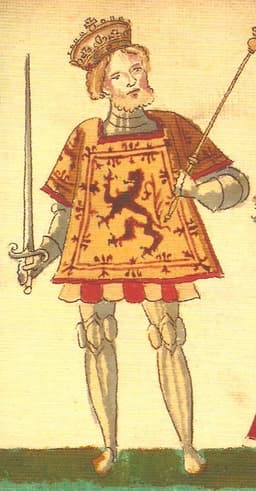
James I of Scotland
Emperor · Medieval
44.6Total
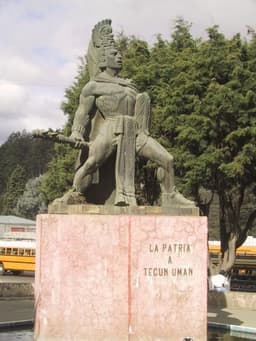
Tecun Uman
Emperor · Medieval
40.3Total
Basic Information
Born
1394
1500
Died
1437
1524
Era
Medieval
Medieval
Nationality
Scotland
Kiche
Occupation
Emperor
Emperor
Civilization
Western
Other
Score Comparison
Military (10%)
21.2
21.2
Political (20%)
43.7
26.4
Influence (20%)
54.9
54.9
Legacy (20%)
45.0
47.5
Leadership (15%)
48.4
31.2
Strategy (15%)
36.8
39.6
TOTAL
44.6
40.3
James I of Scotland — Complete Timeline
1406 AD
Capture by English PiratesOther
James I was captured by English pirates while traveling to France for safety. He was handed over to Henry IV of England and imprisoned in the Tower of London, remaining a captive for 18 years. His father Robert III died soon after, leaving Scotland without a king.
CaptureImprisonmentRegency
Impact: nationaltragic
1424 AD
Release and Return to ScotlandPolitical Action◆ Major
James I was released from English captivity after the Treaty of London, which required a ransom of 40,000 pounds. He returned to Scotland and was crowned at Scone, beginning his personal rule after 18 years of regency.
ReleaseCoronationRansom
Impact: nationalconstructive
Publication of The Kingis QuairCultural
James I wrote The Kingis Quair, a poetic allegory of his imprisonment and love for Joan Beaufort. The poem is considered a major work of Middle Scots literature and reflects the influence of Chaucer on Scottish poetry.
PoetryLiteratureImprisonment
Impact: nationalconstructive
1425 AD
Execution of Albany StewartsPolitical Action◆ Major
James I executed Murdoch Stewart, Duke of Albany, and his sons at Stirling Castle for treason. The executions eliminated the powerful Albany family, who had ruled as regents during James's captivity, and consolidated royal power.
ExecutionNoble PurgeCentralization
Impact: nationaldestructive
1437 AD
Assassination at PerthPolitical Action
James I was assassinated by a group of nobles led by Sir Robert Graham at the Blackfriars monastery in Perth. The murder was a response to James's centralizing policies and harsh treatment of the nobility. His death plunged Scotland into another period of regency.
AssassinationNoble RevoltRegency
Impact: nationaltragic
Tecun Uman — Complete Timeline
1524 AD
Led K'iche' Resistance Against SpanishWar◆ Major
Tecun Uman commanded the K'iche' Maya army in battle against Spanish conquistador Pedro de Alvarado in the Guatemalan highlands. He led thousands of warriors in an attempt to defend the K'iche' kingdom from Spanish invasion.
Spanish ConquestMaya ResistanceBattle
Impact: regional
Battle of El PinarWar
Tecun Uman fought in the Battle of El Pinar against Pedro de Alvarado's forces. The K'iche' were defeated due to Spanish cavalry and firearms. Tecun Uman was killed in the battle, according to Maya accounts, by Alvarado himself.
Spanish ConquestBattleDefeat
Impact: regionaltragic
Expert Analysis
Origins
James I of Scotland was born in July 1394 at Dunfermline Palace, the third son of King Robert III. His early life was marked by political turmoil; in 1406, at age 11, he was sent to France for safety but was captured by English pirates off Flamborough Head and delivered to Henry IV. He spent 18 years as a prisoner in the Tower of London and various English castles, receiving a refined education, including poetry and music, from English tutors. This captivity shaped his literary output and his determination to centralize royal authority upon return.
Tecun Uman was born around 1500 in the K'iche' Maya kingdom of Q'umarkaj in the Guatemalan highlands. He was a prince of the royal lineage, trained in warfare and leadership from a young age. The K'iche' were the dominant Maya state, with a complex social hierarchy and a tradition of militarism. Tecun Uman rose to become the supreme commander of the K'iche' army, likely through martial prowess and noble birth, with little known about his early life due to limited pre-Columbian records.
Rise to Power
James I's rise was accidental. After his older brothers died, he became heir apparent while still captive. His father died in 1406, making James king at age 12, but he remained imprisoned until 1424 when the Treaty of London secured his release for a ransom of 40,000 pounds. He returned to Scotland, was crowned at Scone, and immediately asserted authority. His key turning point was the execution of Murdoch Stewart, Duke of Albany, and his sons in 1425, which eliminated the powerful Albany family that had ruled as regents during his captivity.
Tecun Uman's rise was more conventional. He likely assumed command of the K'iche' army around 1520 as the Spanish threat loomed. He consolidated power through military campaigns against neighboring Maya groups, expanding K'iche' influence. His defining moment came in 1524 when he faced Pedro de Alvarado's Spanish expedition. Alvarado had allied with rival Maya groups, including the Kaqchikel, to undermine K'iche' dominance. Tecun Uman led a large army to confront the invaders at the Battle of El Pinar.
Leadership & Governance
James I ruled with a centralized, authoritarian style. He reformed Scotland's legal system, established the Court of Session (a supreme civil court), and curbed the power of nobles by confiscating lands and executing rivals. He also promoted economic reforms, such as standardizing weights and measures. His governance scored 48.4 in leadership and 43.7 in political acumen, reflecting his effectiveness at strengthening the crown. However, his heavy-handed approach alienated many nobles, leading to his assassination.
Tecun Uman governed as a traditional Maya ruler, relying on a council of nobles and priests. His leadership style was collective, with decisions made by consensus among the elite. He scored 31.2 in leadership and 26.4 in political ability, partly due to the fragmented nature of Maya politics. He lacked the institutional tools of European monarchs and faced the challenge of uniting diverse Maya factions against the Spanish. His strategy score of 39.6 reflects tactical competence but strategic limitations against superior technology.
Triumph & Tragedy
James I's triumphs include the restoration of royal authority after decades of noble dominance. He successfully executed the Albany Stewarts, reclaimed crown lands, and improved justice. His poetic achievement, *The Kingis Quair*, is a literary triumph, blending autobiographical reflection with allegory. However, his tragedy was his assassination at Perth in 1437 by a group of nobles led by Sir Robert Graham. His reforms created enemies, and his death plunged Scotland into a period of instability under his young son James II.
Tecun Uman's triumph was his heroic resistance against the Spanish, embodying Maya defiance. He fought bravely at the Battle of El Pinar, but the K'iche' were defeated by Spanish cavalry, firearms, and steel armor. According to legend, Tecun Uman killed Alvarado's horse before being slain himself. His tragedy was the collapse of the K'iche' kingdom; after his death, Q'umarkaj was destroyed, and the population was subjugated. His legacy became a symbol of indigenous resistance, but his failure to adapt to European warfare led to conquest.
Character & Destiny
James I was intelligent, cultured, and determined, but also ruthless and unforgiving. His captivity instilled a desire for control, which drove his centralizing policies. Historians describe him as a capable administrator but a poor diplomat; his execution of nobles without trial violated norms and bred resentment. His character scored 44.6 overall, with strengths in influence (54.9) and legacy (45.0) but a low military score (21.2) due to his lack of battlefield experience.
Tecun Uman was courageous and patriotic, but his adherence to traditional warfare doomed his cause. He scored 40.3 overall, with influence (54.9) and legacy (47.5) comparable to James, but lower in leadership (31.2) and strategy (39.6). He lacked the tactical flexibility to counter Spanish innovations. His destiny was sealed by technological and political disadvantages; he could not unite all Maya against the invaders.
Legacy
James I's legacy is mixed. He strengthened the Scottish monarchy, but his assassination demonstrated the limits of his methods. His legal reforms influenced Scottish governance for centuries, and *The Kingis Quair* remains a notable literary work. He is remembered as a poet king, but his political impact was limited by his short reign (1424-1437). His legacy score of 45.0 reflects this ambiguity.
Tecun Uman's legacy is immense in Guatemala. He was declared a national hero in 1960, appears on the 0.50 quetzal coin, and is celebrated on October 20 (Revolution Day) and in folklore. He symbolizes Maya resistance and identity, with schools, monuments, and a military brigade named after him. His influence score of 54.9 matches James's due to his cultural resonance, but his historical impact is less tangible in terms of institutional change.
Conclusion
James I of Scotland had a marginally greater overall impact, reflected in his higher total score of 44.6 versus Tecun Uman's 40.3. James left concrete institutional reforms that shaped Scotland's legal and political development, whereas Tecun Uman's legacy is primarily symbolic. Both scored equally in influence (54.9), but James's political and leadership scores (43.7 and 48.4) exceed Tecun's (26.4 and 31.2). While Tecun Uman represents heroic resistance, James I's governance had more lasting structural effects. Thus, James I edges ahead in the comparison, though both remain significant in their respective contexts.
Rankings
🥇
James I of ScotlandLeader
Mil: 21.2Pol: 43.7Inf: 54.9
44.6
🥈
Tecun Uman
Mil: 21.2Pol: 26.4Inf: 54.9
40.3
+4.3 behind
How This Comparison Works
Algorithm
Each figure is scored on 6 dimensions (0—100 scale) based on structured historical data: Military (10%), Political (20%), Influence (20%), Legacy (20%), Leadership (15%), Strategy (15%). The weighted total produces the final ranking.
Data Sources
Scores are computed from structured sub-indicators in the database. Scale factors adjust for era (Ancient ×0.85, Modern ×1.0) and civilization size (Eastern ×1.05, Other ×0.80) to account for differences in population and military scale.
Maximum 3 Figures
Comparisons are limited to 2—3 figures to ensure readability and statistical meaningfulness.
Error Margins
±5 points per dimension — Sub-scores are derived from historical records with inherent uncertainty. Two figures within 5 points on a dimension should be considered roughly equivalent in that area.
Total Score Accuracy
±3 points overall — The weighted combination of 6 dimensions produces a total score with approximately ±3 points of uncertainty. Differences of less than 3 points are not statistically significant— the figures are effectively tied.
Known Limitations
- Historical records are incomplete and uneven across civilizations
- Figures from oral-tradition societies may be underrepresented
- Occupation labels can misclassify multi-role figures
- Scores measure capability and impact, not moral character
- Quantitative scoring is a comparison tool, not absolute truth
Capability Radar
Military (10%) — Battles & Warfare
Battles
10
15
Win Rate
10
10
Expansion
10
5
Political (20%) — Governance & Reform
Reform
50
5
Diplomacy
30
10
Economy
40
5
Influence (20%) — Cultural & Global Reach
Cultural
50
40
Global
20
20
Legacy (20%) — Historical Impact
Historical
40
45
Longevity
30
40
Leadership (15%) — Power & Stability
Tenure
40
10
Stability
20
5
Strategy (15%) — Tactics & Innovation
Strategy
10
15
Tactics
10
20
Reform
10
5
Similar Comparisons
Comments & Discussion
No comments yet. Be the first to share your thoughts!